
When assembling a pitch deck, sales collateral, or enterprise one-pager, inserting glowing customer soundbites and dramatic return-on-investment metrics is standard practice. Yet commercial teams often treat client testimonials as lightweight design ornaments rather than binding advertising claims. Under United States regulatory doctrine, using unverified or embellished client quotes in commercial pitches exposes companies to substantial scrutiny.
Navigating this regulatory environment requires understanding two distinct federal frameworks: the Federal Trade Commission (FTC) trade regulation rule on consumer reviews and testimonials, codified at 16 CFR Part 465, and the broader administrative guidance set out in the FTC Endorsement Guides at 16 CFR Part 255. Establishing a disciplined internal audit before sharing slides with prospects or investors protects both your reputation and your balance sheet.
The Legal Landscape: 16 CFR Part 465 vs. the Endorsement Guides
Marketing and revenue leaders often conflate formal regulations with regulatory guidance. While both signal federal enforcement priorities, their legal mechanisms and financial penalties differ fundamentally.
The Commission's Rule on the Use of Consumer Reviews and Testimonials (16 CFR Part 465) took effect on October 21, 2024, empowering federal courts to impose civil penalties for knowing violations, as outlined in the FTC Questions and Answers. This rule specifically outlaws fake or fabricated consumer reviews and testimonials, including statements misrepresenting whether the author actually experienced the product or service.
By contrast, the Endorsement Guides at 16 CFR Part 255 serve as agency interpretations rather than independent formal regulations. As detailed in the FTC Advertisement Endorsements overview, the FTC revised these guides in June 2023 to modernize standards around social media, influencers, and digital reviews. While the Endorsement Guides do not carry direct civil penalties on their own, non-compliance provides the factual basis for the agency to initiate enforcement actions under Section 5 of the FTC Act, which prohibits unfair or deceptive acts or practices in commerce.
| Regulatory Instrument | Legal Status | Core Focus | Primary Consequence of Non-Compliance |
|---|---|---|---|
| 16 CFR Part 465 | Formal Trade Regulation Rule | Outlaws fabricated testimonials, fake accounts, and misrepresented user experiences | Direct civil monetary penalties authorized by federal courts for knowing violations |
| 16 CFR Part 255 | Agency Administrative Guidance | Outlines expectations for clear disclosures of material connections and typical results | Enforcement actions and administrative lawsuits under Section 5 of the FTC Act |
What Counts as a Testimonial in Commercial Pitches?
The FTC defines a testimonial as an advertising message that prospective buyers are likely to believe reflects the opinions, beliefs, or experiences of an individual or entity that has purchased, used, or had direct experience with a product, service, or business.
Crucially, when an enterprise incorporates a quote into its slide deck, website, or marketing collateral, it is legally disseminating that claim. Under the FTC Questions and Answers, an organization placing testimonials on its own properties is an active publisher rather than a passive host, meaning the company itself can face regulatory liability if those statements are false.
A critical boundary exists regarding B2B transactions: the text of Part 465 expressly defines testimonials around consumers and celebrities. Current FTC guidance pages do not settle whether a quote from an enterprise procurement officer in a strictly business-to-business pitch deck constitutes a consumer testimonial under the formal rule. However, marketing leaders cannot assume immunity. Even where Part 465 may not strictly apply to an enterprise negotiation, Section 5 of the FTC Act continues to govern commercial deception across all business trade.
Verifying Experience Versus Polishing Opinions
A common trap in pitch deck development is "ghostwriting" the client voice. Marketing teams often draft an idealized quote, ask a friendly client champion to approve it over email, and paste it alongside a customer logo.
The regulatory boundaries around this practice are explicit. According to the FTC Questions and Answers, a business should not provide the text for a testimonial without a reasonable basis to conclude that the text is truthful about the testimonialist's experience.
Section 465.2 specifically addresses misrepresenting a testimonialist's actual experience, meaning what actually happened when they used the service. While a subjective expression of opinion (such as stating an affinity for a brand) operates under one standard, asserting factual events (such as timeline acceleration, implementation ease, or measurable workflow gains) requires demonstrable truth.
Furthermore, businesses are required to act upon obvious warning signs. The agency advises companies to watch for red flags indicating a statement may be deceptive. For example, if an individual submits a glowing testimonial but later requests basic access to the product, or if the business knows the author actively relies on a competing product, the enterprise must substantiate the statement before using it in promotional collateral, as highlighted in the FTC Questions and Answers.
Material Connections and the Requirement for Disclosure
Commercial presentations frequently draw endorsements from early-stage design partners, technical advisors, strategic investors, or pilot accounts receiving steep commercial discounts. These relationships represent material connections under federal advertising law.
Under the FTC's Endorsement Guides: What People Are Asking, a material connection is any financial, employment, personal, or commercial relationship between an endorser and a company that a significant minority of consumers would not expect and that would influence the weight or credibility given to the endorsement.
If your deck highlights a quote from an executive who also serves as an angel investor, holds advisory shares, or participated in an unpaid commercial exchange, omitting that relationship can mislead the reader. In its revised guidance summarized by Epstein Becker Green, the FTC established that disclosures must be clear, conspicuous, and easily noticeable to ordinary readers. In digital presentations, burying an asterisk in an illegible appendix note does not satisfy the requirement for transparent communication.
Similarly, outlier performance metrics require context. Under the FTC Advertisement Endorsements guidelines, presenting an exceptional, unrepresentative outcome without indicating what typical customers generally achieve can lead to enforcement under Section 5. If one client achieved an unprecedented ten-fold efficiency gain due to unique infrastructure conditions, pitching that number as standard validation without contextual clarity invites regulatory scrutiny.
The Role of Synthetic Avatars and Automated Slide Tools
As sales teams adopt generative media to produce dynamic collateral, questions arise about using artificial avatars to deliver customer soundbites.
Official agency guidance published in November 2024 clarifies that the Consumer Review Rule has no blanket prohibition on the use of AI-generated avatars in marketing, as noted in the FTC Questions and Answers. Synthetic avatars can be deployed for explanatory or narrative purposes. However, the agency explicitly notes that using an avatar depicting a real individual without their consent violates the rule, and presenting an avatar as a genuine user giving a testimonial when the underlying product claims are false remains actionable.
When building narrative decks, founders often turn to visual creation platforms. Established presentation software like Canva Pro or specialized presentation builders offer rapid templating, and strategic teams often consult the Knowledge guides for marketing to structure their customer journey narratives. Similarly, learning Why Investors Stop Reading Pitch Decks After 3 Minutes? helps founders eliminate fluff and focus on core arguments.
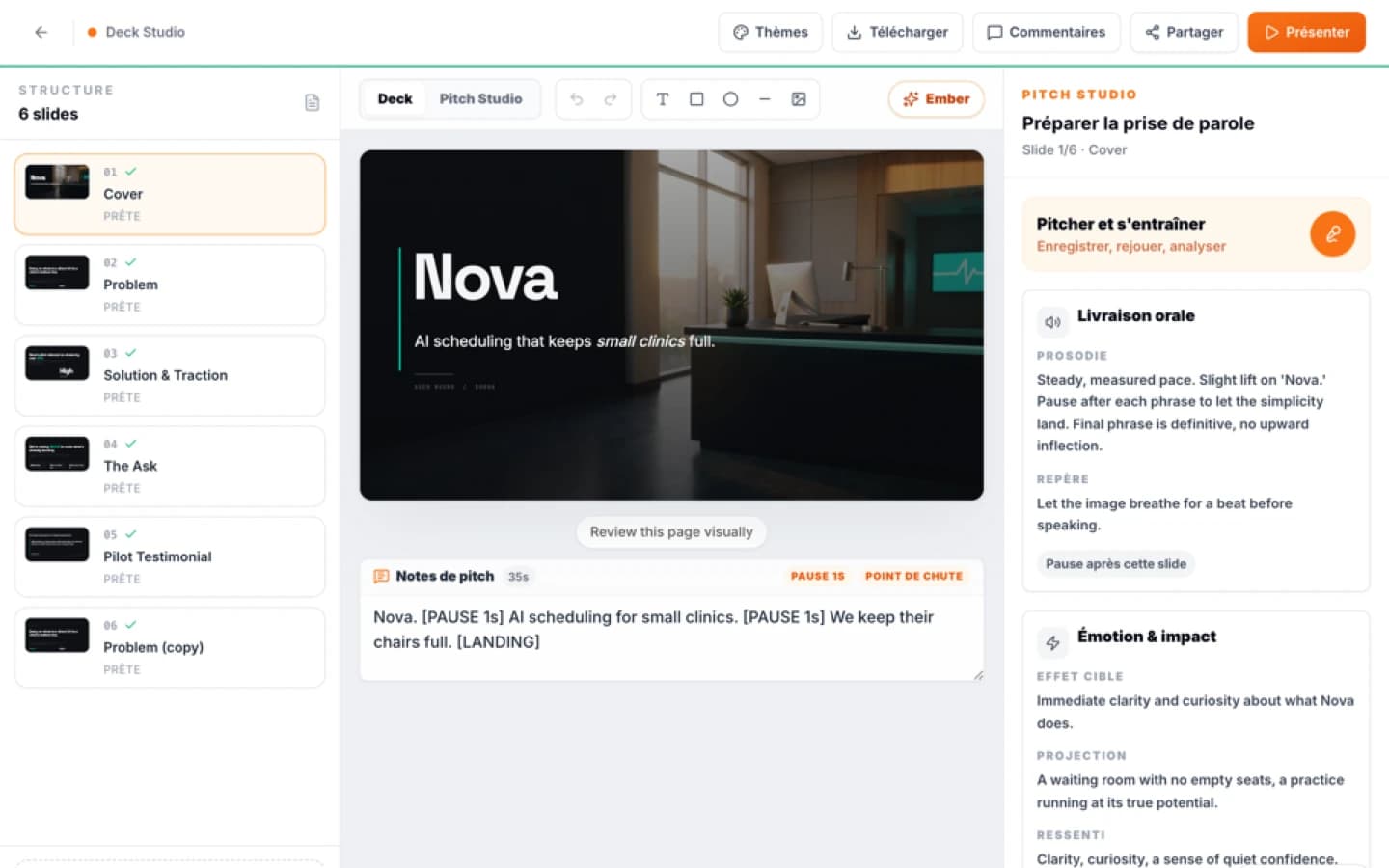
However, software cannot substitute for factual substantiation. Ember provides presentation generation through Creation, assisting founders in assembling structured business cases from their strategic inputs, but the software does not audit customer quotes for regulatory compliance or independently verify client metrics. The legal responsibility for substantiating real-world customer statements remains entirely with the executive team.
A Four-Step Verification Protocol for Commercial Collateral
To insulate your presentations from regulatory and reputational risk, implement a repeatable diligence process before publishing any customer quote or case study slide:
- Secure Verifiable Proof of Usage: Maintain dated internal records proving the client actively used the specific product version or service mentioned, during the relevant timeframe.
- Obtain Explicit Textual Sign-Off: When summarizing an oral quote from a client interview, return the exact verbatim transcript to the client and secure written permission for that precise wording. Never amplify an executive's modest statement into an unqualified commercial claim.
- Disclose Commercial and Equity Ties: If the quoted party owns equity, receives referral fees, holds an advisory role, or received free enterprise provisioning in exchange for public advocacy, add a clear and conspicuous attribution directly on the slide.
- Anchor Metrics in Typical Outcomes: If highlighting a client who achieved extraordinary results, accompany the metric with qualitative context explaining the baseline conditions, ensuring the prospective buyer understands what is realistically achievable under standard deployment.
Sources
- FTC's Endorsement Guides: What People Are Asking
- The FTC Finalizes Changes to Endorsement Guides
- Guides Concerning the Use of Endorsements and ...
- FTC, The Consumer Reviews and Testimonials Rule: Questions and Answers : source S1
- FTC, Advertisement Endorsements (The FTC’s Endorsement Guides: Being Up-Front With Consumers) : source S2
FAQ
Creation
Work on substance and impact
Structure the reasoning, form and mental journey of your presentation.