
When business leaders need to prepare an executive presentation, they usually face a split in the road: produce a standard slide deck rapidly using prompt-driven design templates, or construct a grounded narrative that directly supports a high-stakes decision.
Automated presentation software accelerates visual formatting, but executive meetings rarely stall because of typography or layout. They stall when underlying figures clash, business assumptions lack citations, or the story fails to address the exact question buyers or investors are asking.
Understanding the operational differences between Decktopus and Ember Creation reveals when to deploy an automated slide generator and when your materials demand structured narrative grounding.
Two Paradigms: Automated Slides vs Decision Support
Tools like Decktopus focus on rapid slide assembly. You provide a prompt or an uploaded document, select a visual style, and the engine produces presentation slides or social carousels. This workflow is built for speed and visual convenience, making it effective for webinars, event summaries, introductory sales overviews, and lecture material where immediate layout assistance is the primary bottleneck.
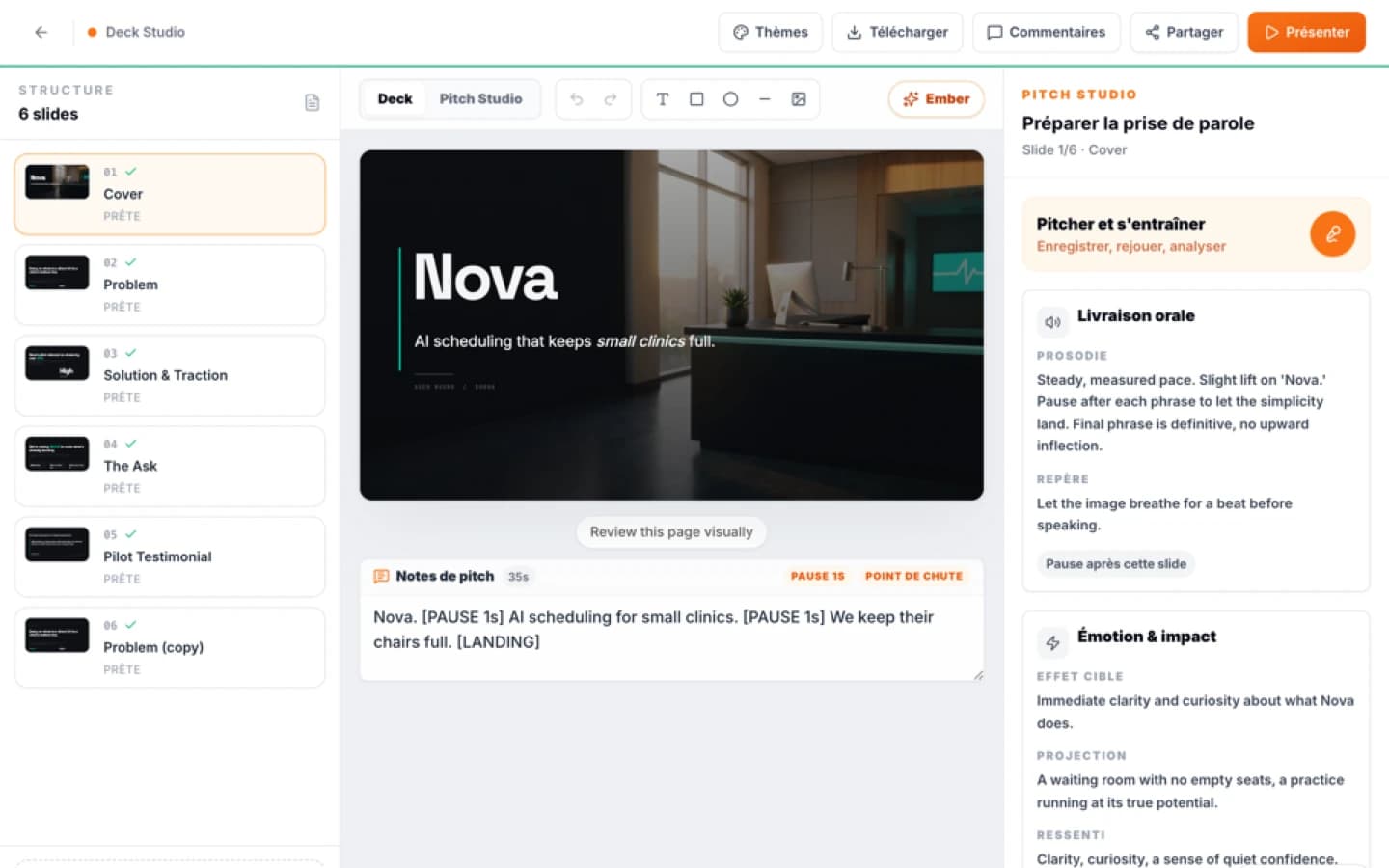
Ember Creation approaches the problem from business context rather than visual prompts. Instead of assembling generic layouts from a raw prompt, the module extracts established project context, validated venture data, and strategic inputs to build structured visual artefacts. It addresses eight distinct business formats: pitch decks, one-pagers, business model canvases, market maps, LinkedIn posts, stories, YouTube thumbnails, and open graph images.
The structural contrast comes down to validation. As communication expert Nancy Duarte outlines in her analysis of business storytelling methods, a persuasive presentation requires one clear idea stated as a point of view plus the stakes of taking or failing to take action. When high-value decisions are on the line, the narrative must clearly tether every claim to verified operational data rather than decorative prose.
Feature and Workflow Comparison
Evaluating these tools requires looking at how each platform handles structured inputs, quantitative rigor, and export workflows.
| Capability | Decktopus | Ember Creation |
|---|---|---|
| Core Focus | Automated slide and carousel creation | Context-grounded business narrative artefacts |
| Supported Formats | Presentations, social carousels | Decks, one-pagers, canvases, market maps, social formats |
| Data Grounding | Prompt or document ingestion without source checks | Reuses validated project context; explicit citations |
| Oral Practice | Delivery rehearsal with the Loop module | Speaking practice with pacing and rhetoric feedback |
| Export Formats | PDF, PowerPoint (.pptx), PNG | PDF and PowerPoint (.pptx) for decks; lossless PNG for other assets |
Automated Content Assembly with Decktopus
According to the official Decktopus pricing page, the platform offers a Pro plan starting at $24.99 per month on a monthly billing cycle, $19.99 per month billed every three months ($59.97 total), or $9.99 per month billed annually at $119.88 per year. The Pro tier provides 750 AI credits per month (noted as approximately 150 slides), presentations and carousels, PDF, PPT, and PNG exports, version history, and an interactive presentation coaching module called Loop, which simulates audience questions. For teams needing collaboration, a custom domain, and 1,000 credits per seat, Decktopus provides a Business tier priced at $44.99 per seat monthly or $19.99 per seat per month billed annually ($239.88 per year).
For straightforward visual tasks, this setup gets teams to a workable draft fast. If a team needs a clean set of slides for a weekly project check-in or a high-level educational webinar, generating a quick draft from a prompt reduces friction.
Context Grounding and Honest Metrics in Ember Creation
Presentations that drive fundraising rounds, strategic steering committees, or complex commercial proposals operate under severe scrutiny. If a metric cannot be traced back to underlying sources, executive confidence erodes.
Ember Creation resolves this by drawing directly from the user's documented project context. When generating dense formats such as investor one-pagers or business model canvases, known data is preserved while unverified metrics or unknown identities are deliberately omitted rather than filled with speculative hallucinations.
On investor one-pagers with locked text templates, Creation validates visible metric values against exact citations from project sources. Any compatible estimate that lacks complete source verification is marked with an approximation sign and flagged outside the page layout as an unverified hypothesis.
Creation operates across eight specific formats, allowing teams to generate market maps, dense one-pagers, and strategic decks from identical project data. Decks can be exported to PDF or editable PowerPoint (.pptx) files, while the other seven formats export as lossless PNGs from the canvas editor. If your team is evaluating presentation workflows across other tools, reviewing our comparative guide on Google Slides vs PowerPoint Copilot vs Ember Creation provides further context on ecosystem tradeoffs.
Rehearsal and Delivery: Loop vs Speaking Practice
Slide design accounts for only half of presentation success; oral delivery determines whether the audience acts on the recommendation.
Decktopus addresses delivery through Loop, a practice feature integrated into its paid tiers that allows speakers to rehearse their timing and simulate potential audience questions before an event.
Ember Creation integrates Speaking practice directly into the deck workflow. The feature records, replays, and evaluates presentation takes slide by slide. Rather than offering generic tips, the analysis breaks down vocal pacing, pauses, clarity, structural flow, and specific rhetorical axes. This lets presenters identify exactly where their delivery slows down or where a core message loses impact before walking into an executive review.
Choosing the Right Platform for Your Team
Selecting between Decktopus and Ember Creation hinges on the nature of the meeting and the sensitivity of the decisions involved.
Decktopus is a practical fit when:
- You need rapid generation of presentation slides or carousels from scratch or from unstructured notes.
- Visual formatting speed matters more than auditing underlying operational figures.
- Your presentation serves informational, training, or top-of-funnel marketing purposes where audience scrutiny is low.
Ember Creation is the stronger choice when:
- You are producing an investor deck, a board review, or an executive sales presentation where every claim must hold up under questioning.
- You need aligned collateral, like generating a pitch deck alongside an investor one-pager and a business model canvas from the same source data.
- You require auditable metrics that separate proven operational data from business hypotheses.
Teams preparing critical stakeholder meetings can explore how Ember Creation generates decks and visual assets directly from validated strategic context, or examine our guide on how to prepare a pitch deck for external handover to structure materials that earn executive buy-in.
Sources
FAQ
Mini audit
Test your Pitch Deck
Get an initial diagnosis of substance, form and impact.