
B2B presentations demand verifiable claims. When a founder, sales leader, or product marketer stands in front of enterprise buyers or board members, an unsupported metric can derail the entire meeting. Yet the primary presentation platforms have rushed to integrate generative AI that drafts slides quickly while often detaching statements from their underlying facts.
Choosing the right presentation workflow requires understanding how Google Slides with Gemini, Microsoft PowerPoint with Copilot, and Ember Creation handle external citations, draft consistency, and team handoffs.
The Core Tradeoff: Office Suites vs. Source-Grounded Workflows
If your primary objective is keeping everything inside your current cloud storage, incumbent suites are often good enough. According to Google Workspace, Google Slides provides collaborative browser-based presentation authoring with live editing, comments, and granular permissions. Similarly, Microsoft describes PowerPoint as a complete deck environment where Copilot assists with editing, reorganizing, and drafting slides directly inside familiar presentation formats.
However, neither suite was architected around verifiable data grounding. They draft slides from prompts or broad document overviews, leaving the user with the burden of auditing every slide to confirm which document produced which statement.
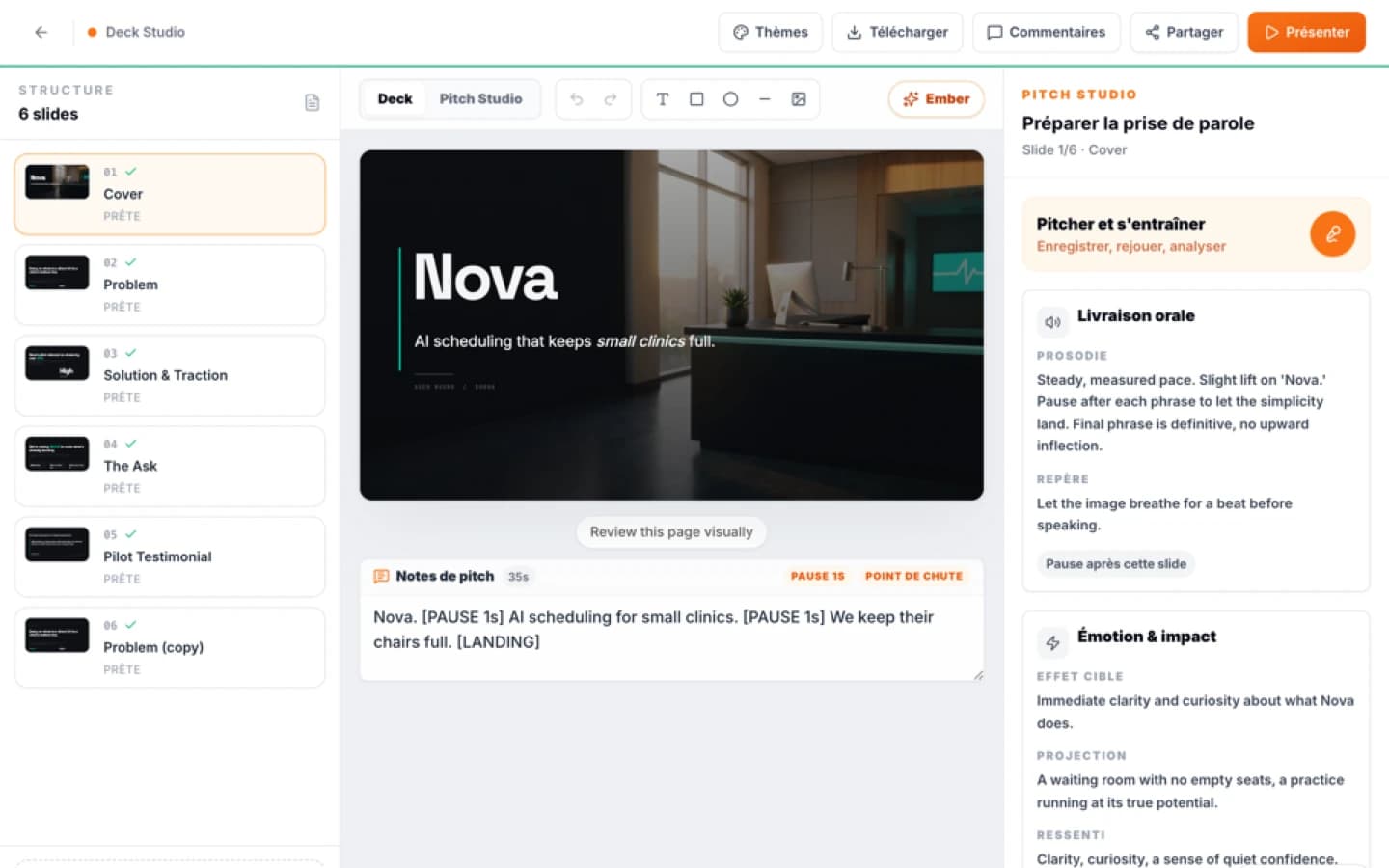
Ember takes an alternate route through its Creation module. Instead of generic slide assembly, Creation orchestrates structured generation directly from validated project context across eight visual formats, including decks, one-pagers, business model canvases, market maps, LinkedIn posts, YouTube thumbnails, open graph images, and stories. For strategic B2B documents where every claim must stand up to scrutiny, Creation ensures that stated facts map back to cited project references rather than hallucinated approximations.
Google Slides with Gemini: Collaborative Drafting and Workspace Integration
For teams deeply embedded in Google Drive, Gemini inside Google Slides streamlines early brainstorming and team alignment.
According to Google's official documentation in a Google Support guide, users can describe their presentation goals, add Google Drive references and existing decks for style, answer or skip clarification questions, review a generated outline and source list, and then produce fully editable presentations. Once generated, teams refine the deck slide by slide or adjust individual elements manually.
Google has also steadily expanded persistent user preferences. In an official update announced by the Google Workspace Updates blog, Google rolled out custom instructions across the Gemini side panel in Slides, Sheets, and Gmail starting September 2, 2026. This allows users to store stylistic and tone instructions once without needing administrator controls.
Where Google Slides with Gemini falls short is verification rigor. While it allows referencing Drive files, the resulting slide content does not maintain strict provenance markers for critical data points, making it easy for unverified assertions to slip into executive decks.
Microsoft PowerPoint with Copilot: Enterprise Native Deliverables
For organizations whose clients and board members expect standard .pptx files, PowerPoint remains the default enterprise standard.
According to official product notes from Microsoft Support, Copilot can draft decks from an existing document or topic, summarize long presentations, and answer questions about the file, provided users operate on supported PowerPoint files with appropriate licenses.
Microsoft continues to expand Copilot's research and workflow customization. According to the Microsoft 365 Copilot release notes, an update released on August 11, 2026, enabled users to ask Copilot in PowerPoint to reference relevant online sources while creating a presentation. Furthermore, release notes published on September 23, 2026, by Microsoft Learn announced that Copilot in PowerPoint on the web supports user-defined custom skills, moving beyond strictly predefined actions.
Despite these updates, Microsoft explicitly instructs users to review AI output carefully. Copilot functions as an editorial drafting assistant rather than a factual verification engine. Web references pulled during presentation creation are not automatically tied to locked metrics, and external formatting can still require significant manual cleanup.
Ember Creation: Fact Preservation and Multi-Format Delivery
Ember Creation is designed for operators who cannot afford factual inaccuracies in their external materials. Rather than starting from a blank prompt, Creation builds presentations and collateral from structured project context.
When generating data-heavy materials such as investor one-pagers, market maps, or business model canvases, Creation actively preserves supplied facts, distinguishes estimates from verified metrics, and omits unknown entities. On locked investor one-pagers, each metric value is checked against exact citations from provided sources. If a figure matches contextually but lacks an exact citation, the system affixes an approximate indicator ("≈") alongside an unverified assumption notice. Missing information is surfaced outside the slide rather than filled with hallucinated placeholder text.
Beyond pitch decks, Creation generates and edits seven additional visual formats from the same narrative context:
- One-pagers
- Business model canvases
- Market maps
- LinkedIn posts
- YouTube thumbnails
- Open graph (OG) images
- Stories
Decks can be exported directly to PDF or editable PowerPoint (.pptx) formats, while the remaining formats export as lossless PNG files. Furthermore, Creation includes Speaking practice, a built-in module allowing presenters to rehearse their decks, record runs, and receive targeted analysis on pacing, clarity, impact, and rhetorical structure before delivering their pitch live.
For founders reviewing their collateral before sharing it with investors or enterprise prospects, our guide on how to prepare a pitch deck for external handover covers the critical validation steps required.
Head-to-Head Feature Comparison
| Capability | Google Slides with Gemini | Microsoft PowerPoint with Copilot | Ember Creation |
|---|---|---|---|
| Primary Workspace | Google Drive and browser | Microsoft 365 desktop and web | Ember web platform |
| Slide Generation Input | Prompts and linked Drive files | Prompts and Word or web sources | Structured project context and web research |
| Output Artifact Formats | Google Slides | PowerPoint presentations | Decks, one-pagers, BMCs, maps, and social formats |
| Text Layout Management | Manual slide adjustment | Native PowerPoint layouts | Zone-by-zone editing and automated text fit |
| Metric Citation Verification | Manual user verification | Manual user verification | Citation matching and unverified indicators |
| Presentation Rehearsal | Standard presenter view | Standard presenter view | Speaking practice with pacing and delivery feedback |
| Export Standards | PDF, PPTX, and image formats | PPTX and PDF native saving | PPTX and PDF for decks; lossless PNG for other assets |
Choosing the Right Platform for Your Team
The right choice comes down to the operational stakes of your presentations:
- Choose Google Slides with Gemini when your organization operates entirely in Google Workspace, values real-time multi-author collaboration above all else, and only needs AI to generate preliminary drafts that your team will manually verify and polish.
- Choose Microsoft PowerPoint with Copilot when your recipients demand native enterprise
.pptxtemplates, your workflows rely on SharePoint and Microsoft 365 governance, and your team is comfortable auditing external web references manually. - Choose Ember Creation when you need automated presentation generation that preserves factual integrity, enforces citation rigor on sensitive numbers, provides built-in oral rehearsal, and extends across supporting strategic assets like one-pagers and market maps.
To compare how Creation evaluates against other design-first presentation platforms, read our analysis of Visme vs Ember Creation: How to Choose the Right Tool, or explore the wider library of the Knowledge guides for marketing to refine your collateral strategy.
When your presentations serve as the deciding factor in enterprise sales or investor diligence, preserving your sources is not optional. You can build verified, presentation-ready collateral by starting directly with Ember Creation.
Sources
- Support for Content Security Policy (CSP) in SharePoint ...
- Understanding the July 2026 SharePoint Attacks
- Restrictions et limitations dans OneDrive et SharePoint
- Google Workspace : les instructions personnalisées de Gemini arrivent dans Slides, Sheets et Gmail (déploiement dès le 2 septembre 2026) : source S1
- Microsoft 365 Copilot : compétences personnalisées dans PowerPoint sur le web (notes de version du 23 septembre 2026) : source S1
- Google Slides: source-grounded Gemini drafts and shared editing: source S1
- Google Slides: source-grounded Gemini drafts and shared editing: source S2
- PowerPoint: Copilot-assisted native deck workflows: source S1
- PowerPoint: Copilot-assisted native deck workflows: source S2
- Ember Création, artefacts visuels éditables
FAQ
Mini audit
Test your Pitch Deck
Get an initial diagnosis of substance, form and impact.