
Choosing the right software for strategic sales collateral comes down to a fundamental trade-off: do you need an open design environment that connects your product designers to slide canvases, or an automated workflow that turns project context and commercial data into decision-grade sales decks?
Sales teams evaluating Figma Slides against Ember Creation are usually trying to solve two distinct operational bottlenecks. Figma Slides brings presentation building directly into the Figma ecosystem, allowing designers and revenue teams to build slides using established design systems, collaborative chat, and real-time presenter handoffs. Ember Creation operates on a narrative and context engine that turns validated project data, business models, and market intelligence into complete, structured sales assets across eight visual formats.
Here is how both platforms approach strategic collateral, where Figma Slides remains the natural choice, and where revenue teams need a workflow anchored in commercial context rather than raw graphic design.
Where Figma Slides Excels: Design Systems and Live Collaboration
According to the official Figma Slides product page, the platform is positioned as the first presentation tool built specifically for designers and their teams. Because Figma Slides is included with all seats on every plan, revenue teams whose product or brand teams already work inside Figma gain immediate access without adding a separate software subscription to their stack.
Figma Slides delivers three major operational advantages when a deal requires direct design team involvement:
- Direct access to brand components. If your organization maintains typography scales, vector icons, product UI screenshots, and color tokens inside Figma, team members can drop those shared components into slides without exporting assets back and forth.
- Native co-presenting controls. Sales engineers and account executives delivering joint enterprise pitches can take advantage of built-in co-presenting transitions, presenter notes, and internal audio or chat collaboration directly within the workspace.
- Import for existing assets. Teams transitioning from legacy files can bring existing PowerPoint presentations into Figma Slides through a supported presentation import workflow.
For commercial teams that work hand-in-hand with a dedicated product designer on bespoke enterprise proposals, Figma Slides eliminates the friction of exporting mockups into third-party presentation tools.
The Core Limitation: A Blank Canvas Does Not Structure Commercial Arguments
While Figma Slides excels at layout precision, sales teams face a different challenge during active sales cycles: reps are rarely professional visual designers.
When an account executive needs to assemble a strategic pitch for a prospective buyer, the hardest part is not choosing typography. The challenge lies in synthesizing customer context, validating business metrics, structuring a persuasive argument, and aligning the narrative to the buyer's evaluation criteria.
In Figma Slides, building a deck still starts with a blank canvas or a visual template. The software provides design tooling, but it does not analyze the underlying business case, generate the narrative arc, or verify whether customer-facing metrics match verified commercial facts. Reps must write copy, structure slides, and format layout containers manually. If a team lacks dedicated design support, sales representatives often spend hours resizing text frames and aligning layout grids instead of closing business.
Furthermore, enterprise sales deals rarely close on presentation slides alone. High-velocity enterprise cycles require supporting collateral: executive summaries, market positioning maps, and single-page leave-behinds. A design tool leaves the creation of these companion formats entirely up to manual graphic assembly.
How Ember Creation Structures Strategic Sales Collateral
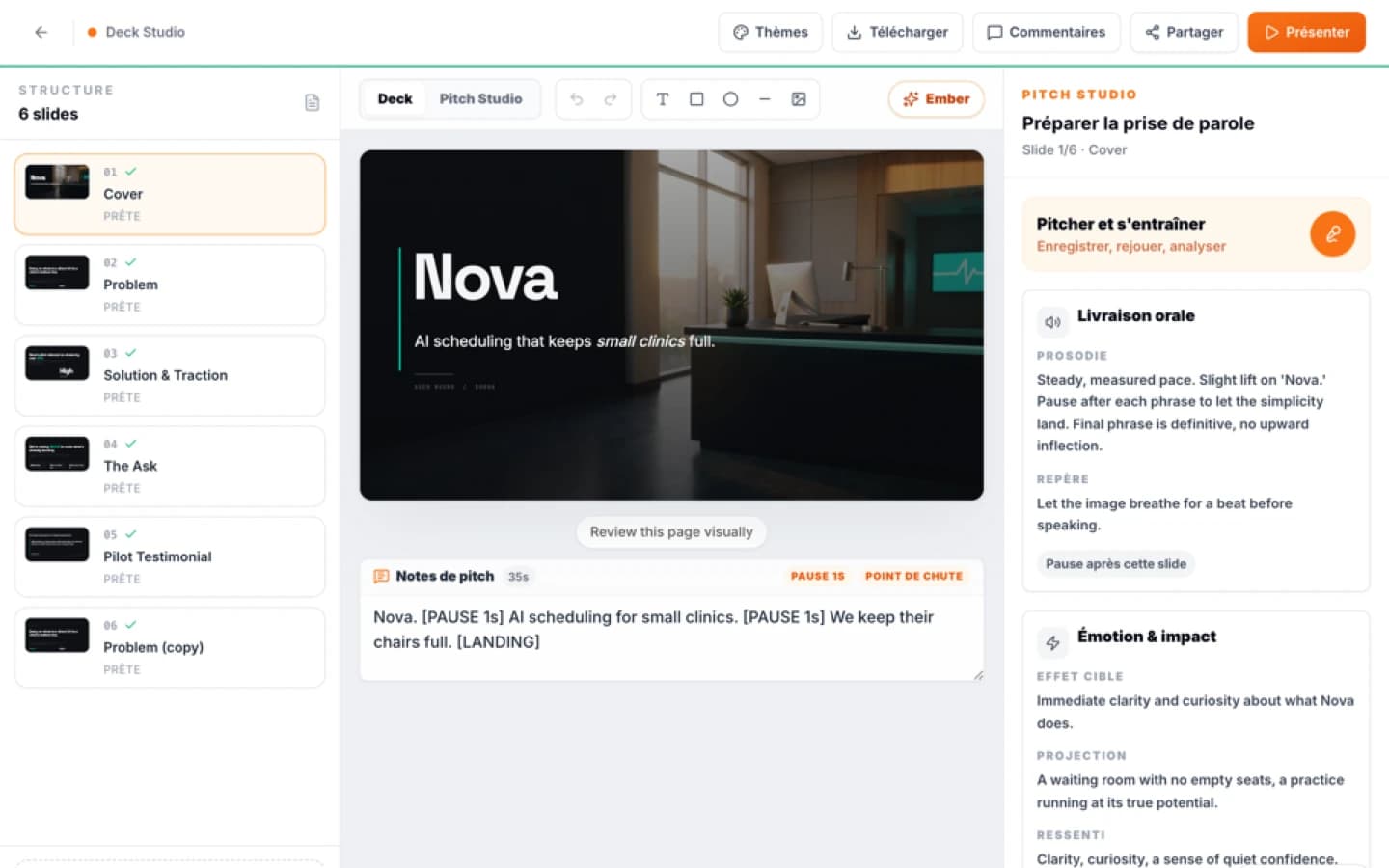
Ember Creation approaches the problem from the opposite direction. Rather than acting as a general-purpose graphics editor, Creation is an orchestrated workflow that converts structured project context into production-ready visual assets.
As detailed in the documentation for Ember Creation, the module generates and edits eight distinct visual formats:
- Presentation decks
- One-pagers
- Market maps
- Business model canvases
- LinkedIn posts
- YouTube thumbnails
- Open Graph (OG) images
- Social stories
Every format operates on its own dedicated canvas layout, playbook, and export rules.
Context-Driven Generation Over Template Guesswork
Instead of prompting an artificial intelligence model in a vacuum or forcing reps to fill out generic placeholder slides, Creation pulls directly from the user's project context. If the workspace includes validated commercial inputs, such as target market definitions, unit economics, or growth plans, Creation structures the pitch deck around those validated facts.
Before generating any asset, Creation conducts a brief framing sequence to clarify audience intent and document structure, asking targeted questions before creating slides. Reps can specify target slide counts (such as 8, 10, 12, or 15 pages) and set the document language in English or French.
Metric Classification and Factual Discipline
Sales collateral loses credibility the moment numbers do not add up. In dense analytical formats such as investor one-pagers and executive summaries, Creation maintains strict content boundaries. The system retains supplied commercial facts, distinguishes rough estimates from verified figures, and omits unverified claims. When working with metric-dense layouts, unverified assumptions receive explicit markers to prevent reps from presenting ungrounded claims to prospects or investment committees.
Once content is generated, Creation fits text to its assigned zones to prevent visual overflow while keeping headlines visible. Edits can then be made slide by slide or zone by zone using natural language adjustments without breaking layout coherence.
Rehearsal and Team Delivery
Closing an enterprise deal requires more than clean slides; it requires a disciplined delivery. Creation includes a dedicated speaking practice feature directly inside the deck module.
Account executives and founders can record their pitch, replay takes, advance slides, and review an automated assessment covering pacing, speech clarity, structural transitions, and rhetorical impact. This gives commercial teams an objective way to rehearse complex enterprise pitches before client-facing calls.
Teams interested in how commercial leaders apply these workflows in production environments can explore how sales managers use Ember Creation for deal collateral.
Direct Comparison: Figma Slides vs Ember Creation
| Evaluation Criteria | Figma Slides | Ember Creation |
|---|---|---|
| Primary Objective | Design team collaboration and canvas presentations | Automated generation of structured commercial assets |
| Core User Base | Designers and cross-functional teams using Figma | Revenue teams, founders, and commercial leaders |
| Format Variety | Slide decks | Eight formats including decks, one-pagers, and market maps |
| Source of Narrative | Manual copy entry by team members | Project context and structured framing questions |
| Factual Verification | Manual user verification | Metric classification and clear assumption labeling |
| Rehearsal Tools | Presenter notes and audio co-presenting | Speaking practice analyzing pace, clarity, and structure |
| Export Standards | Cloud presentation and PPTX import support | PDF and PowerPoint for decks, lossless PNG for other formats |
Teams distributing decks across different regulatory jurisdictions should also review The Ember Brief #24 on AI disclosures in commercial decks to ensure customer-facing collateral complies with evolving transparency rules.
Making the Decision for Your Sales Workflow
Choosing between these two tools comes down to where your operational friction lives.
Select Figma Slides if:
- Your organization has dedicated product designers who build custom visual templates for every strategic enterprise deal.
- Your sales narrative relies heavily on embedding live vector UI components, design libraries, and interactive mockups maintained in Figma.
- Your primary need is co-presenting control and design-file commenting during team presentations.
Select Ember Creation if:
- Your revenue team needs to produce complete, structured collateral rapidly without waiting on design team bandwidth.
- You require multiple aligned commercial formats for every deal, pairing a main presentation deck with executive one-pagers and market comparison maps.
- You want presentation narratives grounded in verified business context rather than manually typed template placeholders.
- You need structured speaking rehearsal tools to sharpen pitch execution before key customer meetings.
For teams managing external deal handoffs, pairing clear narrative structures with proper document standards is critical. Consult our guide on how to prepare a pitch deck for external handover to ensure your commercial files maintain fidelity regardless of the presentation environment your buyers use.
Sources
- FPPT: Figma to PowerPoint (PPTX), Google Slides, Pitch ...
- Figma Tutorial: How to Export Figma Slides to PowerPoint (PPTX)
- SlideShip: Export Figma to PowerPoint (PPTX), PDF, PNG ...
- PPTX to Figma
- Export Figma Slides to PowerPoint (.pptx)
- Figma Slides: design-tool presentations bundled into every plan
- Ember Création, artefacts visuels éditables
FAQ
Mini audit
Test your Pitch Deck
Get an initial diagnosis of substance, form and impact.