
For a sales manager, collateral production often turns into a quiet operational drain. Account executives spend hours stitching together customer slides from outdated files, while marketing distributes static collateral that reps abandon because it does not fit the prospect's industry.
The Seventh Edition of the Salesforce State of Sales report highlights that reps spend almost one full day of their workweek on prospecting, with 47% stating that cold outreach is one of the worst parts of the job and another 47% reporting their team lacks the bandwidth for it. When prospecting consumes that much weekly capacity, sales teams cannot afford to waste additional hours rebuilding decks or wrestling with graphic design tools.
Ember Creation addresses this tension directly. Built around structured project context rather than decorative prompts, it supports eight distinct visual formats to equip a commercial team across the sales cycle: decks, one-pagers, business model canvases (BMCs), market maps, LinkedIn posts, YouTube thumbnails, open graph (OG) images, and stories.
Here is how sales leadership can deploy Creation across four concrete operational moments.
1. Account-Specific Pitch Decks That Move Decisions Forward
Most generic slide generators focus on surface styling: stock illustrations, gradients, and automated layouts that leave the narrative hollow. In an enterprise deal, an attractive deck with no clear value logic rarely moves an executive committee.
Creation analyzes the substance of the underlying deal context and establishes the narrative path before producing slides. For a sales manager, this unlocks a repeatable standard across account executives:
- Tailored Deck Length: The composer lets you define the structure by choosing an exact slide count (5, 8, 10, 12, 15, 20 slides, or automated sizing) to match the meeting format, whether it is a 15-minute introductory screen or a 45-minute solution deep dive.
- Context-Driven Content: Instead of relying on a blank canvas, slides pull from validated project context and verified facts, ensuring product capabilities and commercial metrics stay consistent across reps.
- Export Flexibility: Decks can be exported from the editor directly to PDF or PowerPoint (.pptx). If a customer demands a classic slide deck or enterprise procurement requires an offline presentation, reps can download editable slides without manual rebuilds.
When reps need to move from casual messaging to boardroom-ready commercial proposals, teams can build high-impact B2B sales collateral with Ember Creation that aligns directly with deal requirements.
2. Leave-Behind One-Pagers and Executive Summaries
Decision-makers rarely forward a 25-slide presentation to internal stakeholders. Internal buying champions need concise leave-behinds that summarize the operational problem, recommended solution, and business impact in a single view.
Creation treats the one-pager as a dedicated visual format, engineered to maintain dense, honest summaries:
- Strict Fact Verification: On dense formats, known facts are preserved, estimates are distinguished from proven metrics, and unverified data points are flagged outside the canvas rather than filled with hallucinated numbers.
- Executive One-Pagers: The one-pager format is restricted to one page by default (with a second page generated only when explicitly requested), giving sales leaders an easy tool to produce executive summaries, technical overview sheets, or partnership briefs.
- Clean PNG Exports: Like the remaining six non-deck formats, one-pagers export directly as lossless PNG files from the editor, ready to attach to an executive email follow-up or embed in a commercial portal.
By keeping summaries grounded in verified source points, sales managers protect deal accuracy during competitive procurement reviews.
3. Account Planning with Market Maps and Business Model Canvases
Quarterly business reviews and major account planning sessions often stall because visual artifacts require too much manual design work. Sales managers typically have to choose between messy internal spreadsheets or asking design teams for help.
Creation includes native formats for both market maps and business model canvases:
- Market Maps for Competitor Positioning: Reps can construct visual landscape overviews that clarify where your product sits against incumbents in the prospect's software stack.
- BMCs for Champion Coaching: When helping an internal champion build a business case for the Chief Financial Officer (CFO), reps can generate a structured canvas reflecting the prospect's cost drivers, revenue streams, and operational partners.
- Zone-by-Zone Editing: Sales leaders can refine these dense planning documents directly. The editor allows natural language adjustments and targeted, reversible edits zone by zone, preventing inadvertent layout breakage while adjusting messaging.
When evaluating collateral workflows across expanding teams, comparing Gamma or Creation for presenting your project in a new market helps determine whether your priority is rapid web slides or structured commercial assets.
4. Rehearsing Key Pitches with Speaking Practice
Generating a structured deck solves only half the sales challenge. How an account executive delivers the narrative on a live call often decides the outcome.
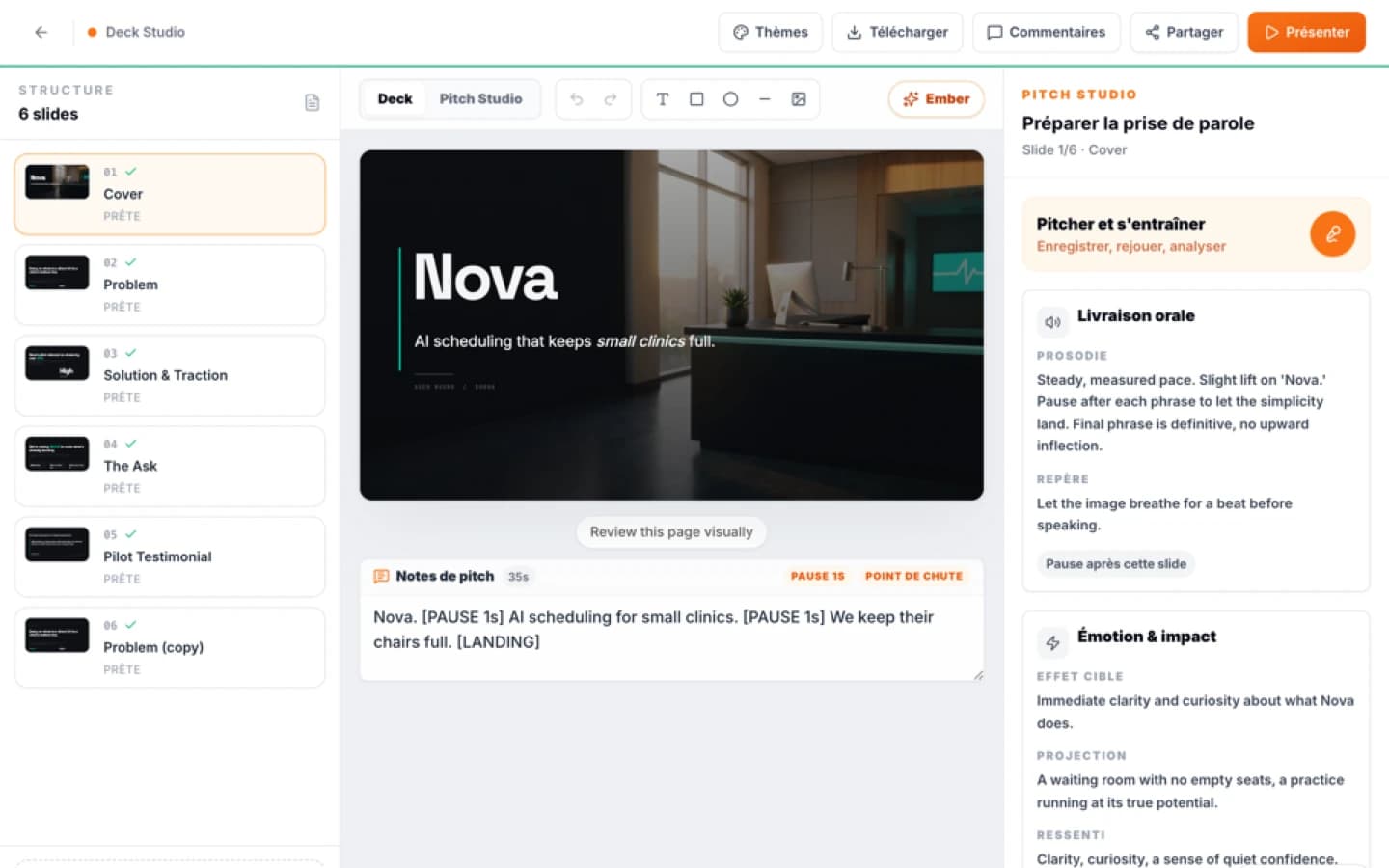
For sales managers focused on coaching and onboarding, Creation includes a built-in rehearsal tool called Speaking practice (Préparation orale in French), available specifically for the deck format:
[Record Live Run] ──> [Audio Capture & Pauses] ──> [Automated Analysis] ──> [Diagnostic Feedback]
                                                                            ├── Speaking Pace
                                                                            ├── Pause Distribution
                                                                            ├── Articulation Clarity
                                                                            └── Rhetorical Structure
- Live Run Recording: Reps can start, pause, resume, flip through slides, and re-record takes directly inside the interface.
- Objective Delivery Analysis: The engine evaluates the recorded take on rhythm, pause placement, clarity, rhetorical structure, and narrative impact.
- Targeted Feedback: Sales managers can review the diagnostic readout alongside the rep to pinpoint where the narrative drags or where product explanations become convoluted.
Instead of waiting for an enterprise call to go poorly, sales managers can turn rehearsal into a standardized routine during deal preparation.
Choosing the Right Visual Format Across the Sales Cycle
Creation separates production into specific visual playbooks rather than forcing every sales asset into a 16:9 presentation template:
| Sales Stage | Recommended Creation Format | Export Type | Operational Goal |
|---|---|---|---|
| Inbound and Social Prospecting | LinkedIn Post, OG Image | Lossless PNG | Social proof and brand awareness |
| Discovery Qualification | One-Pager | Lossless PNG | Executive summary for internal champions |
| Solution Demonstration | Deck | PDF, PowerPoint (.pptx) | Structured narrative to drive buying decisions |
| Strategic Account Review | Market Map, BMC | Lossless PNG | Competitive landscape and business case modeling |
| Pitch Preparation | Deck (with Speaking Practice) | Diagnostic Analysis | Rehearsing delivery, pacing, and rhetoric |
Implementing Creation in Your Sales Workflow
Adopting Creation does not require rewriting your entire sales methodology. A practical rollout for sales managers involves three initial steps:
- Standardize Core Assets: Generate your team's baseline discovery deck and customer leave-behind from verified product data, ensuring message consistency across reps.
- Mandate Rehearsals on Key Accounts: Require reps handling tier-one enterprise demos to complete a run in Speaking practice before the final client call.
- Equip Internal Champions: Provide reps with single-page summaries and market maps to ensure non-technical evaluators understand the product's precise fit.
To explore how narrative structure and contextual assets can strengthen your commercial pipeline, review the official overview of Ember Creation.
Sources
FAQ
Mini audit
Test your Pitch Deck
Get an initial diagnosis of substance, form and impact.