
Understanding Canva Pro's "One Design" Rule in B2B Pitch Decks
When revenue leaders and founders build B2B pitch decks, they frequently copy slides, charts, and visual assets across multiple investor presentations and commercial proposals. In Canva, this common practice intersects directly with specific terms in the platform's licensing framework.
According to Canva's Content License Agreement, content is organized into four distinct categories: Education Content, Branded Content, Pro Content, and Free Content. Under that same agreement, if you create a design that combines assets from multiple categories, the most restrictive category automatically applies to the entire design Canva Content License Agreement. Furthermore, Canva grants a license to use Pro Content or Pro Templates in a single design under what it terms a Pro Content License or One Design Use License Canva Content License Agreement.
For teams building commercial presentations, this restriction introduces clear operational boundaries that require careful license tracking.
Legal and Copyright Realities of Canva Asset Reuse
The mechanics of the Canva license affect how marketing and commercial teams manage presentation assets across projects.
The Single Design Restriction and Subscription Exports
Under the terms established by Canva, users may not copy, download, or distribute Pro Content as a standalone item Canva Content License Agreement. Each Pro Content license covers only one design, meaning that non-subscribers must pay to obtain a new license every time they wish to reuse that content in a new document Canva Content License Agreement.
For paying subscribers, Canva automatically issues a new license each time the user exports a new design containing that asset Canva Content License Agreement. In practice, this means that duplicating a slide deck to create a tailored investor pitch or client proposal requires an official export action to remain compliant. Pulling stock graphics out of an existing deck to store in an internal asset drive or share across unlinked files breaches the standalone prohibition Canva Content License Agreement.
Content Cascading and Third-Party Rights
Two additional contractual points in Canva deserve attention from corporate counsel and commercial directors:
- The Restrictive Category Rule: Because the most restrictive content category governs the entire presentation Canva Content License Agreement, adding a single branded, educational, or Pro element subjects the rest of the presentation to those tighter contractual terms.
- Warranty Disclaimers on Free Assets: While presentations represent a permitted use for both Free and Pro content Canva Content License Agreement, Canva explicitly states that it does not grant any right or make any warranty regarding the use of names, people, trademarks, logos, registered designs, or works of art depicted in Free Content Canva Content License Agreement. Teams relying on unvetted free imagery for external fundraising or strategic sales assume full third-party risk.
Beyond asset licensing, self-serve Canva subscriptions auto-renew and establish a binding legal agreement with the user's organization when an enterprise domain is used Licenseware Wiki. Canva Pro is priced at US$144 per year for one person, while Canva Business costs US$250 per year per person, excluding applicable taxes Canva Pricing.
Canva vs Ember Creation: Architectural and Workflow Comparison
Canva provides a complete graphic design environment centered on templates, visual asset libraries, and guided drafting Canva Presentations. In contrast, Ember Creation approaches B2B presentations as structured artifacts built directly from project context and verified strategic data.
| Decision Criterion | Canva Pro | Ember Creation |
|---|---|---|
| Primary Design Focus | Broad visual design and stock media library | Structured narrative decks and strategic formats |
| Asset Licensing Mechanism | Single-design license with export re-licensing | Proprietary HTML canvases and owned project inputs |
| Slide Formats Supported | Guided presentation slides and custom layouts | Decks and seven additional business formats |
| Pitch Rehearsal Tools | Standard presenter view and presenter notes | Speaking practice with verbal delivery diagnostics |
| File Export Capabilities | PowerPoint, PDF, video, and web links | PowerPoint (.pptx) and PDF for presentations |
In Canva, users can create presentations using AI prompts, review outlines, design collaboratively, and export completed decks to PowerPoint, PDF, video, or web pages Canva Presentations.
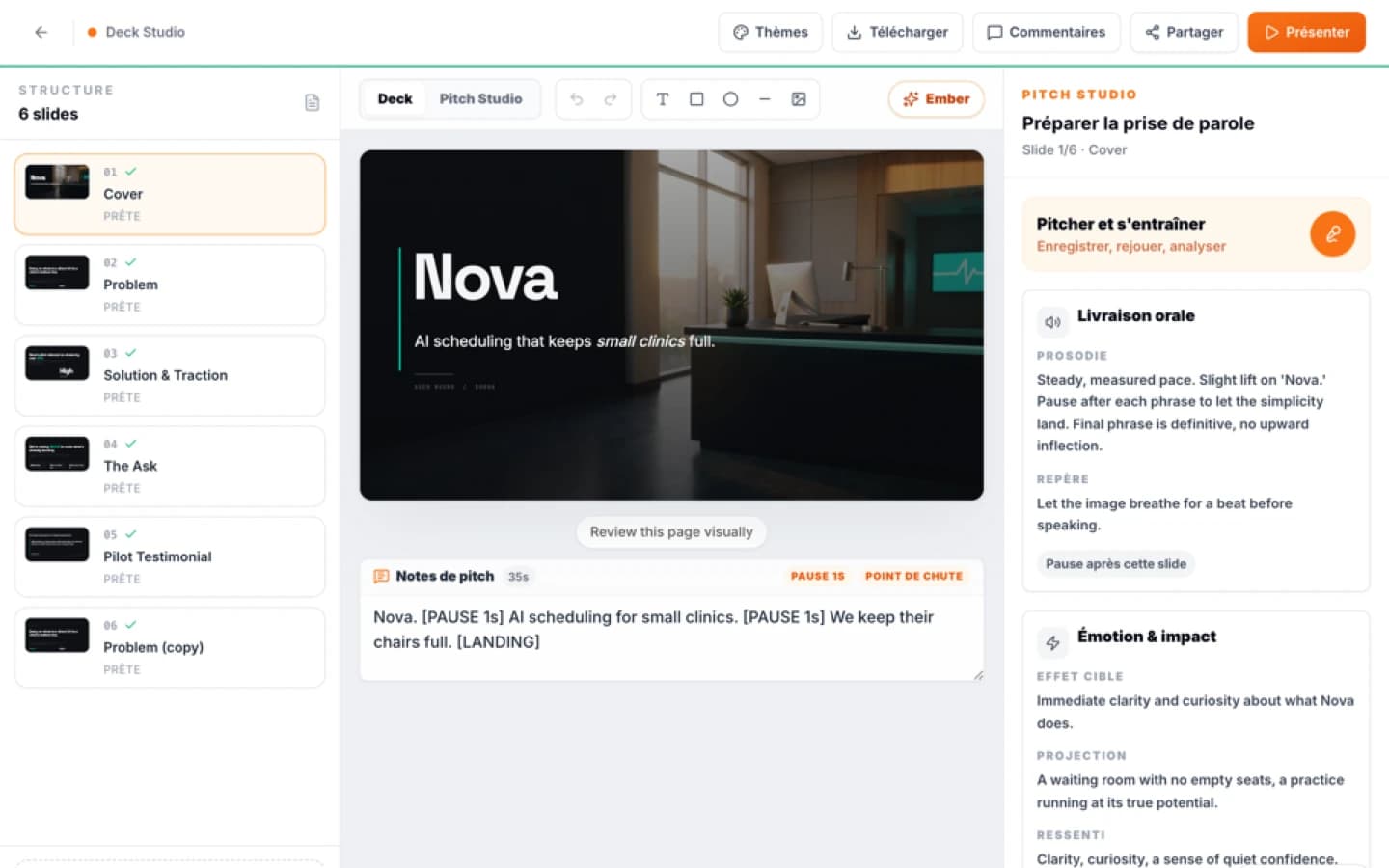
With Ember, the software generates and edits eight distinct visual formats: pitch decks, LinkedIn posts, YouTube thumbnails, market maps, business model canvases, one-pagers, open graph images, and stories. Each format operates within an explicit playbook and fixed HTML canvas, editing slide by slide or zone by zone without depending on third-party stock asset catalogs. For decks specifically, Ember provides an export to PDF and PowerPoint (.pptx), alongside a dedicated Speaking practice module that analyzes rehearsal recordings for pace, clarity, pauses, impact, and rhetorical structure. To explore related presentation workflows, read about Google Slides vs PowerPoint Copilot vs Ember Creation or consult Figma Slides vs Ember Creation for Strategic Sales Decks.
When to Choose Canva and When to Choose Ember Creation
Choosing between these two platforms comes down to whether your deck depends on stock visual media or structured business context.
When Canva Is the Right Fit
Canva is an effective, accessible tool for teams that need:
- Broad Multi-Format Creative Assets: If marketing teams need to produce social collateral, flyers, event posters, and internal slides within a single shared canvas, Canva's massive asset ecosystem excels.
- Flexible Media Exploration: For consumer-facing pitch decks or creative proposals requiring photography, video clips, and decorative illustrations, Canva offers an intuitive editing environment Canva Presentations.
- Standard Guided Drafting: If your team wants to generate a quick outline and visually appealing starter slides from a simple text prompt, Canva AI's guided presentations provide immediate templates Canva Presentations.
For organizations using Canva, complying with the Content License Agreement simply requires maintaining an active subscription, exporting each iteration through the platform, and avoiding the extraction of stock files for standalone reuse Canva Content License Agreement.
When Ember Creation Is the Strategic Choice
Ember Creation fits business readers, founders, and B2B operators who require:
- Narrative and Factual Consistency: Rather than relying on generic stock elements, Ember builds presentations directly from project context, distinguishing estimates from established figures and keeping critical data intact.
- Comprehensive Format Continuity: Teams can translate the same underlying strategic narrative across pitch decks, one-pagers, market maps, and business model canvases without manually rebuilding layout blocks.
- Integrated Oral Rehearsal: The Speaking practice feature allows presenters to rehearse their deck directly against their slides, receiving feedback on pacing, structural delivery, and rhetorical clarity before entering client meetings or investor reviews.
- Complete File Portability: Presentation decks export directly into editable PowerPoint (.pptx) format or raster PDF, ensuring clean delivery to external stakeholders.
Teams looking to streamline their B2B storytelling can start building structured presentations through Ember Creation or examine additional methodologies in the Knowledge guides for marketing.
Sources
- Unlock more reach with the same team. Learn ...
- Canva Terms of Use, Master Services Agreement and ...
- Canva : licence de contenu Free et Pro, catégorie la plus restrictive et licence « un seul design » pour les éléments Pro : source S1
- Canva: guided presentation creation and visual delivery: source S1
- Canva US pricing receipt
- Ember Création, artefacts visuels éditables
FAQ
Mini audit
Test your Pitch Deck
Get an initial diagnosis of substance, form and impact.