
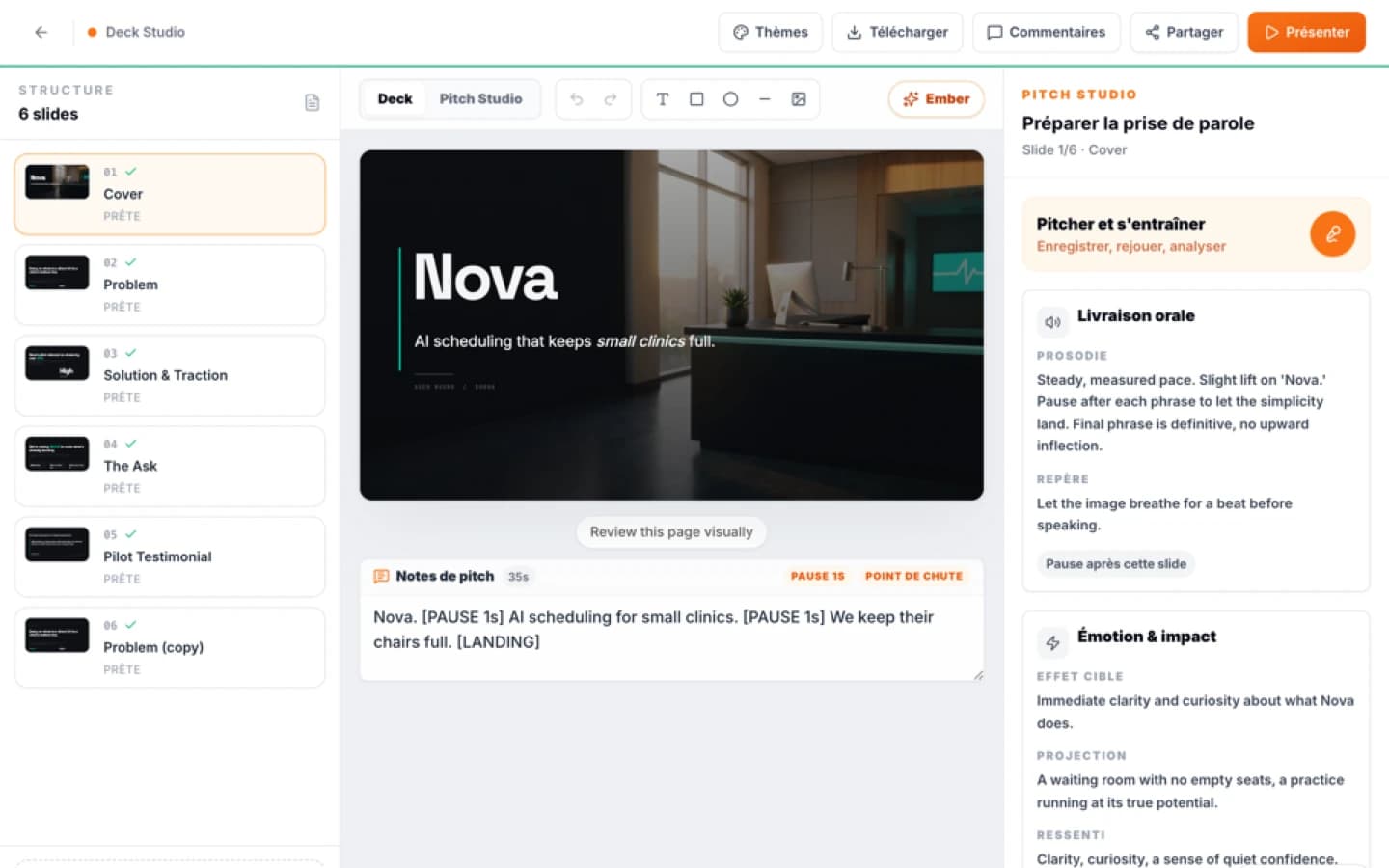
Business leaders and founders building presentations face a fundamental workflow divergence: generate individual slides inside their existing slide software via prompt plugins, or construct an end-to-end strategic narrative rooted in validated company context.
The distinction between Plus AI and Ember Creation represents exactly this split. Plus AI functions as an in-app add-in that lives directly within Microsoft PowerPoint and Google Slides. Ember Creation functions as a dedicated visual asset engine that structures narrative storylines from real project foundations before outputting slides, one-pagers, or market maps. Understanding where each tool excels prevents wasted time, misaligned brand messaging, and fractured arguments during high-stakes pitches.
Two Divergent Presentation Philosophies
The core difference between these tools is architectural. Plus AI operates where many corporate operators already spend their working hours: inside traditional presentation software. You prompt the add-in to create single slides, rewrite text, or adjust outlines without leaving your existing slide deck. This approach minimizes platform switching and keeps files directly inside existing enterprise cloud storage.
Ember Creation approaches the problem from the perspective of strategic substance rather than slide population. Instead of treating slides as empty containers waiting for ad-hoc prompts, it grounds generation in project data, such as validated growth files and structured founder materials. By analyzing substance and structuring narrative progression before producing visual outputs, the engine builds presentations designed to advance specific business decisions rather than simply accumulating bullet points.
The Best Case for Plus AI: Native Editing in Existing Slides
When your primary requirement is keeping team members inside PowerPoint or Google Slides, an add-in tool has clear operational merit. Enterprise teams frequently rely on strict slide templates and internal shared drives that make standalone web applications cumbersome.
According to the Plus AI pricing page, the service offers tiered plans billed annually or monthly:
- Basic at 10 dollars per user per month billed annually (15 dollars billed monthly) with 1,500 AI credits per month.
- Pro at 20 dollars per user per month billed annually (25 dollars billed monthly) with 3,000 AI credits per month and document uploads.
- Team at 30 dollars per user per month billed annually (40 dollars billed monthly) with 6,000 AI credits per month and custom branding controls.
- Max at 200 dollars per user per month billed annually (240 dollars billed monthly) with unlimited AI credits.
All plans start with a 7-day free trial providing 1,000 AI credits, with actual task credit consumption varying by complexity.
For routine status updates, internal team summaries, or quick slide rewrites where corporate templates are already mandated, Plus AI is a natural fit. You prompt the assistant to draft a slide, tweak existing layouts, and continue collaborating using familiar presentation features. Readers evaluating broader presentation ecosystems can review our breakdown of Google Slides vs PowerPoint Copilot vs Ember Creation.
How Ember Creation Works: From Project Context to Narrative Multi-Format
Ember Creation addresses a different friction point: the risk of generating polished, generic slides that lack factual consistency with your company's core strategic metrics.
Context-Grounded Architecture
Rather than relying on isolated text prompts typed into a sidebar, Creation draws directly from what the platform already knows about your venture, including connected growth records. When inputs are assembled, the engine references validated project blocks without fabricating unsupplied facts. If data is missing in dense formats, the engine marks the gap outside the active canvas rather than inventing speculative metrics.
Beyond Pitch Decks: Eight Visual Formats
Presentation needs extend far beyond slide decks. The module generates and edits eight distinct formats:
- Decks
- One-pagers
- Business model canvases
- Market maps
- LinkedIn posts
- YouTube thumbnails
- Open Graph (OG) images
- Stories
Each format operates on its own dedicated canvas, playbook, and export rules. Decks support export to PDF and PowerPoint (.pptx). The remaining seven visual formats export as lossless PNG files directly from the browser editor.
Speaking Practice and Delivery
A strategic presentation is only as effective as the presenter who delivers it. Ember Creation includes an integrated Speaking practice module for decks, allowing founders to record, replay, and rehearse their presentations slide by slide. The system analyzes the recording across delivery metrics, evaluating pacing, clarity, pauses, impact, and structural rhetoric to refine verbal delivery before meeting stakeholders. When preparing a deck for outside partners, reviewing how to prepare a pitch deck for external handover helps ensure your narrative survives scrutiny.
Workflow Comparison
| Criterion | Plus AI | Ember Creation |
|---|---|---|
| Environment | Inside PowerPoint and Google Slides | Standalone browser canvas engine |
| Primary Input Method | In-slide conversational prompts and document uploads | Structured project context and guided scoping |
| Deliverable Scope | Presentations and individual slides | Decks plus seven additional formats |
| Pitch Rehearsal | None included in the add-in | Integrated Speaking practice with delivery diagnostics |
| Export Standards | Native presentation files (.pptx and Google Slides) | PDF and PowerPoint for decks; PNG for other visual formats |
Limits and Practical Tradeoffs
Choosing between these systems requires acknowledging where each platform stops:
- Ember Creation constraints: It is not an embedded sidebar plugin inside PowerPoint or Google Slides. While completed decks export smoothly to PowerPoint (.pptx) or raster PDF, real-time drafting occurs in a dedicated web application. For non-deck formats, exports are strictly limited to PNG; they do not export to PDF or editable presentation files.
- Plus AI constraints: As an add-in focused on slide generation, it does not manage multi-format marketing collateral like market maps, business model canvases, or social assets from a unified data layer. It also lacks structured delivery tools like rehearsal diagnostics, leaving the verbal pitch entirely to the user. For founders comparing dedicated design canvases, exploring Figma Slides vs Ember Creation for strategic sales decks offers another helpful angle.
Choosing the Right Tool for Your Objectives
Opt for Plus AI if your workflow is firmly anchored in daily PowerPoint or Google Slides collaboration, your team needs in-app text adjustments, and your primary goal is speeding up the drafting of conventional slide decks inside existing templates.
Opt for Ember Creation when preparing strategic milestones, fundraising decks, or unified launch materials where narrative coherence, verified project inputs, and spoken delivery matter more than staying inside a traditional slide editor. You can start directly with a structured workflow on Ember to build presentations designed to drive definitive business decisions.
Sources
- FAQ sur la conformité des exportations
- Top 10 des modèles PowerPoint de procédures d' ...
- Utiliser les modèles de votre organization dans PowerPoint
- Plus AI : plans Basic, Pro, Team et Max, prix en dollars par utilisateur et par mois, crédits d'IA, dans PowerPoint et Google Slides : source S1
- Ember Création, artefacts visuels éditables
- PowerPoint: Copilot-assisted native deck workflows: source S1
- PowerPoint: Copilot-assisted native deck workflows: source S2
- PowerPoint Copilot : références web dans la création de présentation : source S1
FAQ
Mini audit
Test your Pitch Deck
Get an initial diagnosis of substance, form and impact.