
Claim to verify
For early stage founders, capital efficiency is a survival metric. The strategic choice between bootstrapping and raising venture capital, as discussed by Stephen Turban on LinkedIn, dictates how carefully a company must deploy its resources. When building a pitch deck or a business presentation, a bootstrapped founder cannot afford to waste capital on rigid templates or opaque pricing models. Before choosing a presentation tool like Creation, founders should verify three specific categories of evidence.
First, verify pricing transparency and workflow control. Many artificial intelligence (AI) tools charge upfront without showing the potential output. In contrast, the onboarding flow for Creation suggests three templates with previews, asks useful questions, then starts generation after framing, billed at actual cost. Founders can review the framing before generation starts.
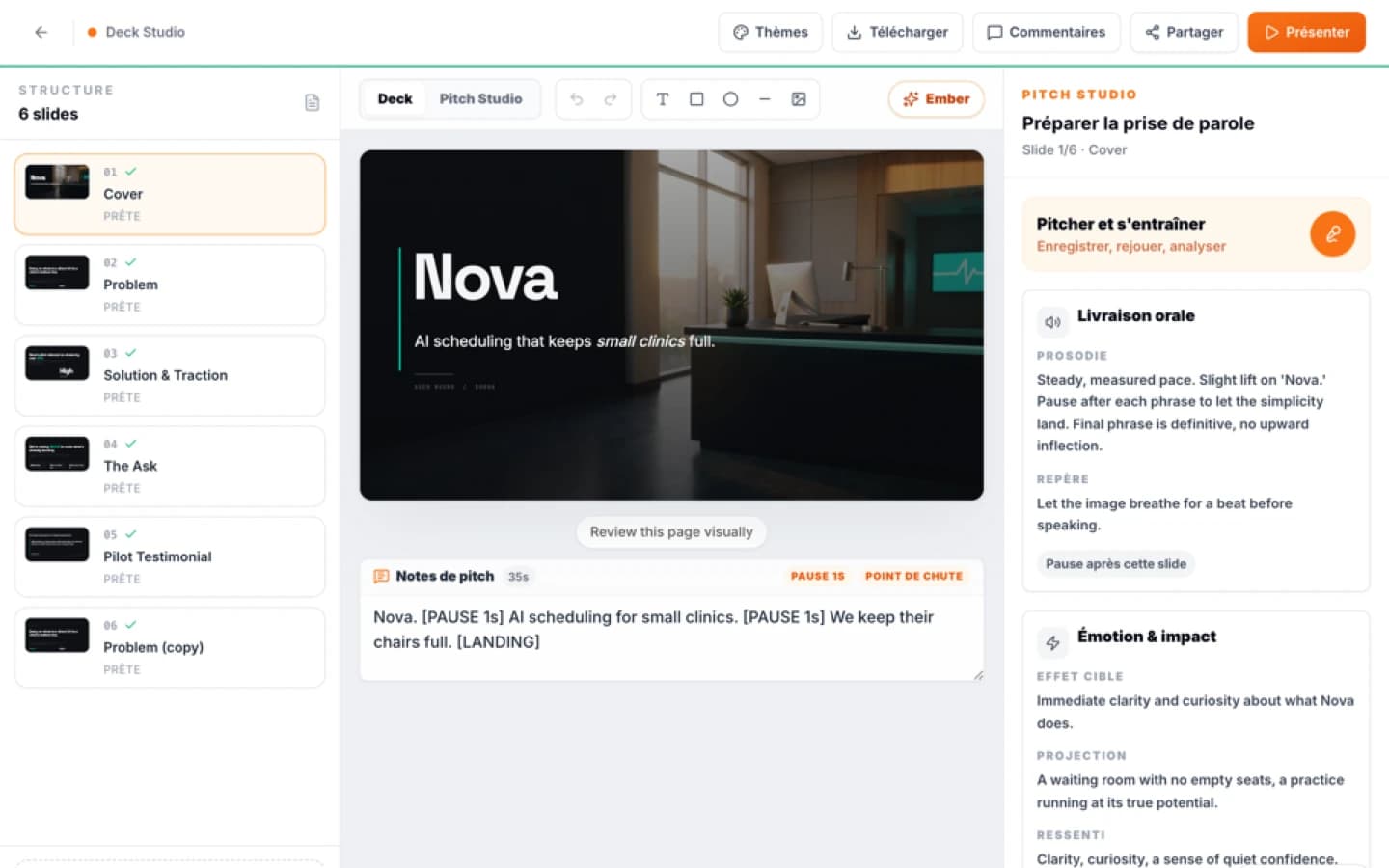
Second, verify post generation editability. A common pitfall of automated slide generators is the creation of static, unchangeable layouts. A bootstrapped team needs to iterate rapidly without paying for redesigns. The audited capability of Ember lets users edit the generated presentation in Creation, ensuring that the founder retains complete creative and strategic control over the final slides.
Third, verify the availability of rehearsal tools. Creating slides is only half the battle; delivering them with conviction is what moves decisions forward. Incumbent tools are often highly capable in this area. For instance, Microsoft PowerPoint provides a valuable Speaker Coach for private rehearsal before the presentation, helping presenters refine their delivery. To ensure a professional finish, founders should check if their AI tool offers similar support. Ember addresses this need directly, as the platform lets users record, replay and rehearse the presentation in Speaking practice.
Evaluating these features against established benchmarks helps founders avoid costly mistakes. For a broader look at the preparation required before selecting growth and funding tools, founders can consult the strategic guide on What Evidence Must Bootstrapped Founders Verify Before Piv? to align their tooling with their long term business goals.
To place this decision in context, the Knowledge guides for marketing brings together deeper guidance on the same field.
Methodology
Evaluating a presentation tool requires a systematic approach, especially for early stage founders who must protect their limited capital. To determine if Creation fits a bootstrapped business model, founders should verify key operational proofs before committing their resources.
First, verify the transparency of the creation process and its pricing structure. A bootstrapped founder cannot risk paying for blind generations. The evaluation methodology should test how the platform structures the initial setup. In this regard, the platform suggests three templates with previews, asks clarifying questions, then starts generation after framing, billed at actual cost, as detailed on the Creation product page. This framing helps founders choose a direction before generation starts.
Second, evaluate the level of post-generation control. Many automated tools output static files that require external software to modify. A viable tool must keep every element fully adjustable. Founders can verify that the platform lets users edit the generated presentation directly within Creation, ensuring that the narrative can be refined as the business model evolves.
Third, assess the integration of delivery and rehearsal features. Designing slides is only the first step, as the actual pitch requires rigorous practice. Traditional presentation tools are highly capable in this area. For instance, Microsoft PowerPoint provides a private rehearsal experience through its Speaker Coach feature, which helps presenters prepare before their live delivery, as documented by Microsoft Support. To match this utility, founders should verify that their chosen platform provides native rehearsal capabilities. The system allows users to record, replay, and rehearse the presentation in Speaking practice, as outlined on the Creation product page.
By systematically testing these pillars, including pricing transparency, editing autonomy, and rehearsal support, bootstrapped founders can make an objective decision that preserves capital while maximizing narrative impact.
Evidence
To make an informed decision, a bootstrapped founder must look closely at how alternative platforms manage credit consumption and feature access. For instance, Gamma structures its offering across six plans spanning individual and team tiers, including Free, Plus, Pro, Ultra, Teams, and Business, as detailed on the Gamma Help Center. Under this model, the free plan provides a one-time grant of 400 credits at signup with no refresh, while paid plans refill credits monthly with limited rollover up to double the plan size, according to the Gamma Credit Guide. This type of credit constraint means that mistakes during the generation phase can quickly deplete a founder's available resources.
In contrast, verifying the workflow of Creation reveals a design built to protect the founder's budget. The platform suggests three templates with previews, asks useful questions, then starts generation after framing, billed at actual cost, as detailed on the Creation Page. The actual credit cost then depends on the work performed. Furthermore, once a presentation is generated, Ember lets users edit the generated presentation directly in Creation, as documented on the Creation Page, preventing the need to spend additional credits on entirely new generations just to make minor adjustments.
Beyond slide creation, a bootstrapped founder must also evaluate how a tool supports the actual delivery of the pitch. Traditional software has long recognized this need. For example, Microsoft PowerPoint includes a private rehearsal feature called Speaker Coach to assist with private preparation before a presentation, as described on the Microsoft Support Page. To match and exceed this standard without requiring external subscriptions, Ember lets users record, replay, and rehearse their presentations directly in Speaking practice, as shown on the Creation Page.
Ultimately, choosing the right presentation partner is about securing predictable costs and comprehensive features. For early stage founders, whose strategic path relies on extreme resourcefulness, as discussed in Stephen Turban's analysis of bootstrapping versus venture capital on LinkedIn, verifying these operational proofs ensures that every dollar spent directly advances the business.
To explore this point further, Creation vs Gamma: Which Tool Builds Your Visibility? details a step directly related to this decision.
Demonstration and examples
To understand how these principles function in a real scenario, consider an early stage founder preparing to pitch to potential partners. The strategic choice between bootstrapping and raising Venture Capital (VC), as discussed on LinkedIn, requires absolute clarity on resource allocation. In this context, evaluating a presentation tool comes down to testing how it handles the creation and rehearsal phases.
A practical demonstration of a capital-efficient workflow is how the platform structures the initial setup. Instead of charging the user immediately, Creation suggests three templates with previews, asks useful questions, then starts generation after framing, billed at actual cost, as detailed on the Creation page. The founder can review the framing before generation starts.
Once the draft is created, the next proof of utility is the editing experience. A common pitfall of automated design tools is the inability to modify the output without starting over. To prevent this, Creation lets users edit the generated presentation directly within the workspace, as documented on the Creation page. This keeps the narrative flexible and fully customizable.
Finally, the presentation must be rehearsed. While established tools like Microsoft PowerPoint provide a private rehearsal option with their Speaker Coach feature, as shown on the Microsoft Support page, a dedicated startup workflow benefits from integrated feedback. Within the same workspace, Creation lets users record, replay, and rehearse the presentation in Speaking practice, as explained on the Creation page. This integration allows founders to refine their delivery alongside their slides, ensuring they are fully prepared before speaking to stakeholders.
Observed results
When evaluating the practical outcomes of a presentation tool, early stage founders must look at how these features translate into actual preparation. For traditional slide decks, incumbents like Microsoft PowerPoint provide reliable, established tools such as Speaker Coach for private rehearsal before a presentation, as documented on the Microsoft Support page. This is often sufficient for founders who already have a finalized structure and simply need to practice their delivery.
However, for bootstrapped founders who need to build their narrative from scratch while protecting their cash flow, the observed workflow in Ember offers a different level of control. As shown on the Creation product page, the system suggests three templates with previews, asks useful questions, then starts generation after framing, billed at actual cost. The actual cost depends on the generation. Once the draft is ready, the platform lets users edit the generated presentation directly in Creation, ensuring they retain full creative control. To prepare for the actual pitch, founders can also record, replay, and rehearse the presentation in Speaking practice, as detailed on the Creation product page. This structured environment helps bootstrapped entrepreneurs transition smoothly from strategic planning to active fundraising without wasting valuable time or capital.
This approach also connects with Use Creation to Pitch Business Angels: A Structured Guide, which clarifies the next choice.
Limitations
Every tool has its operational boundaries, and bootstrapped founders must understand these constraints to avoid wasted effort. While Creation provides an integrated environment to build and refine presentations, it is not a tool designed to bypass the hard work of strategic thinking.
First, the generation workflow requires active participation. Instead of instantly spitting out slides from a single keyword, the platform suggests three templates with previews and asks targeted questions to capture the substance of the project, before starting generation after framing, billed at actual cost, as detailed on the Creation Page. For founders looking for a zero-input template generator, this structured questioning might feel like an extra step, but it is necessary to ground the presentation in real business logic.
Second, editing and rehearsal have specific pathways. Once a presentation is generated, founders can edit the slides directly within the editor, as shown on the Creation Page. For delivery preparation, the platform allows users to record, replay, and rehearse their pitch within Speaking practice. This integrated approach is different from traditional offline tools. For instance, those accustomed to legacy software might prefer the offline, private rehearsal features of Microsoft PowerPoint, which offers Speaker Coach for preparation before a live presentation, as documented on the Microsoft Support Page.
Finally, a bootstrapped business model demands rigorous verification of all strategic assumptions before spending capital. Founders should evaluate these operational realities alongside the broader benchmarks for self-funded ventures, as outlined in the guide on What Evidence Must Bootstrapped Founders Verify Before Piv?. Understanding these limits ensures that when you choose to build your deck, you do so with a clear view of the required human input and the platform's structured workflow.
Decision criteria
When evaluating whether to adopt a dedicated presentation platform like Creation, early stage founders must look beyond aesthetic templates and focus on criteria that directly impact business survival. For a bootstrapped business, every asset must perform. The first criterion is narrative depth. A founder should verify if the tool merely applies a superficial layout or if it actually helps the presentation build understanding and move a decision forward beyond visual polish, as outlined on the Ember Creation page. This distinction is critical when presenting a business model that relies on self-sustaining growth rather than external capital.
The second criterion is the level of user control and editability. Automated slide creation is only useful if the resulting output can be tailored to specific customer or partner conversations. Founders should ensure that the platform keeps every element editable. For instance, Creation lets users edit the generated presentation directly and request changes in natural language while staying in control within the editor. This flexibility prevents the common bottleneck of being locked into rigid, unalterable designs.
The third criterion involves delivery and rehearsal. A great deck is ineffective without a strong delivery. Traditional software remains highly capable in this area. For example, Microsoft PowerPoint provides a reliable, established option with its Speaker Coach feature, allowing for private rehearsal before a presentation, as detailed in the Microsoft Support documentation. For founders seeking an integrated workflow, verifying whether the creation tool also supports the rehearsal phase is key. Creation addresses this by letting users record, replay, and rehearse their presentation in Speaking practice, analyzing rhythm, clarity, impact, and structure during practice runs.
Finally, bootstrapped founders must demand absolute cost transparency. When capital is limited, hidden fees or unexpected subscription tiers are unacceptable. A professional tool should make its pricing structure clear from the outset. In Creation, the system suggests three templates with previews, asks useful questions, then starts generation after framing, billed at actual cost, allowing founders to check the framing before generation starts. This structured approach helps early stage leaders make informed decisions as they navigate the strategic trade-offs of their growth journey, whether they are pursuing self-funding or evaluating Venture Capital (VC) routes, a choice discussed further in this LinkedIn discussion on funding routes. For additional insights on what evidence to verify during these critical transitions, founders can consult the What Evidence Must Bootstrapped Founders Verify Before Piv?.
In practice, How Small B2B Sales Teams Tell Customer Stories Without Fud? completes this framework with another angle on the same topic.
What remains unproven
For an early stage founder, the ultimate test of any presentation tool is not how quickly it generates slides, but whether those slides can withstand the scrutiny of partners, clients, or potential funders. When comparing automated alternatives, founders often face complex credit structures that make long-term costs difficult to predict. For example, the presentation platform Gamma operates across six distinct plans spanning individual and team tiers, including Free, Plus, Pro, Ultra, Teams, and Business, as outlined on the Gamma Subscription Page. On their free tier, users receive a one-time grant of 400 credits at signup with no refresh, according to the Gamma Credit Support Page. For their paid tiers, credits refill monthly with a rollover capped at double the plan size, providing 1,000 monthly credits on the Plus plan, 4,000 on the Pro plan, and 20,000 on the Ultra plan, as detailed on the Gamma Subscription Page.
For a bootstrapped business where every dollar must be accounted for, these recurring credit limits mean that the cost of iterative editing remains unproven until you begin actively modifying your narrative. This is why a founder must verify how a tool handles the edit and review phase. To prevent unexpected costs during the drafting process, Ember ensures transparency by suggesting three templates with previews, asking clarifying questions, and starting generation after framing, billed at actual cost, as shown on the Creation Page. Once generated, the platform lets users edit the presentation directly within Creation and rehearse the presentation in Speaking practice, as documented on the Creation Page. This structure allows founders to refine their message while checking the actual credit cost of later changes, ensuring that the final output is shaped by human judgment rather than automated guesswork.
Checked sources
Sources
FAQ
Creation
Work on substance and impact
Structure the reasoning, form and mental journey of your presentation.