
Symptom or signal
The goal is a clean decision, not random abandonment
A small sales team cannot pursue every prospect forever. The useful decision is not simply "follow up or abandon". It is "continue, pause or close". This distinction protects selling time without treating temporary silence as a permanent rejection.
Salesforce describes B2B prospecting as a sequence of research, prioritisation, initial contact, nurture and qualification (source). A prospect should therefore leave the active sequence when available evidence no longer justifies the effort, not only because one message went unanswered.
Six signals to review
Score each criterion from 0 to 2:
- Fit: does the company still match the ICP?
- Problem: is there recent evidence of the problem you solve?
- Access: have you identified a relevant person and a credible contact path?
- Priority: does an event, deadline or initiative make the issue current?
- Reciprocity: has the prospect offered any signal, such as a question or introduction?
- Ability to serve: can your team genuinely deliver the expected outcome in this context?
ICP and qualification work should happen before volume increases. Overloop also recommends checking profile, need and ability to serve before expanding prospecting activity (source).
What changed
Context changes when the source, person concerned, decision stage or follow-up capacity changes. Record that change precisely. Without a dated comparison point, the team may attribute the result to the latest visible action rather than the actual mechanism.
Facts and sources
Separate published facts, internal observations and assumptions. Keep a link for every external fact and a defined scope for every internal observation. An assumption remains explicitly revisable and never becomes a general promise.
Why the common explanation is incomplete
The common explanation often favours volume, channel or one label. It remains incomplete when it ignores information provenance, decision timing, contact constraints and the team's capacity to handle the next step properly.
The real problem
Three decisions instead of a binary verdict
Continue when fit is strong, the problem is documented and a reasonable next step exists. Limit the next move to one action: a question, a call or a resource connected to the account's context.
Pause when fit is strong but timing is poor. Record the signal that should trigger a review, such as hiring, a contract deadline or a leadership change. Without an expected signal or review date, a pause becomes hidden pursuit.
Close when the ICP does not fit, the need is absent, the team cannot serve the account or several relevant attempts produced no reciprocity. A closed record should preserve the reason, not only the status.
A 15-minute weekly review
Take every prospect without a next action and use the same order:
- Read the last factual signal.
- Check fit against the current ICP.
- Count genuinely different attempts, not copied reminders.
- Choose continue, pause or close.
- Record the reason and, where relevant, the restart condition.
This routine keeps old opportunities from occupying the pipeline and distorting forecasts. It also keeps the decision reversible: new evidence can bring a closed account back without deleting history.
A simple closure message
A final message should not create guilt or false urgency:
I am closing this topic so I do not keep adding follow-ups. If the priority changes around [specific problem], I can restart the conversation with the context already shared.
When the prospect has explicitly declined, do not search for a different angle. Record the refusal and respect it.
Metrics worth tracking
Track a small set of measures and connect each one to a decision:
- share of active prospects with a dated next action;
- time spent on accounts without reciprocity;
- restart rate for paused accounts after the expected signal;
- most common closure reasons;
- conversion of prospects kept after the review.
A sound system does not aim to close more accounts. It concentrates effort on the accounts with the strongest current evidence.
How the mechanism works
The mechanism has four stages: observe a change, verify its provenance, choose one bounded action, then compare the outcome with a condition written before acting. A contradiction corrects the rule. An unknown remains open.
Concrete examples
Example: two records look similar, but only one contains a recent, verifiable change. The team documents that fact, chooses a fitting action, sets a review date and keeps the other record as a control. It learns from the contrast without inventing certainty.
When to use this diagnosis
Use this diagnosis when a signal changes priority, an action consumes meaningful time or the team must explain why it pursues, postpones or closes an item. It is especially useful when several plausible causes compete.
When not to use it
Limits and special cases
A complex sale can remain quiet while the internal project continues. Do not confuse a long cycle with an absent need. Conversely, a polite reply is not proof of buying priority.
Adapt timing to deal value, stakeholder count and the customer's calendar. Never infer budget, authority or urgency from a job title alone. Public information should prepare a question, not manufacture certainty.
Next step
Choose a small scope, name the owner and review date, then record the fact, assumption, action and stopping condition. Correct one rule at a time so the team can tell what genuinely changed the outcome.
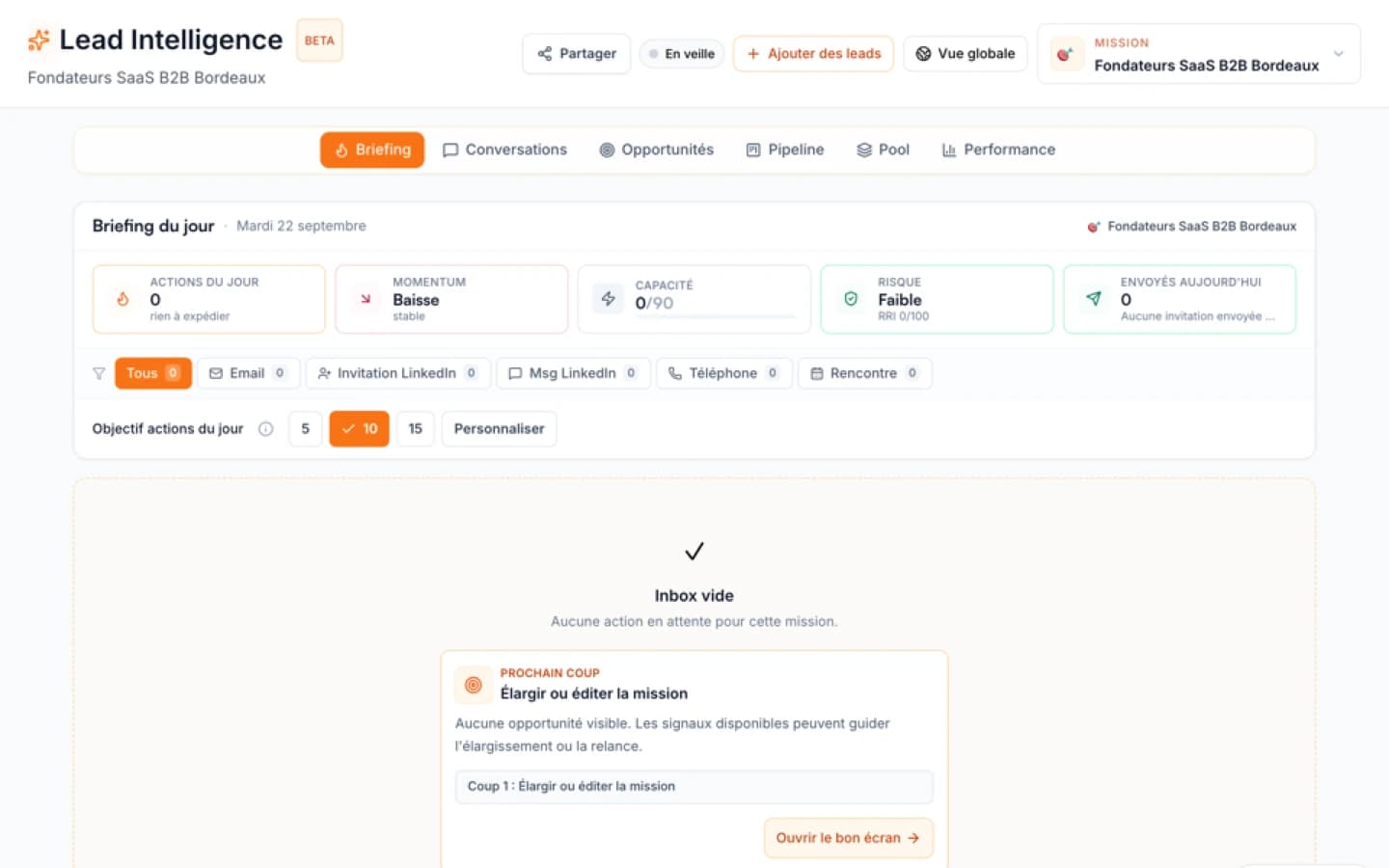
In Ember, Lead Intelligence prioritises opportunities from the available context. It classifies accounts into explained opportunities to watch, act on or set aside. It proposes the next action and channel that fit the lead situation. These capabilities support a review, but do not prove intent, consent, budget or an outcome.
Sources and methodology
External sources frame facts and limitations rather than promise a universal result. Recommendations are editorial analysis. Assumptions, unknowns and revision conditions remain visible throughout the article.
Sources
FAQ
Free diagnostic
Test your sales file
Drop an Excel or CSV and check its readiness without sending its rows to Ember.