
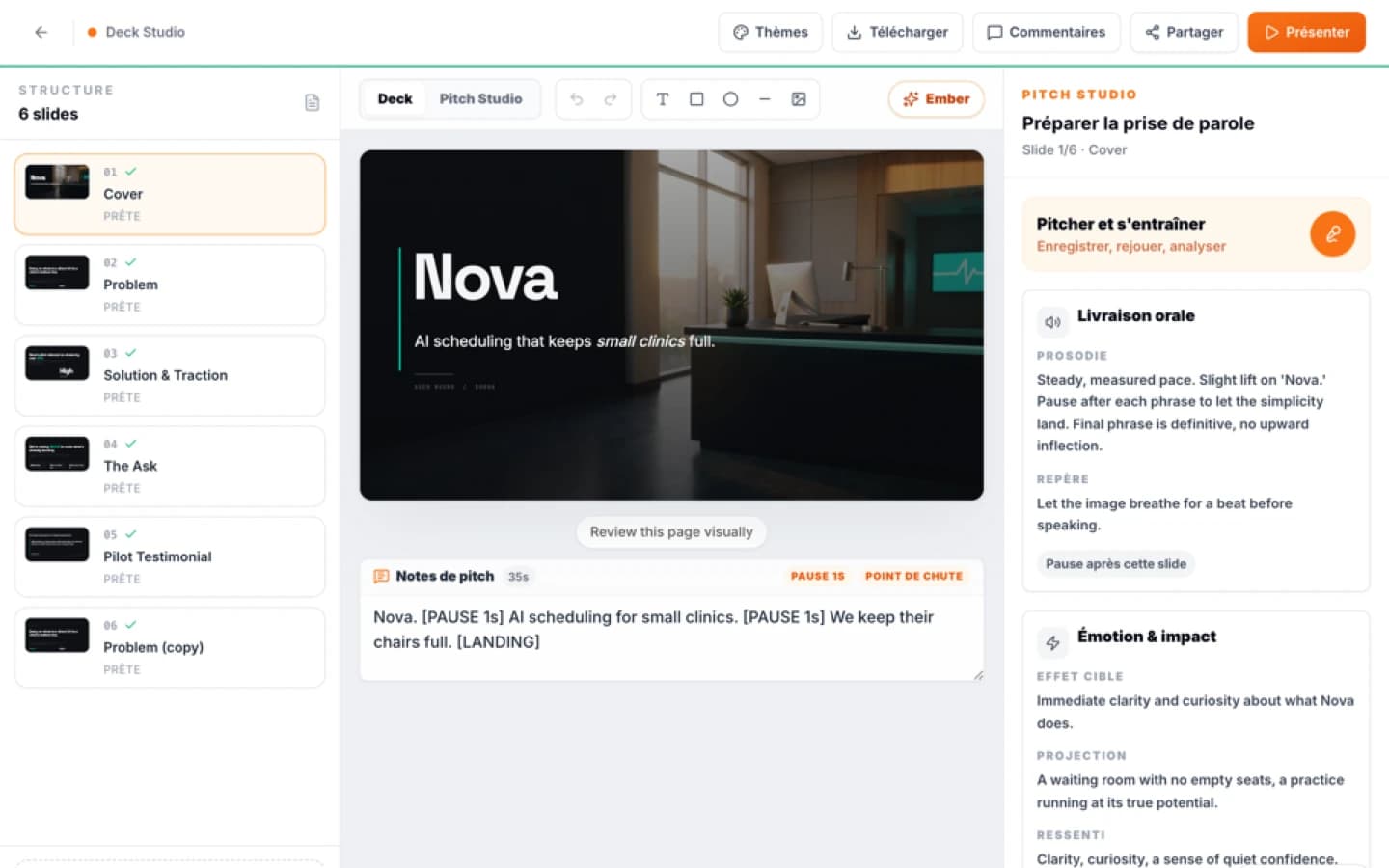
A sales pitch deck rarely wins an enterprise deal on aesthetic flair alone. Clean visuals prevent distraction, but buying committees commit budget when a proposal proves its value clearly, states its trade-offs, and withstands finance-team scrutiny. Choosing between Canva and Creation means choosing between two philosophies: a general-purpose design platform, or a presentation engine that starts from business context.
How each platform builds a pitch narrative
Structuring a commercial pitch means establishing tension between the buyer's current friction and their future state. As communication specialist Nancy Duarte notes, business storytelling demands one clear idea, a precise point of view, and the stakes of acting or failing to act. Your tooling decides whether reps sharpen that point of view or reposition text boxes.
Canva: guided drafting from design prompts
According to the official Canva Presentations documentation, Canva AI's Guided Presentations turn a text prompt into a personalized, ready-to-edit deck. The workflow follows a set sequence: pick the presentation category, set audience, style and length parameters, enter a topic prompt, review and reorder the generated outline, then edit and share.
This gives reps an immediate visual skeleton plus extensive collaboration: simultaneous editing, assigned comment tasks, and exports to PowerPoint, PDF, video or hosted websites. The reviewed page does not establish how generative features verify the figures they produce: the team remains responsible for checking every factual claim.
Creation: artifacts anchored in project context
Creation, available through the Creation workspace, starts from the project's documented context rather than an isolated design prompt. The workflow analyzes the substance and structures the narrative path before producing the chosen format, among eight: decks, one-pagers, business model canvases, market maps, LinkedIn posts, YouTube thumbnails, Open Graph images and stories.
In dense formats (one-pagers, business model canvases, market maps), Creation keeps provided facts, distinguishes estimates from known data and omits unverified identities. Each creation preserves its French or English language through edits and exports, without automatic translation of existing pages. The document stays editable page by page in the visual editor, with targeted, undoable edits.
When Canva is the stronger choice
Canva is often the most practical tool for high-volume visual communication and collateral where design flexibility outweighs data auditability:
- Diverse media formats: video embeds, audio tracks, animated transitions and website publishing directly from presentation files.
- Simultaneous multi-user design: mature real-time co-editing for designers, copywriters and account executives on the same canvas.
- All standard marketing collateral: flyers, trade-show signage, LinkedIn banners and decks inside one shared brand kit.
When the official Canva Pricing page was read on September 13, 2026, Canva Pro was listed at US$144/year for one person and Canva for Business at US$250/year per person, excluding applicable tax. Enterprise deployments require custom agreements, and intensive AI usage draws on a shared allowance whose consumption varies with the tool and task complexity.
When Creation fits decision-grade sales decks
Creation is built for high-consideration B2B cycles where the buyer's finance lead, security reviewer or technical committee dissects the presentation after the meeting:
- Narrative coherence across the deal cycle: the initial deck aligns with the one-pager left for executives, the business model canvas shared with champions and the market map explaining positioning, each format reusing the same project context.
- Reviewable metrics: in dense formats, provided facts are kept and estimates distinguished from known data, helping reps spot imprudent commitments before sending.
- Decision architecture first: as Duarte advises, test the narrative structure before the design; Creation applies that principle by structuring the path before producing the format.
To go further, How to Structure a Commercial Teaching Pitch Deck? details the framework, and How to Build a Pitch Deck Closing Commitment Slide? shows how to close on a commitment rather than a passive summary.
| Criterion | Canva | Creation |
|---|---|---|
| Primary objective | Multi-format graphic design and visual storytelling | Decision-grade business and sales artifact generation |
| Generation input | User prompt with style, audience and length parameters | Project context with narrative path analyzed before production |
| Fact handling | Text generated from prompts; the reviewed page does not specify source verification | In dense formats: provided facts kept, estimates distinguished from known data |
| Editing | Freeform canvas, animations and real-time co-editing | Page-by-page visual editor with targeted, undoable edits |
| Produced formats | Presentations, social visuals, print, documents, video | Eight formats: decks, one-pagers, BMCs, market maps, LinkedIn posts, YouTube thumbnails, OG images, stories |
| Exports | PowerPoint, PDF, video and hosted website | PDF or PowerPoint for decks; PNG for the seven other formats |
Decision framework for revenue leaders
Three operational questions settle the choice:
- Who are your presentations for? Early-funnel prospects sensitive to visual impact call for Canva's template library and media formats. Analytical buyers or purchasing committees call for Creation's narrative structure.
- Where does your data come from? Decks written on the fly benefit from Canva's guided prompts. An organization with a trusted documentary base draws more from Creation's project context.
- What role does the deck play after the meeting? A visual backdrop during the talk favors staging. A deck that then circulates as a standalone document, justifying budget to absent stakeholders, favors demonstration clarity.
If your team primarily needs fast graphic consistency across all collateral, Canva is an accessible, flexible design environment. If your goal is to prepare complex meetings with rigorous arguments for buying committees, structuring your pitches through Creation provides a clear decision framework.
Sources
FAQ
Mini audit
Test your Pitch Deck
Get an initial diagnosis of substance, form and impact.