
Signal of the week
A founder looking for first customers may be tempted to buy a larger contact list. That can produce activity without answering which company has a problem worth discussing now. Begin with one customer profile, a real problem hypothesis, a reason to contact each account and a way to record what the person actually says.
The practical question is how to distinguish a relevant opportunity from an available name. A dated company change can justify research, but it does not prove purchase intent. A reply, meeting or request for evidence is stronger because it records an action by the buyer. Keep those levels of evidence separate before adding volume.
Facts and sources
Apollo.io offers a large contact database and sales engagement tools. Database scale can help a team find people, but the number of records does not demonstrate readiness to buy. The Ember Lead Intelligence page describes context-based opportunity priority. Compare these approaches on a small sample of your own accounts, with the same definition of a useful conversation.
Ember interpretation
Lead Intelligence starts from the project context available in Ember and helps explain which accounts may deserve attention. That is useful when a small team has to choose where to spend its limited time. The person reviewing a priority still needs to read the source, understand why the event matters and decide whether contact is permitted.
A list of names and a list of supported reasons answer different questions. Neither automatically produces a customer. A team can test both by recording the account selected, the reason, the action taken and the buyer response. Use that evidence to improve the target profile rather than assuming that more contacts or faster software will solve weak positioning.
What Ember can help with
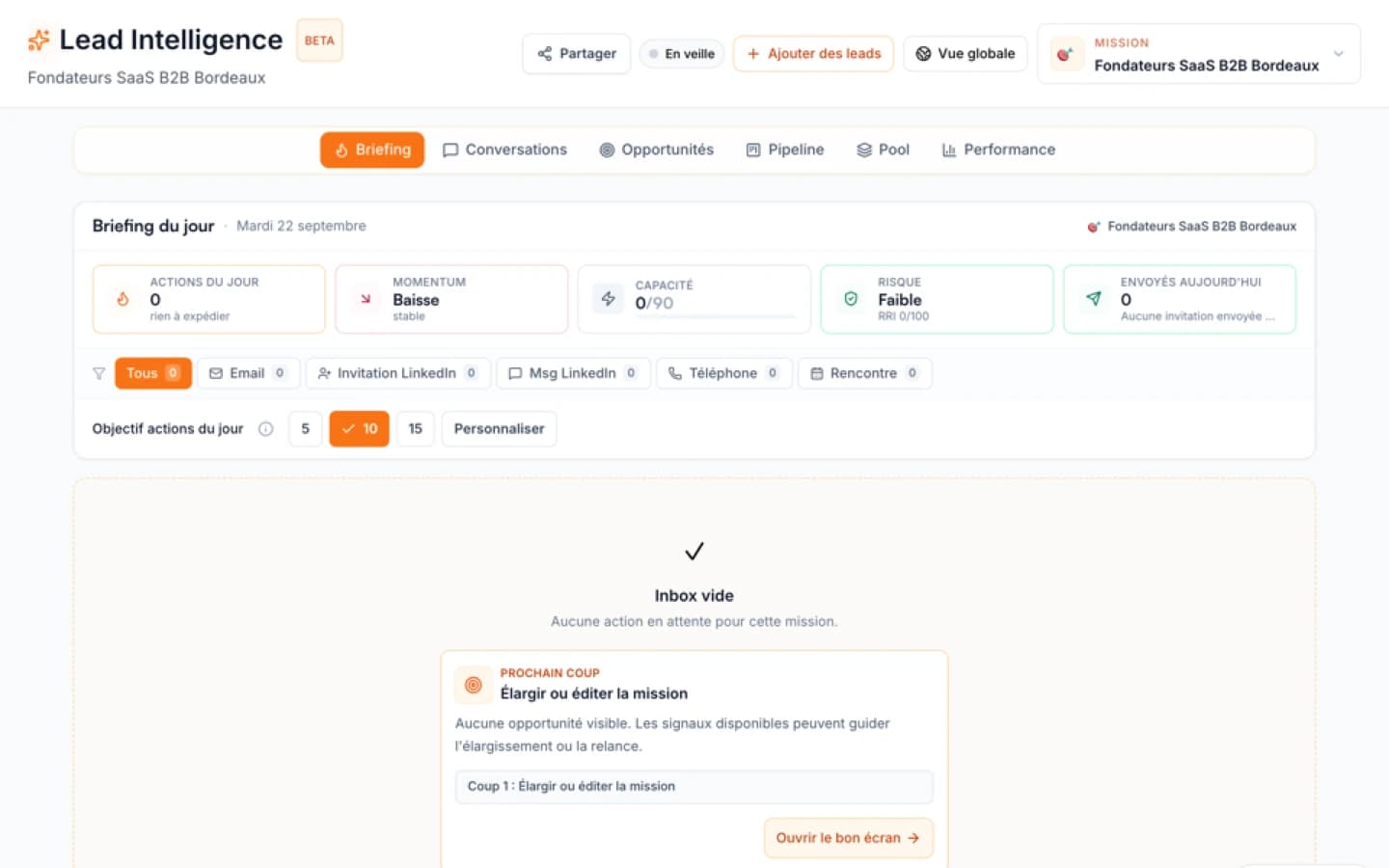
Lead Intelligence presents contextual priorities and recommended next actions source. The time required to receive useful results depends on the mission and available context. Check the actual output for your project, including the stated reason and source, before acting. Do not treat the presence of an account as evidence that it is ready to buy.
Benchmark
| Criteria | Apollo.io | Ember Lead Intelligence |
|---|---|---|
| Primary offering | Large contact database with email/phone enrichment | Context-driven prioritisation from your project data |
| Ideal for | Teams that need raw volume and broad prospecting | Teams that need a reasoned priority among a small set of accounts |
| Time to first value | Database and AI research; review actual setup and output | Depends on mission context and the usefulness of the resulting accounts |
| Minimum contacts | Check the target segment and features of the chosen plan | Check current input options and limits in the application |
| Signal detection | Data, signals and AI-assisted research, depending on plan | Automated classification: watch, act on, set aside |
| Next action | Research and outreach tools support next actions; check the plan | Tool proposes next action and channel per lead |
| Pricing | Subscription-based, often higher for premium data | Check the current plan and credit terms before any paid action |
Apollo is excellent when you need massive scale and have the team to filter manually. Ember is better when you have limited time and need to know exactly who to contact and why. For a startup sales team, the context-driven approach removes the paralysis of a blank page.
Recommendations
For sales teams that are solution-aware and comparing options, here is a decision framework.
Use Apollo when: you need a massive database for large-scale outbound, you have a dedicated sales development team to work through lists, and your ICP is broad enough that volume matters. Test the database and engagement workflow against your own sourcing needs.
Use Ember Lead Intelligence when: you are a founder or a small sales team with limited time, you need to move from zero to a prioritised list fast, and you want each lead to come with a reason and a next action. The context reuse from your business plan means you are not starting from scratch each time.
Complement with: Crunchbase News for market intelligence on competitors and funding trends. Use it to validate your ICP and spot new signals.
Practical tip: start with Ember to define your ICP and let Lead Intelligence build the first wave of prioritised accounts. If you then need to scale to hundreds of contacts, check the current import limits and review a small authorised sample before expanding. You do not have to choose one tool forever.
For the first trial, select accounts the team knows well enough to judge whether the output is relevant. Record the source of each change, the proposed contact and the reason to reach out. Review buyer replies and the human effort required before expanding.
Detailed playbook
- Set up your mission context in Ember: complete your business plan, define your ICP, and document your offer and strategy. This is the foundation.
- Launch a Lead Intelligence mission. Ember will research, discover accounts, and classify them into opportunities.
- Review the prioritised opportunities. Each account shows why it is a watch, act on, or set aside.
- Take the proposed next action for each priority lead: use the suggested channel and angle.
- Monitor signals. Lead Intelligence updates priorities as new data arrives.
- Iterate. After a few weeks, the learning loop connects executed actions, replies, and meetings to refine what works.
Sources and methodology
This brief compares the account-research role of Apollo.io with the contextual-priority role described on Ember's Lead Intelligence page. The recommended test is an editorial method, not a measured Ember result. Confirm current import and price terms in each product before a purchase decision.
Sources
FAQ
Free diagnostic
Test your sales file
Drop an Excel or CSV and check its readiness without sending its rows to Ember.