
Definition
Qualification is a decision contract, not a number
Salesforce describes qualification as gathering information about need, budget, buying authority and fit so sales can focus on promising leads (official documentation).
A team without marketing support cannot rely on an MQL handoff or an unseen scoring model. It needs a small, explicit contract that sales can apply, challenge and improve from real conversations.
Separate qualification from priority. Qualification asks whether the opportunity may responsibly enter a sales process. Priority asks which qualified or researchable opportunity deserves time first.
Prerequisites
Before starting, name the expected outcome, owner, acceptable sources and stopping condition. Keep unknowns visible. Missing data is neither negative proof nor permission to invent a conclusion.
Steps
Use known, unknown and contradicted
Apply the same three evidence states to every gate:
- Known: a current source or direct buyer statement supports the field.
- Unknown: the information is missing or ambiguous and a specific research action exists.
- Contradicted: current evidence conflicts with the accepted requirement.
Do not turn unknown into false. That shortcut systematically rejects unfamiliar markets and rewards records with more data rather than better fit.
Gate 1: account eligibility
Define the ICP boundary in observable terms: company type, operating context, problem environment, geography or delivery constraints that actually affect product fit.
Record both inclusion and exclusion rules. An account outside a hard product, legal or delivery boundary is contradicted. A missing employee count or industry label is merely unknown unless it is genuinely required.
Gate 2: current problem evidence
Capture a dated event, operating condition or direct statement that makes the problem plausible now. Separate the fact from the interpretation.
For example, a role change or product launch may justify research. It does not prove urgency, budget or dissatisfaction. The qualifying field should say what was observed and what still needs buyer confirmation.
Gate 3: credible person and buying condition
Verify that at least one person has a plausible professional relationship to the problem and an appropriate contact path. Then identify which role, authority, budget, implementation or timing question remains open.
Do not require a final decision maker before the first useful conversation. Require a credible route to learn how the decision is made.
Contact rights are part of this gate. The CNIL states that professional electronic prospecting requires information and an ability to object and must relate to the person’s profession when relying on legitimate interest (official guidance).
Gate 4: useful next decision
A qualified opportunity needs a next decision that both sides can understand. Examples include agreeing a diagnostic, reviewing a proof asset, confirming an implementation constraint or deciding whether a pilot is appropriate.
"Follow up later" is not a decision unless it includes a condition or date. A meeting without a stated outcome remains activity, not progression.
Assign one of four operational states
Pursue
The hard fit gates are known, no contradiction blocks contact and a useful next decision exists. Assign an owner and date.
Research
The account may fit, but one evidence gap can be resolved without contact or with an appropriate clarifying question. Name the gap and stop after it is answered.
Nurture
Fit and problem are plausible, but a stated timing or evidence condition blocks evaluation. Record the return condition rather than a generic reminder sequence.
Disqualify
A hard fit, rights, need or delivery requirement is contradicted. Preserve the reason and source so the team can calibrate later.
Use a compact qualification record
For each lead, retain:
- account boundary evidence;
- problem fact and interpretation;
- person relevance and source;
- open buying condition;
- rights or objection status;
- next decision, owner and date;
- operational state and reason;
- correction history.
Do not hide these fields behind one score. The reviewer must see which gate drives the state.
Calibrate weekly from decisions, not outcomes alone
Review a small set of pursued, researched, nurtured and disqualified records. Ask:
- Did another seller reproduce the state from the evidence?
- Which unknowns were cheap or expensive to resolve?
- Which contradictions predicted a real stop?
- Which accepted records later exposed a missing hard gate?
- Which group or source was systematically under-documented?
Change one rule at a time and version it. Do not rewrite the framework to explain one lost deal.
Worked example
Example: the team reviews a record whose context changed. It retains the fact and source, marks the interpretation as an assumption, chooses one next action and sets the condition that will continue, correct or stop the work.
Common mistakes
Common mistakes include confusing activity with progression, turning an unknown into certainty, changing several variables in one test and postponing an action without revisiting its reason. Each mistake should leave a visible correction.
Tools
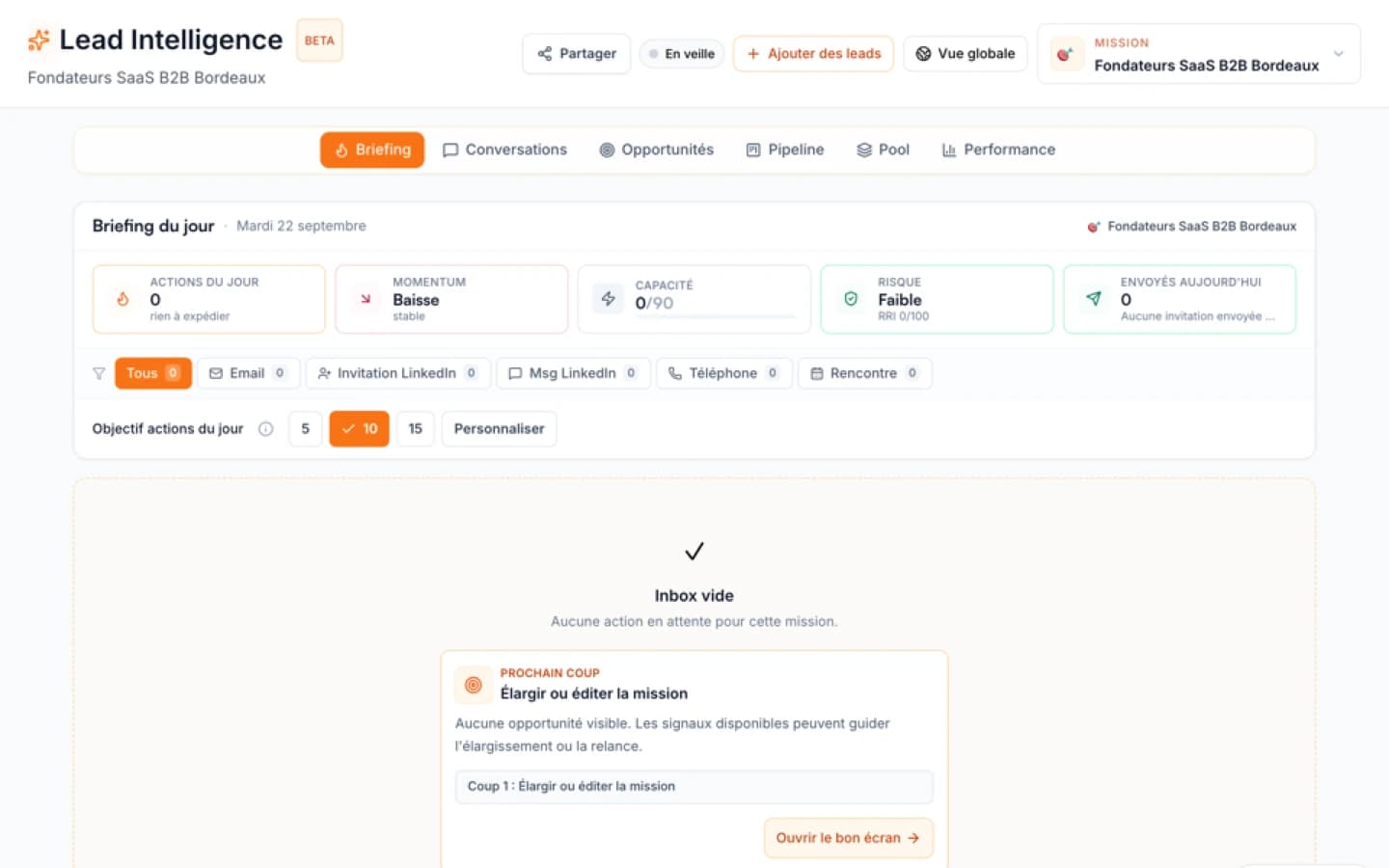
In Ember, Lead Intelligence prioritises opportunities from the available context. It classifies accounts into explained opportunities to watch, act on or set aside. It proposes the next action and channel that fit the lead situation. These capabilities support the method but do not prove buyer intent, consent, budget or an outcome.
Where Lead Intelligence fits
It cannot confirm need, authority, budget, consent or a next decision without human evidence. Any generated priority must remain subordinate to the qualification contract and the underlying sources.
When to use this method
Use this method when several options appear plausible, evidence is scattered or the team must explain why one action comes before another. It is most useful for decisions that can be reviewed against an observable result.
When not to use it
Limits
No framework eliminates seller judgement or buyer uncertainty. The right hard gates depend on product, contract, regulation, geography and delivery model. A qualified lead can still decline or lose priority.
Action plan
Start with a small set of records. Apply the same decision contract, record exceptions and review outcomes on the chosen date. Keep what remains reproducible, change one rule at a time and explicitly close actions that no longer produce useful learning.
Sources and methodology
External sources are listed with their URLs to separate published facts from editorial recommendations. They frame the method rather than promise a universal outcome. Assumptions and limitations remain identified in the article.
- Salesforce Finding and Qualifying Leads documentation
- CNIL guidance on commercial prospecting by email (in French, page dated June 2026)
Sources
FAQ
Free diagnostic
Test your sales file
Drop an Excel or CSV and check its readiness without sending its rows to Ember.