
Choosing Between an Embedded CRM Agent and a Configurable Research Engine
B2B sales teams evaluating modern outbound intelligence face a fundamental architectural choice: should you deploy a turnkey prospecting agent embedded directly inside your customer relationship management (CRM) platform, or build modular, multi-provider enrichment workflows in an external spreadsheet engine?
HubSpot approaches outbound by embedding an autonomous worker inside its core database through the Breeze Prospecting Agent, aiming to minimize setup friction and automate account qualification. Clay, on the other hand, relies on Claygent, its artificial intelligence web research agent, alongside waterfall enrichment providers to give operations teams granular control over data sourcing and scoring logic.
Understanding the operational tradeoffs between these two philosophies determines whether your revenue team gains a predictable prospecting engine or inherits unnecessary workflow complexity.
HubSpot Breeze Prospecting Agent: Packaged Buying Signals at a Predictable Unit Cost
For organizations already centered on HubSpot for their commercial records, the primary advantage of the Breeze Prospecting Agent is native cohesion. According to HubSpot's Fall 2026 Spotlight, the Breeze Assistant takes direct action based on sales instructions and pulls in the Prospecting Agent to monitor over 40 buying signals, assemble buying groups, and draft personalized outreach. HubSpot also announced in the same launch that it is the first CRM to integrate with ChatGPT Ads HubSpot announcement.
The commercial model for the agent is structured around unit consumption rather than seats. As stated on the HubSpot AI Prospecting Agent page, the tool is priced at $1 per lead for each prospect where the agent recommends outreach. This pricing model runs on HubSpot Credits across the Starter, Professional, and Enterprise editions of HubSpot, with some subscriptions including monthly allotments while additional credits can be purchased as needed HubSpot pricing.
To support account identification, the agent integrates with external data suppliers including ZoomInfo, Apollo, Surfe, and Seamless to build out buying committees HubSpot feature documentation. When contacts are identified, users retain the option to review and edit AI drafted emails before any message is sent HubSpot feature documentation.
This packaging works well for sales teams that want automated signal tracking such as funding rounds, leadership changes, or website visits without having to configure custom scraper logic or maintain complex application programming interface (API) keys.
Clay and Claygent: Open Web Research and Multi-Provider Orchestration
Clay takes the opposite architectural stance. Instead of locking prospecting into a fixed CRM agent, it acts as an orchestration canvas that combines dozens of enrichment providers with custom web agents.
At the center of Clay's custom research layer is Claygent, Clay's AI agent with access to live web research, which is included across all plans including the free tier according to the Clay pricing page.
Rather than relying on pre-packaged buying signal definitions, Clay allows revenue operations teams to ask open-ended questions across the web. For example, a team can instruct Claygent to visit company job boards to verify specific software usage, scan press releases for regional expansion plans, or confirm whether a company has a dedicated compliance officer.
This flexibility makes Clay well suited for teams running sophisticated go-to-market (GTM) motions that require cascading data logic. A user can query one vendor for corporate domain verification, waterfall to another provider for mobile phone numbers, and use Claygent to synthesize recent executive quotes before exporting the qualified record into a sequencing tool or CRM.
Feature and Workflow Comparison
The table below outlines how these two platforms compare across key operational dimensions.
| Operational Dimension | HubSpot Breeze Prospecting Agent | Clay with Claygent |
|---|---|---|
| Primary Operating Model | Native CRM agent executing prospecting plays | Data orchestration grid combining APIs and web scraping |
| Core AI Agent | Prospecting Agent triggered via Breeze Assistant | Claygent web research agent |
| Signal Detection | Predefined tracking across 40 plus buying signals | Custom prompting across live public websites |
| Pricing Architecture | One dollar per recommended outreach lead via credits | Tiered software subscriptions with credit consumption |
| Outbound Review Flow | Reps review and edit generated draft messages in CRM | Enriched data mapped to external sequences or CRM fields |
| Data Provider Strategy | Native connections to ZoomInfo Apollo Surfe Seamless | Waterfall provider integrations across dozens of data sources |
Where Each Architecture Hits Its Operational Ceiling
HubSpot's model is convenient, but it introduces specific constraints. While paying $1 per recommended lead offers clear unit economics, that cost applies whenever the agent recommends outreach HubSpot AI Prospecting Agent page. If an organization targets accounts requiring nuanced qualification that cannot be captured by standard signals, paying per recommendation can accumulate without producing pipeline. Furthermore, teams whose workflows require custom scraping logic or niche regional data sources may find pre-configured committee assembly restrictive.
Conversely, Clay requires substantial operational expertise. Building custom waterfalls, tuning prompts for web research agents, and troubleshooting data delivery can quickly turn into a full-time revenue operations role. For lean sales teams without dedicated operations support, maintaining spreadsheet formulas and prompt templates often distracts from actual buyer engagement. When outbound infrastructure becomes too complex, deliverability hygiene can suffer; teams looking to safeguard their sending domains can review Google Bulk Sender Rules: Personal Gmail vs Workspace to maintain technical compliance.
Deciding on Your Outbound Engine
Selecting the right solution depends on your team structure, technical bandwidth, and target market dynamics:
-
Choose HubSpot Breeze Prospecting Agent if your sales representatives already spend their day inside HubSpot, your addressable market responds well to conventional triggers like leadership changes and funding rounds, and you prefer an out-of-the-box system that requires no custom integration maintenance.
-
Choose Clay with Claygent if you have a dedicated operations specialist, your ideal customer profile requires hard-to-find qualitative data points that off-the-shelf databases miss, and you require multi-vendor waterfall enrichment to maximize contact accuracy.
-
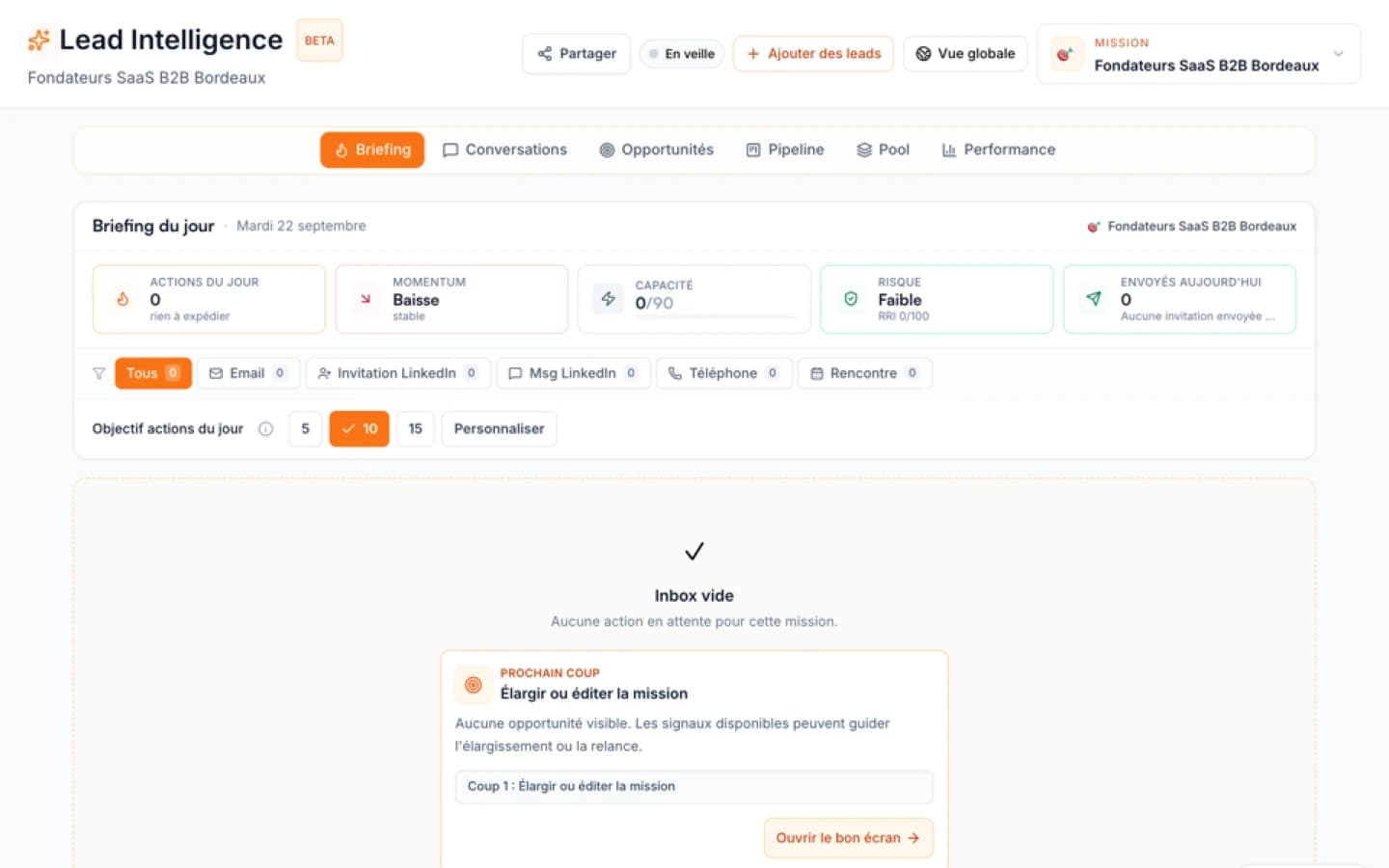
Consider contextual intelligence when timing matters more than database volume. For commercial teams that want actionable outreach angles derived directly from strategic positioning rather than managing sprawling data grids, Ember offers Lead Intelligence. Rather than acting as a simple list broker, Lead Intelligence prioritizes who to contact and why right now, allowing sales teams to import existing lists in batches of up to 3,500 rows, review qualified candidates in an enrichment pool, and keep outbound execution strictly under human review before messages are sent. Additional strategies for structuring prospecting conversations can be explored in the Knowledge guides for sales.
Sources
- HubSpot, Fall 2026 Spotlight (16 septembre 2026) : assistant Breeze, agent de prospection sur plus de 40 signaux d'achat et publicités dans ChatGPT : source S1
- HubSpot, agent de prospection : 1 dollar par lead pour lequel l'agent recommande un contact, signaux d'achat et comité d'achat : source S1
- Clay: Claygent AI research agent
- Page publique Lead Intelligence : reçu S8
- Page juridique données prospects : reçu S9
FAQ
Free diagnostic
Analyse your HubSpot data
Measure whether HubSpot contacts contain enough context for sales action.