
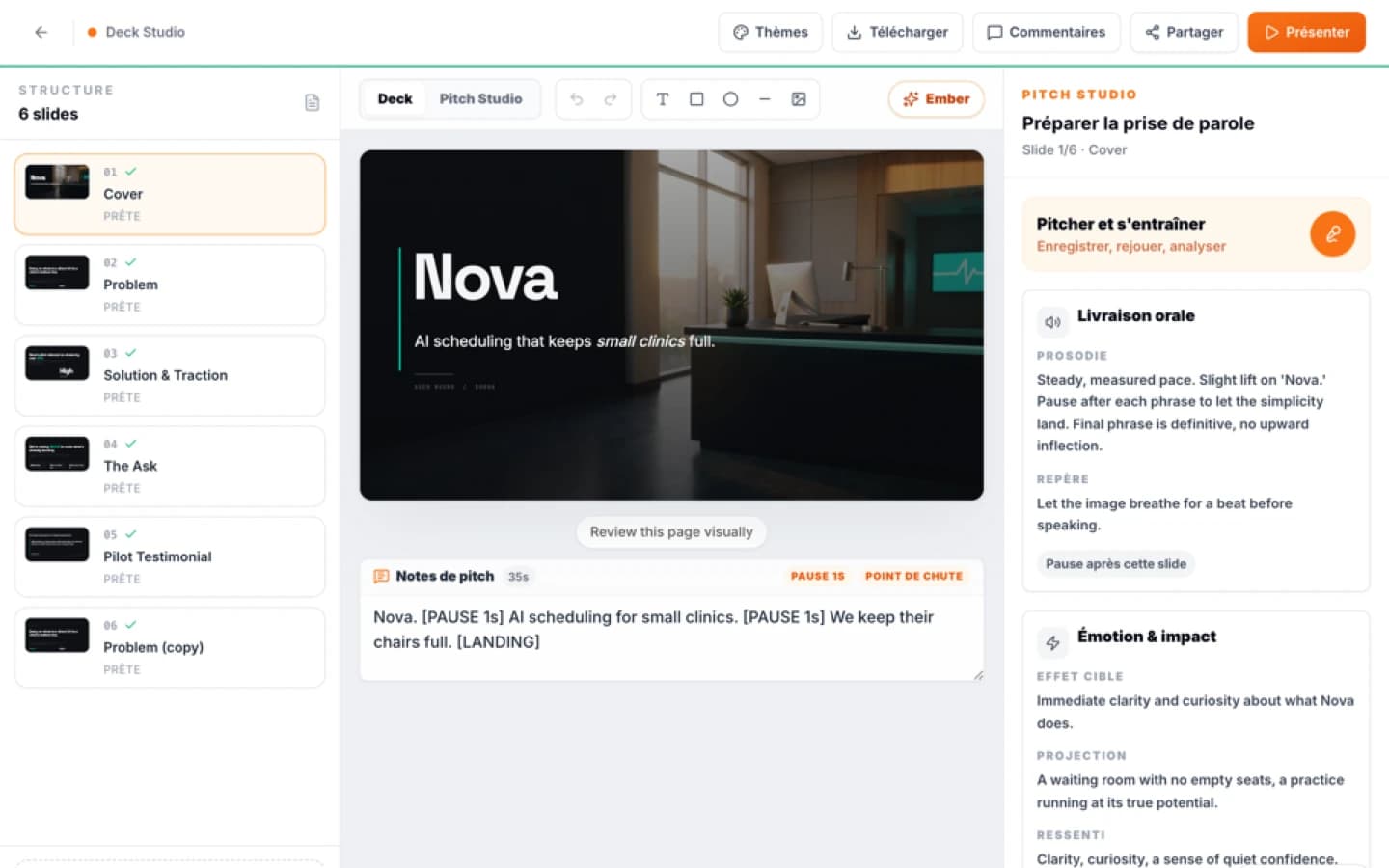
| Criterion | Gamma | Ember (Creation) |
|---|---|---|
| Starting point | Three creation modes: generate from a topic, paste text to format, or import a file or web page | Asks scoping questions based on the project context, offers templates with a preview and asks for confirmation before creating |
| Oral rehearsal | Present mode with presenter view, private speaker notes and a timer; recording and analysis of a take not documented on the help pages read on 09/29/2026 | Speaking practice: record, replay and rehearse a deck, with an analysis of pace, clarity, impact and structure (take of up to 15 minutes) |
| Templates and style | Custom themes (colors, fonts, logo) saved to the workspace; extraction from an imported PowerPoint file | Templates with a preview; images from the Library can guide the visual style |
| Exports | PDF, PNG and PowerPoint (PPTX); watermark on free-plan exports, removed with a paid plan; no Word (.docx) format | Deck: PDF or PowerPoint (.pptx); the other seven formats: PNG |
| Sharing | Share link and workspaces; access levels No access, View, Comment or Edit | A deck can be shared with an Ember user or team, read-only or editable, with comments anchored to slide objects |
| Generation size | Initial generation capped at 50,000 tokens on the free plan and 100,000 on Plus and Pro | Deck page count can be set (Auto, 5, 8, 10, 12, 15 or 20); each format keeps its own length limits |
Why look for an alternative
An early-stage founder preparing a pitch is not trying to produce a nice looking deck. The real job is to make an investor or a customer understand the project, believe in it, and act, which means every slide has to carry the reasoning, not just the layout. That is where a tool built around fast AI generation can start to work against the founder's goal.
Gamma structures its output around cards, described as the fundamental building blocks of a presentation, each acting like a flexible slide, section, or canvas source. That flexibility is useful for assembling content quickly, but it says nothing about whether the resulting narrative actually moves a decision forward, which is the founder's real constraint under time pressure before a fundraising meeting.
The free plan adds friction at the worst moment. New free users get 400 credits that do not refresh once used source, and free accounts cannot purchase more, since additional credits are sold in blocks of 1,500 for 6 US dollars and reserved for paying users source. A founder iterating on a pitch the night before a meeting can hit that wall exactly when refining the argument matters most.
There is also a credibility cost. Presentations exported from a free account carry a "Made with Gamma" watermark, removed only once the founder subscribes to a paid plan source. Sending a watermarked deck to an investor is a small but real signal, at the exact moment the founder wants full attention on the story, not on the tool used to build it. Once credits, plan tiers, and export polish start competing with the actual argument, it is fair to ask whether the deck is being built around the pitch, or the pitch around the deck's limits.
To place this decision in context, the Knowledge guides for marketing brings together deeper guidance on the same field.
Decision criteria
The real decision is not "which tool builds slides faster" but "which tool gets the founder to a deck an investor will act on." A few concrete checks help settle that, and they line up with facts you can verify before switching.
First, look at how the tool treats a first draft. Gamma organizes every presentation, document or webpage into cards, described as flexible building blocks that can act as a slide, a section or a canvas source. That flexibility is genuinely useful for quick internal documents or one off content, but a founder pitching for funding needs to check whether those cards carry an actual argument in sequence, or whether the narrative logic still has to be built by hand afterward.
Second, check the generation ceiling against the size of the story you need to tell. Gamma caps an initial generation at up to 50,000 AI tokens on some plans and up to 100,000 on others source. For a short teaser deck that is plenty; for a data heavy fundraising narrative with market sizing, unit economics and a multi year plan, it is worth confirming the ceiling still fits in one pass before committing time to a structure.
Third, price the real cost of iterating, not just the first export. New Gamma users start with 400 credits that do not refresh once used source, additional credits are sold in fixed increments of 1,500 for six dollars source, and the watermark that appears on free exports is only removed once you move to a paid plan source. Gamma's plans run from Free through Plus, Pro, Ultra, Teams and Business source. None of that makes Gamma a bad choice for a fast, low stakes draft, but a founder who expects to revise a pitch deck many times before a raise should map that revision cost against the plan tier before assuming the free tier will carry the whole process.
Fourth, and probably the sharpest test: what happens after the deck exists. The number of independent guides comparing Gamma to alternatives, one aimed at presentation building generally source and one aimed specifically at sales teams source, is itself a sign that plenty of buyers reach the export button and still feel the job is not finished. Creation treats that moment as the actual starting point: it analyzes the substance of the project and structures the narrative path before it ever produces a slide, so the story an investor needs to follow exists before the layout does. Founders can still edit in natural language once slides are generated, export to PowerPoint or PDF, and then record and rehearse the pitch, with feedback on rhythm, clarity, impact and structure from the recorded take. That is a qualitative difference in what the tool is optimizing for: helping the presentation build understanding and move a decision forward, not only produce a polished look.
If your real bottleneck is turning a rough idea into a shareable draft fast, Gamma's speed and card based flexibility are a reasonable fit and admitting that is only fair. If your bottleneck is walking into a room and having the deck itself carry the reasoning that gets a yes, the criteria above point toward a tool built around narrative and rehearsal, not around generation speed alone.
Quick decision table
If you need to decide quickly, the practical test is not which tool looks slicker on a first export, it is what happens after the free credits run out and what the deck actually does for the person reading it.
Gamma's free plan gives each new account 400 credits at signup, and those credits do not refresh once used source. When you need more, Gamma sells them in fixed increments of 1,500 credits for six dollars, and free users cannot buy credits at all source. Gamma also spans several paid tiers beyond the free plan, from Plus and Pro up to Ultra, Teams and Business source, and a presentation exported from a free account carries a visible "Made with Gamma" watermark that only disappears once you are on a paid plan source. Structurally, Gamma builds every presentation, document or webpage from cards, its flexible unit that acts like a slide, a section or a canvas source, and each initial generation draws on a token allowance that ranges up to 50,000 or, on higher tiers, up to 100,000 AI tokens source. For a founder who mainly needs a clean, fast deck for an internal update or a quick share, that card based, credit metered model is genuinely good enough, and switching tools just to avoid a watermark rarely changes whether an investor says yes.
The decision changes once the goal shifts from producing slides to moving a specific person to a decision. Creation starts from the substance of the project and works on the reasoning, the audience's mental journey, the structure, the design and the intended impact together, so the presentation is meant to help someone understand, believe and act rather than just look finished. Once the structure and slides exist, Creation keeps every element editable, lets a founder request changes in natural language from inside the editor, exports to PowerPoint or PDF, and, through Speaking practice, lets the founder record a rehearsal, analyse rhythm, clarity, impact and structure in that recorded take, then replay it before the real meeting.
So the quick call is this. If the job is "get slides out fast, watermark aside," Gamma's credit based, card driven system is enough and you should not overthink it. If the job is "walk into a room and have the deck actually carry the argument, then rehearse how it lands," that is the case Creation is built for, and it is worth testing on your next real pitch rather than your next internal slide.
To explore this point further, Creation Use Cases for Founders Launching a New Offer details a step directly related to this decision.
Neutral presentation of the competitor
Gamma is a presentation tool built around fast AI generation, positioned as a way to turn a prompt or outline into a structured deck. Rather than traditional slides, Gamma organizes content into what it calls cards, a flexible slide, section or canvas format that automatically adjusts to the amount of content placed in it source. This card based structure is the core mechanic founders will notice first when they generate a draft.
Gamma runs on a credit system that powers every AI action across the product, meaning generating a deck, rewriting a card or producing new content all draw from the same credit pool regardless of plan source. The free tier grants 400 credits at signup as a one time allocation that never refreshes, so those credits are meant to be spent once rather than relied on ongoing source. Paid plans work differently: credits refill every month, with unused credits allowed to roll over up to double the plan's monthly size source. Gamma structures its offer across six plans spanning individual and team use, from Free through Plus, Pro, Ultra, Teams and Business source, with monthly AI credit allowances of 1,000 on Plus, 4,000 on Pro and 20,000 on Ultra source. Founders who exhaust their allotment can buy more, but only as a paid subscriber, at a rate of 1,500 credits for six United States dollars in fixed increments source.
Two practical limits matter for a founder testing the tool before a fundraising conversation. First, exports on the free plan carry a visible "Made with Gamma" watermark, which is only removed once the account moves to a paid plan source. Second, the initial AI generation itself is capped by an input token limit that scales with the plan, up to 50,000 tokens (a token is the small unit of text an AI model processes) on Free and up to 100,000 tokens on Plus or Pro for a single first generation source. For a founder trying to load a full narrative, financials context or dense investor content into one first draft, that ceiling shapes how much substance can go in before the tool starts trimming or requires a second pass.
Neutral presentation of Ember
Ember approaches the same problem from a different angle. Creation, its presentation product, starts from the premise that a deck's job is to help someone understand a project, believe in it, and act, not simply look polished. Ember describes this directly: Creation helps the presentation build understanding and move a decision forward, beyond visual polish alone (source).
For an early-stage founder, that shows up as a working sequence rather than a single generation step. Creation first works through the substance and the narrative path an audience needs to follow, then produces slides from that structure, and keeps every element editable so the founder stays in control of what changes. Once a first version exists, changes can be requested in plain language directly inside the editor, and the finished deck can be exported to PowerPoint or PDF for sharing outside Ember.
Creation also extends past the slide itself. Inside Speaking practice, a founder can record a rehearsal, replay it, and get the take analysed for rhythm, clarity, impact and structure, which is useful preparation before an investor or client meeting rather than after one. The product is built primarily for founders, with business teams also using it, and it assumes the founder reviews and approves what Ember proposes rather than shipping a deck untouched.
This approach also connects with How B2B Sales Teams Use Content as a Pre-Call Trust Tool?, which clarifies the next choice.
Approach comparison
Gamma's approach centers on speed: turn a prompt or outline into a structured deck built from cards, described as flexible slides, sections or canvases that adjust automatically to the amount of content placed in them source. The method relies on artificial intelligence (AI) generation, and Gamma itself is described as a web based platform that uses AI to generate presentations, documents, webpages and other visual content source. For a founder who needs a presentable draft fast, that speed is genuinely useful, and Gamma's approach is good enough when the goal is a clean first pass rather than a persuasion instrument built around a specific decision.
Where the two approaches diverge is what happens after that first draft. Gamma's generation runs on a token budget, up to 50,000 AI tokens on the initial generation for lower tiers and up to 100,000 for higher tiers source, which shapes how much reasoning the tool applies to a deck in a single pass before the user takes over manually. Creation starts from a different premise: a deck's job is to help someone understand a project, believe in it, and act, not just look finished. In practice that means the product works through structure, the audience's likely questions, and impact before it produces slides, and it asks the useful questions, then asks for confirmation before creating.
That difference shows up again at the editing stage. Gamma's cards can be rearranged and edited after generation, which suits a founder who mainly needs to reorganize content quickly. Creation keeps the founder inside the same reasoning thread throughout: requests to change wording, order or emphasis happen in natural language, but they stay connected to the narrative path chosen at the start, so a late edit does not quietly break the argument the deck was built to make.
For a founder whose real metric is whether an investor or a customer says yes afterward, the honest comparison is not which tool produces a deck faster. It is whether the tool forces you to clarify the argument before you show it, or leaves that work for you to do after the slides already exist.
When the competitor is the better fit
If the goal is a fast internal draft rather than a polished investor narrative, Gamma's free plan can carry that job. A new account starts with 400 credits that do not refresh once spent source, which is enough allowance to generate a rough concept deck and react to it with a cofounder before deciding whether the story is worth refining further. The free tier also supports an initial AI generation up to 50,000 input tokens, rising to 100,000 tokens on the Plus and Pro plans source, which comfortably covers a short outline or a first pass at a pitch narrative. The tradeoff is visible rather than hidden: free exports carry a Made with Gamma watermark, and only a paid plan removes it source. For a document that never leaves the founding team, that watermark costs nothing. For a deck that will sit in an investor's inbox or get forwarded to a partner, it becomes a signal worth avoiding, and that is the moment the decision changes.
Founders who already know their narrative, who have validated the story internally and just need speed to structure cards into a shareable format, are well served by Gamma's card based approach rather than a heavier alternative. The honest line to draw is about what the deck needs to do next. A deck meant to be reacted to, argued over, or used as a working sketch does not need conviction engineering, it needs to exist quickly. A deck meant to change a stranger's mind, an investor, a first enterprise client, a hire deciding whether to join, is a different job, and that is where a faster tool alone stops being the right answer.
When Ember is the better fit
Ember fits when the founder's real problem is not the slide surface but the argument underneath it. Creation's job is to help the presentation build understanding and move a decision forward, beyond visual polish, which is exactly the moment a founder needs when they are trying to convert a skeptical investor or a hesitant early customer, not just circulate a tidy internal update.
That distinction matters most for a founder optimizing conversion rate, since a deck that reads well but does not carry a clear narrative path tends to generate polite interest rather than a yes. Ember works from the project's own context and data rather than a generic outline, so the structure a founder ends up with is tied to what they actually need to prove, not a template chosen for its aesthetic.
There is also a practical reliability angle worth naming plainly. Creation keeps generating after a connection loss or a closed tab, then resumes progress when the founder returns, which matters for anyone building a deck across a distracted day between calls and fundraising admin.
Choose Ember when the deck has to carry weight in a specific room: a term sheet conversation, a board update where the ask is real, a sales pitch where the buyer needs to believe before they act. Choose Gamma when the ask is smaller: an internal alignment doc, a quick recap, something meant to look clean and move fast rather than argue a case. Founders who already know their narrative and just need speed will find Gamma good enough for that job. Founders who are still shaping the argument itself, and whose conversion rate depends on the room actually being convinced, are the ones Creation is built for.
In practice, What Does the Perfect B2B Sales Pitch Actually Look Like? completes this framework with another angle on the same topic.
Limits
Both tools have real limits worth naming before choosing one.
On the Gamma side, the free plan carries a visible constraint: presentations exported from a free account keep the "Made with Gamma" watermark, and that mark only disappears once the user moves to a paid plan source. Credits are also a hard ceiling rather than a renewing allowance: the 400 credits given at signup do not refresh once spent source, and a founder who runs out cannot simply keep working for free, since Gamma states that free users cannot purchase additional credits and paid credits are sold in fixed blocks of 1,500 for six dollars source. Generation depth is capped too: Gamma documents up to 50,000 AI tokens per initial generation on some tiers and up to 100,000 on others source, which matters for a founder trying to fit a dense, evidence heavy narrative into one pass rather than several patched generations.
Creation has its own limit worth stating plainly: it is built to turn the substance already gathered on a project into a structured, editable presentation, not to invent that substance from nothing. A founder who has not yet clarified the argument they want the audience to believe will still need to do that thinking, whether inside Ember or elsewhere, before any tool, Gamma included, can turn it into a deck that actually moves a decision. The practical question is less "which tool generates slides faster" and more "which tool is honest about how much of the thinking is still mine to do."
Contextual recommendation
For an early-stage founder trying to raise conversion on a pitch, the decision usually comes down to what stage of the story you are in, not which tool looks more polished. Gamma organizes a presentation into cards, each acting like a flexible slide, section, or canvas that resizes to the content placed inside it source, which makes it genuinely fast for turning a rough idea into a shareable draft. If the next meeting is an internal sync or a quick concept check, that speed is the right tool for the job and there is no reason to overbuild the moment.
The calculation changes once the deck has to carry an investor decision. Gamma's own plan structure, moving from Free through Plus, Pro, Ultra, Teams and Business source, and its token allowance of up to 50,000 or 100,000 AI tokens per initial generation depending on plan source, point to a tool built around producing more content quickly rather than pressure testing whether that content will convince a specific investor. That is a fair tradeoff for a founder who mainly needs volume and iteration speed, but it leaves the reasoning work, why this narrative order, why this evidence, why this ask, on the founder's shoulders.
Creation starts from the opposite end of that same job. Its stated purpose is to help the presentation build understanding and move a decision forward, beyond visual polish source, which matters specifically when the goal is conversion rather than distribution. Concretely, this means the structure and slides come from the project's own substance, the founder keeps every element editable rather than accepting a locked template, and the deck can be rehearsed and analyzed for rhythm, clarity and impact before it reaches the room. That rehearsal step is the piece a founder optimizing for conversion cannot skip: a deck that reads well is not the same as a delivery that lands well in front of a skeptical investor.
A practical way to decide: if the presentation only needs to exist and circulate, Gamma's free tier and card based workflow will likely do the job, watermark aside. If the presentation needs to change someone's mind on a specific ask, and the founder wants to test and refine how the argument actually lands before the real pitch, that is the case Creation was built to serve.
Before deciding, What to Verify Before Choosing Creation as a Founder? helps connect this method with adjacent priorities.
Sources and updates
This comparison leans on Gamma's own documentation wherever a factual claim about Gamma appears, rather than on secondhand summaries. The credit system, the paid plan structure, the free plan watermark, the card based editor, and the token allowance behind each generation are all described directly from Gamma's help center and developer pages, and each of those points carries its exact source link in the sentence that states it, as shown earlier in this comparison. Gamma's positioning as a tool where founders create by prompting, pasting text, or uploading files comes from its public reference entry rather than from marketing copy, which keeps that description conservative and checkable source. Two industry roundups were also consulted to understand how other buyers frame the Gamma alternatives question, one focused on sales tooling and one focused on presentation builders for regulated industries, and both are cited so a reader can judge their angle for themselves source source. Neither roundup is treated as a substitute for Gamma's own documentation. Pricing pages, credit systems, and plan names change over time on any software product, Gamma included. A founder deciding between Creation and Gamma right before a fundraising round should check Gamma's current pricing and credit terms directly on the linked help center pages rather than relying on any comparison, including this one, as a final source of truth.
Sources
FAQ
Mini audit
Test your Pitch Deck
Get an initial diagnosis of substance, form and impact.