
A lender who does not want your equity
A business angel or a fund becomes a shareholder: it looks at growth potential. A bank or an honor loan network lends: it looks at your ability to repay and the solidity of the project. The deck is therefore not the same. For a deck aimed at an equity investor, see What to show a business angel in a B2B deck?. To compare instruments (grants, debt, equity), read Financing your startup between grants, debt and equity.
What a banker reads
The Bpifrance Creation page How to finance your business creation project, read on September 29, 2026 (in French), says a good assessment of needs makes it possible to fund essential investments properly and to anticipate initial cash needs. Equity generally represents about 30% of financial needs to access bank credit. A banker looks for a well-prepared, coherent project carried by motivated founders; an unbalanced financing plan and few convincing elements about the market do not offer the necessary guarantees. The page adds that it is entirely possible to combine several financings.
What an honor loan committee judges
According to the Bpifrance Creation page on the honor loan (prêt d'honneur), it is a loan granted to the person and not to the company, at zero interest and without guarantee or personal surety. Two main national networks, Initiative France and Réseau Entreprendre, review applications in committees that include business owners and bankers. The candidate presents a solid business plan with convincing elements and defends the project before the approval committee. The amounts cited range from 3,000 to 50,000 euros for Initiative France (10,000 on average) and from 15,000 to 50,000 euros for Réseau Entreprendre (29,000 on average). The page also says that for each euro of honor loan, banks grant on average 9.5 euros (Initiative France) or 13 euros (Réseau Entreprendre) of additional financing. Initiative France describes this loan as a way to strengthen the personal contribution and equity of the business.
| Slide | What the lender looks for | How to handle it |
|---|---|---|
| The need | A justified amount, line by line | Figures from the financing plan, with the date and source of each quote |
| Use of funds | What the money buys, in what order | Use-and-timing table, not mixed with growth ambitions |
| Resources | Personal contribution, other loans, plan balance | Resources and needs on the same page; the balance must be readable at a glance |
| Assumptions | Traceable sales and margin assumptions | Each assumption with its source or marked as an assumption |
| The founder | Ability to carry the project | Background relevant to the project, no filler |
Gamma or Creation to prepare this file
Gamma exports to PDF, PowerPoint or PNG, and suits you well if your figures and text are already written and you want a clean layout quickly. Creation starts from your brief and files to produce a deck or a one-pager, exportable to PDF or PowerPoint. The figures you supply stay exact; an estimable unknown can be presented as an explicitly marked assumption; unknown identities or contact details are omitted rather than invented. That helps separate facts from assumptions, which matters in front of a committee. Check every figure in the result: Creation certifies neither your accounts nor your financing plan.
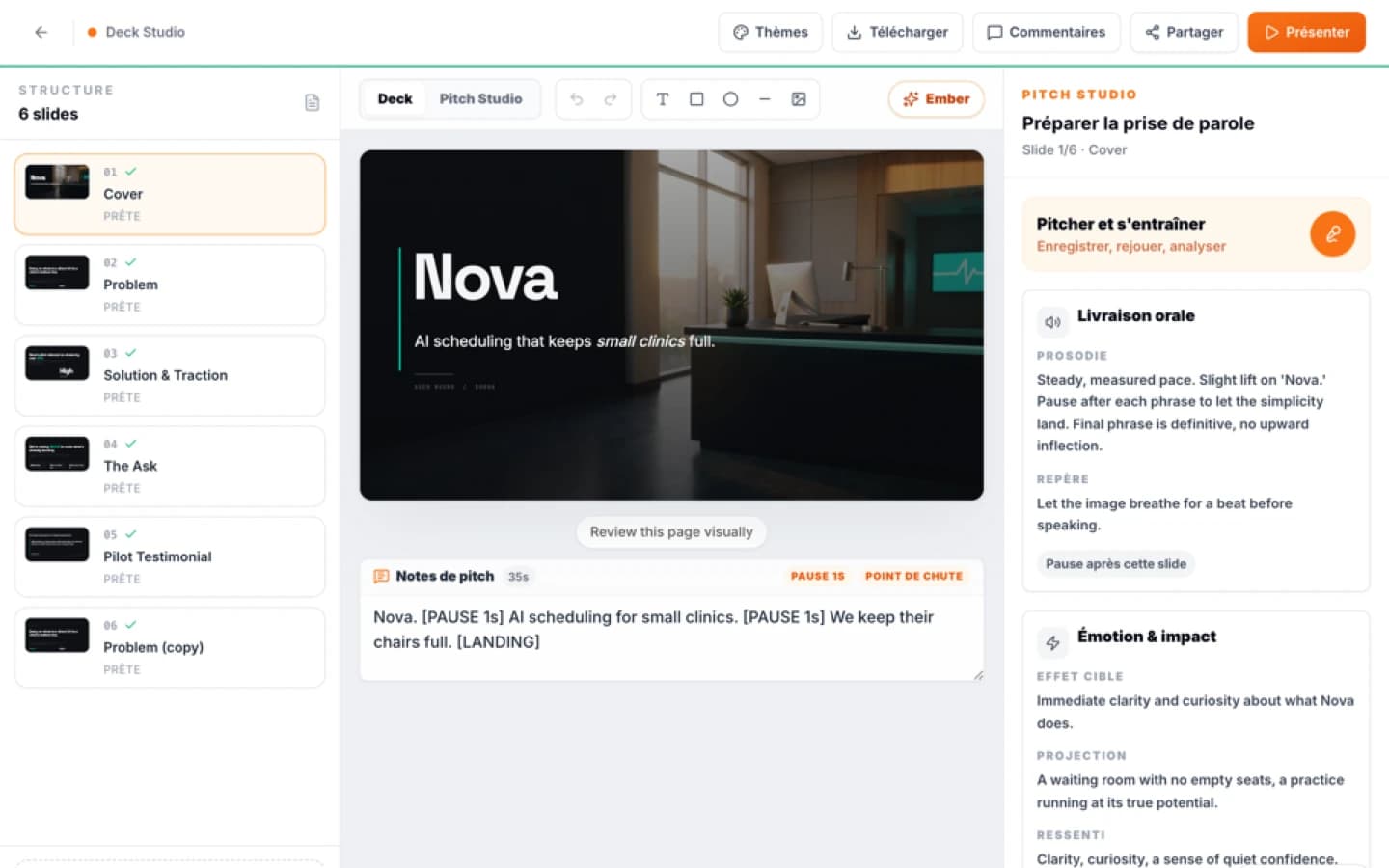
For the oral defense before a committee, Creation's Speaking practice area lets you record a take and analyze it slide by slide.
Before sending
- Is the financing plan balanced (needs equal resources)?
- Is your equity consistent with what the bank expects, around 30% of needs according to Bpifrance Creation?
- Is every assumption sourced or marked as an assumption?
- Have you prepared the hard questions from a banker and a business owner on the committee?
Sources
FAQ
Mini audit
Test your Pitch Deck
Get an initial diagnosis of substance, form and impact.