
Early-stage startups often treat venture capital as the default fuel for every milestone. Using dilutive equity to pay for predictable working capital or pure technological experimentation remains an expensive mistake: shares sold early become progressively more expensive as the company gains value. A mature capital strategy isolates technical risk, cash cycles, and commercial expansion, then funds each with the instrument built for that risk profile.
In the United States, the terrain of this article, three families coexist: federal research grants, bank or guaranteed operational debt, and venture equity. Understanding how they articulate transforms fundraising from a reactive sprint into a structured, multi-layer stack.
The framework: matching risk to financial instrument
The core purpose of a capital stack is to align the cost of capital with the certainty of the outcome. Each layer answers a distinct operational logic:
- Exploratory capital (grants and public subsidies): suited to high technical risk and scientific uncertainty, when commercial outcomes cannot yet be projected.
- Predictable cash-flow financing (operational and venture debt): designed for proven, repeatable models backed by receivables, inventory cycles, or contracted revenue.
- Growth capital (venture equity): justified for aggressive market risk, sales-force deployment, or network-effect races.
Founders who evaluate programs before diagnosing their bottleneck secure the wrong instrument: equity spent on equipment dilutes the cap table for nothing, while debt funding fundamental R&D creates an unsustainable repayment burden.
R&D grants: absorbing technical risk without dilution
For deeptech, life sciences, or hardware development, research grants act as patient capital. In the United States, the SBIR program presented on sbir.gov provides "equity free" funding to American small businesses through federal agencies, for technological development and commercialization. The overview page proves neither a currently open solicitation nor a project's eligibility: every application requires checking the applicable rules and calendar.
As Flag, a firm supporting these applications, points out, the primary appeal of grants is their non-repayable nature, which eases financial pressure while adding external credibility. The same source highlights three constraints to factor into cash planning:
- Staged disbursements: funds are often released in tranches against milestone validation or expense justifications, demanding disciplined bookkeeping.
- Restricted allocation: amounts follow the budget lines of the application and the subsidized project's constraints, with reduced flexibility.
- Competitive, slow selection: rigorous, time-consuming processes; waiting for a grant decision without a cash bridge endangers operations when runway is short.
Grants should absorb technical uncertainty before industrialization. Once feasibility is proven, depending solely on public programs slows execution against equity-funded competitors.
Operational debt and venture debt: financing predictability
Borrowing introduces a contractual obligation to repay principal, usually with interest. Two families coexist:
- Operational debt covers predictable cycles: working capital facilities, receivables financing (the commercial contract backs the advance when payment terms stretch), and equipment financing where assets retain resale value. In the United States, the Small Business Administration's 7(a) program guarantees loans made by lenders rather than lending directly; the official page lists working capital, equipment, and certain refinancing, and requires an operating, for-profit, creditworthy American business.
- Venture debt targets already venture-backed startups. According to the EisnerAmper guide read on September 18, 2026, it is non-dilutive financing typically provided alongside or shortly after an equity round, underwritten less on hard assets than on investor quality, growth, and financial discipline. Quoted terms: floating rates around SOFR + 6-9%, 2-4 year maturities with a 6-12 month interest-only period, warrants of 0.5-1.5% of fully diluted equity, 1-2% upfront fees, and a 3-6% end-of-term payment.
Venture debt is commonly used to add 12-18 months of runway, bridge to the next financing, or fund growth, and deals typically close in 4-8 weeks, sometimes 2-3 weeks fresh off a round. The tradeoff: a blanket lien on assets (including IP and receivables) and possible covenants on minimum cash or additional debt. If commercial milestones slip, those covenants can trigger a liquidity crisis far faster than a patient equity investor would. The same guide judges it most effective post-Series A: seed-stage companies usually do not qualify.
Venture equity: pricing market risk in shares
Equity is the most expensive money a founder will ever accept, with one irreplaceable feature: it assumes the full downside risk without requiring repayment. If the venture fails, shareholders absorb the loss without forcing insolvency.
Founders should deploy venture equity primarily to:
- prove repeatable unit economics across acquisition channels;
- hire executive talent and scale engineering, whose output cannot collateralize a loan;
- enter contested markets where speed determines the leader.
The SEC's educational page, Ready to Raise Capital, read on September 18, 2026, asks founders for an up-to-date capitalization table, understandable financial statements, a raise amount derived from projected expenses and runway, and a view on how investors will get their capital back. Before opening the cap table, studying How to Calculate BSA-AIR Dilution with Cap and Floor? helps model the cumulative impact of convertibles, and Liquidation Preference and Waterfall: How Exit Payouts Work shows what exit terms change for founders.
| Dimension | R&D grants | Operational and venture debt | Venture equity |
|---|---|---|---|
| Primary purpose | Fund technical feasibility and research | Fund predictable cycles and extend runway | Fund commercial traction and key hires |
| Ownership cost | No dilution | Debt can include warrants: 0.5-1.5% in EisnerAmper’s October 2025 examples, not a universal offer | Permanent dilution across share classes |
| Repayment | Non-repayable subject to application compliance | Principal and interest due; October 2025 guide cites SOFR + 6-9% for venture debt examples | No repayment obligation |
| Availability | Milestone-based tranches, slow selection | Timing varies; October 2025 guide cites 4-8 weeks for a venture debt deal | Variable, tied to due diligence and negotiation |
| Conditions and limits | Restricted to the application's budget lines | Asset liens and possible restrictive covenants; venture debt mainly post-Series A | Partial loss of control, high growth expectations |
Sequencing the funding strategy
A resilient capital stack combines instruments over time rather than picking one:
- Validate technology with non-dilutive capital: research grants and innovation programs covering prototyping and feasibility.
- Establish traction with a measured round: raise what is needed to hire the core team and prove product-market fit.
- Extend runway with debt: once revenue or contracts become predictable, layer in operational lines or venture debt, which negotiates more easily fresh off an equity round.
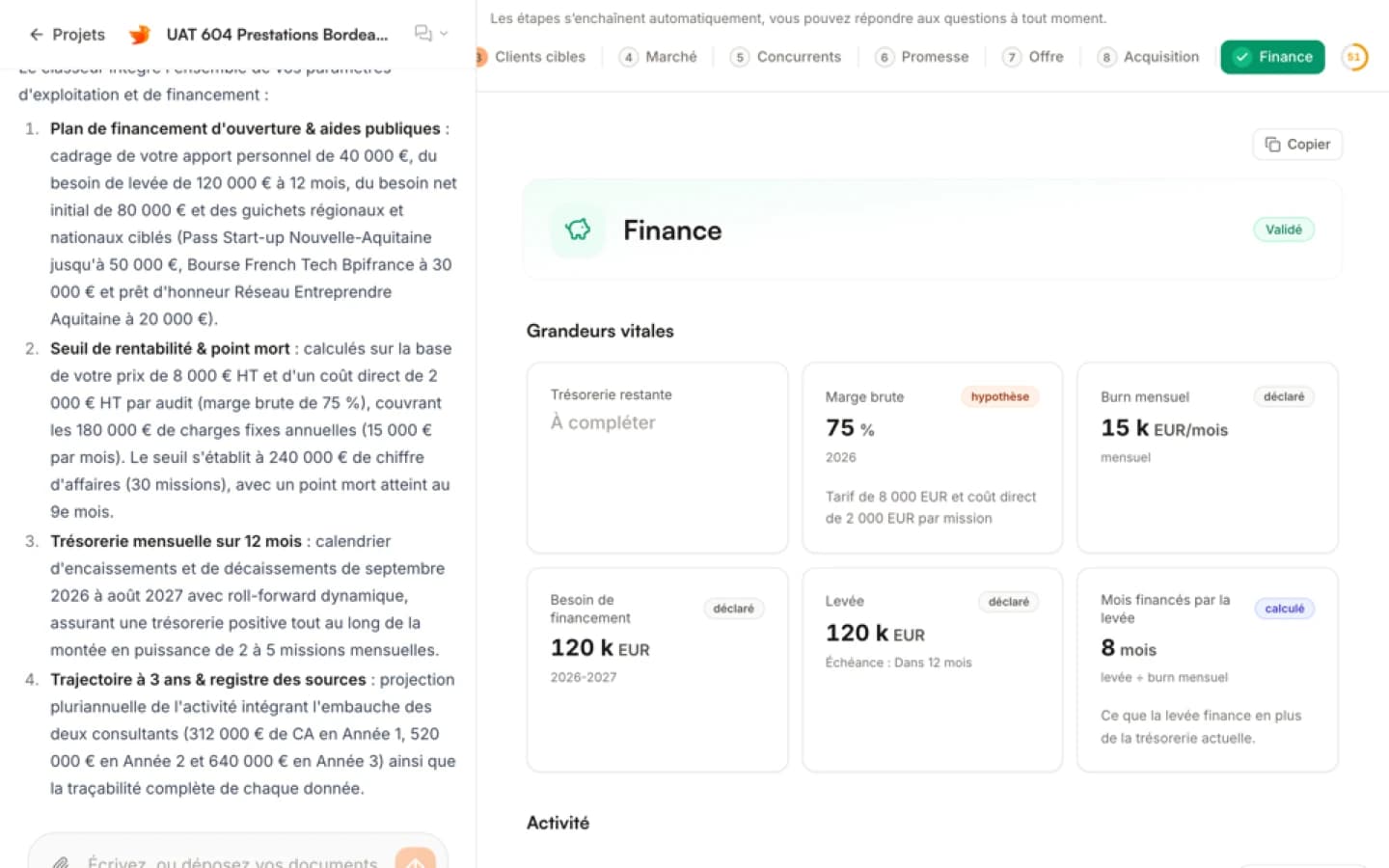
This sequencing requires connecting real data, explicit assumptions, and realistic trajectories. Within Ember, Fund Your Growth replaces generic option lists with a funding strategy coherent with your project: the journey reads the documents you provide, keeps declared, estimated, and confirmed figures separate, compares scenarios by stage, geography, and constraints, then organizes a Data Room connected to the case. A structured case is neither an investor decision nor a guarantee of funding. To go further, How to Manage Runway with 13-Week Cash Discipline for SMEs? secures runway between instruments, and How should a founder read a term sheet before signing? prepares the next round's negotiation.
Sources
FAQ
Fund Your Growth
Connect strategy, proof and funding
Turn project assumptions into defensible decisions and next actions.