
To calculate dilution from a BSA-AIR (Bon de Souscription d'Actions - Accord d'Investissement Rapide) round, you must compare the effective share price produced by the valuation cap against the price produced by the discount at the next priced round, while treating the valuation floor as the absolute lower bound on share price. The investor converts at whichever mechanism produces the lower valuation, yielding the higher number of shares, unless the priced round falls below the floor.
As noted in legal analysis by Biot Avocat, unpriced instruments dominate early rounds, but cumulative caps and missing floors leave founders with unexpected minority stakes once priced rounds close. Understanding the exact interplay between these contractual clauses protects founder equity before signing a term sheet.
The mechanics of a BSA-AIR: Cap, discount, and floor
A BSA-AIR functions similarly to a Simple Agreement for Future Equity (SAFE) in Anglo-Saxon ecosystems, structured under French law via the French Commercial Code. An investor injects capital immediately, postponing valuation until a subsequent equity event sets an explicit share price.
Three core variables govern the eventual conversion:
- Valuation Cap: A contractual ceiling on the company valuation used to determine the investor's share price. If the subsequent round values the business above this ceiling, the investor converts at the cap, receiving more equity for their early risk.
- Discount: A percentage reduction applied to the share price paid by incoming investors in the priced round.
- Valuation Floor: A contractual minimum valuation that establishes the lowest price per share at conversion, protecting founders against excessive dilution during a down round.
In practice, the conversion formula evaluates both the cap and the discount, selecting whichever gives the BSA-AIR holder the more favorable entry. According to Biot Avocat, if a cap is set at 2 million euros and a priced Series A round values the company at 5 million euros, the investor converts on the basis of 2 million euros, receiving 2.5 times more shares than if they had entered at the round valuation.
To place this decision in context, the Knowledge guides for finance bring together deeper guidance on the same field.
Step-by-step dilution calculation with cap and discount
When a priced round occurs, determine whether the cap or the discount dictates the conversion price.
Consider an illustrative case published by Biot Avocat, where two cofounders each hold 50 percent of an SAS with an initial capital of 1,000 shares (500 shares each). An investor injects 100,000 euros via a BSA-AIR with a valuation cap of 1 million euros and a discount of 20 percent.
When the startup later negotiates a priced round at a pre-money valuation of 4 million euros, the conversion proceeds through four steps:
- Calculate the discounted valuation: A 20 percent discount means the investor pays 80 percent of the new round price, which yields an implied valuation of 3.2 million euros.
- Compare against the valuation cap: The agreed cap is 1 million euros. Because 1 million euros is lower than 3.2 million euros, the cap governs the conversion.
- Determine the share price and share creation: Based on the cap of 1 million euros across the 1,000 existing shares, the conversion price is 1,000 euros per share, resulting in the issuance of 100 new shares for the 100,000 euros invested.
- Recalculate ownership: Total company shares expand from 1,000 to 1,100 shares. The founders' original holdings dilute proportionally to accommodate the newly converted equity.
To explore this point further, Liquidation Preference and Waterfall: How Exit Payouts Work details a step directly related to this decision.
How the floor protects against down-round dilution
While caps protect early angel investors against run-away upside where their capital buys negligible equity, the valuation floor is designed specifically for the founders.
If market conditions soften or metrics fail to hit targets before the next priced round, a company may face a down round. Without a floor, converting unpriced instruments against a depressed valuation generates an avalanche of new shares, transferring substantial ownership away from the founding team.
Where the signed BSA-AIR includes a floor, its clauses can set a minimum conversion valuation in a lower-priced round. Apply the actual contract formula and its share-count definition rather than assuming that every instrument has this protection. Negotiating a meaningful floor preserves founder governance and ensures that early risk-sharing remains balanced even in adverse scenarios.
This approach also connects with Back-Office Automation for Bootstrapped B2B Founders Before the First Hire, which clarifies the next choice.
What investors screen for before a first meeting
Understanding dilution math is only half the battle; founders also need to grasp how venture capital investors and business angels evaluate opportunities before agreeing to open discussions or issue a term sheet.
Before a first formal exchange, investors typically examine several fundamental criteria:
- Founder-market fit: The founders' technical legitimacy, their intimate understanding of the sector and their operational endurance against early execution challenges.
- A clearly demonstrated customer problem: Tangible signals proving the targeted customer segment suffers a severe, quantifiable friction rather than a secondary annoyance.
- Exploitable market size and runway visibility: Coherence between the overall market opportunity and a realistic action plan showing how raised capital reaches key milestones before the next round.
When these points are articulated clearly, discussions around early-stage financing instruments stop being purely defensive negotiations and become a strategic partnership.
In practice, What a Credible B2B Pitch Deck Looks Like for a 2026 Seed? completes this framework with another angle on the same topic.
How much capital should a founder raise at pre-seed?
A common question among early-stage founders is how much capital to target during an initial unpriced round. Rather than targeting arbitrary figures, the size of a pre-seed round should be dictated by the milestones required to de-risk the subsequent priced round.
Founders should calculate the operational capital necessary to reach key commercial or product proof points, plus a safety cushion to account for sales cycle delays. Raising too little leaves the business vulnerable to running out of runway before securing sufficient metrics. Conversely, stacking multiple unpriced rounds with aggressive valuation caps creates cumulative dilution that can compromise the cap table before institutional venture capital firms enter.
Before deciding, How to Prepare for Your First Investor Meeting Next Year helps connect this method with adjacent priorities.
Preparing coherent funding scenarios
Standard spreadsheet templates often isolate individual funding rounds, concealing the compounding dilution caused by multiple convertible instruments. When successive caps overlap or discounts convert simultaneously alongside new option pools, founder equity diminishes faster than expected.
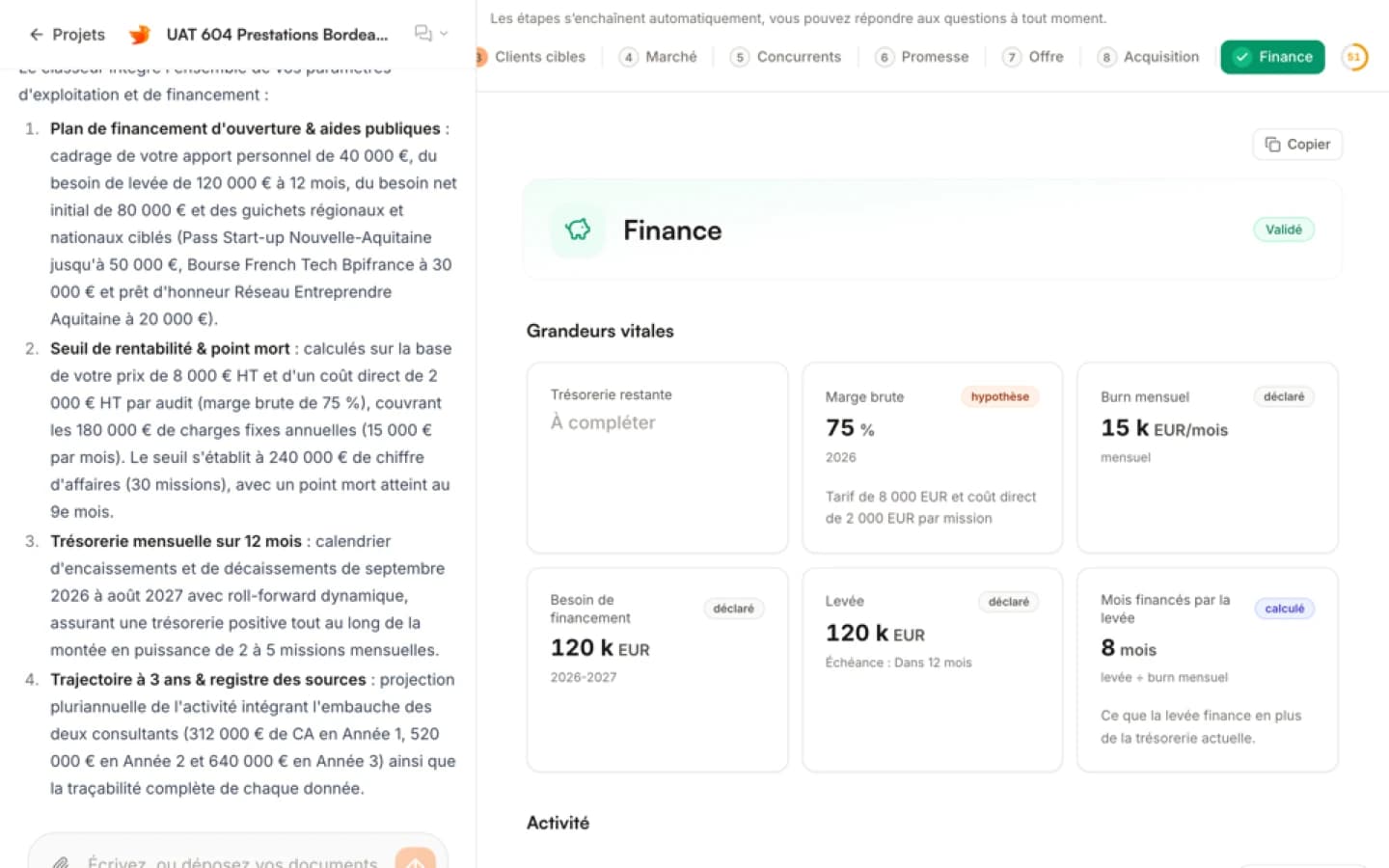
A structured funding strategy models these conversion mechanics alongside real operational assumptions. Ember helps founders map this journey with Fund Your Growth, which structures funding options from project context while keeping declared metrics and qualitative uses of funds intact without inventing arbitrary splits. The same approach compares and structures funding scenarios adapted to the stage, geography and constraints of the file.
By testing scenarios where rounds convert under caps, discounts, or floors, founders can spot weak points in their capitalization plans early. Evaluating these mechanics before signing convertible agreements ensures you retain the equity and runway required to lead your company over the long haul.
Sources
FAQ
Mini audit
Test your Business Plan
Identify strengths, missing proof and the next priority.