
Symptom or signal
Many early-stage founders arrive at their first investor meeting with a polished pitch deck, then discover they are unprepared for the conversation that follows the slides. The deck earns attention; it does not answer the questions that come next. When an investor moves past the introduction, the conversation shifts to the business model, the evidence behind it, and the founder's grasp of how the company actually runs.
The gap usually shows during the question and answer session. A founder may struggle to explain the cap table, how equity is distributed, or plans for an employee stock ownership plan (ESOP), topics an investor commonly raises when examining a company. Another signal is the absence of a single place holding the supporting evidence. If an investor asks for the financial assumptions, the traction data or the legal structure and the founder has to promise a follow-up in a few days, the momentum of the meeting is lost.
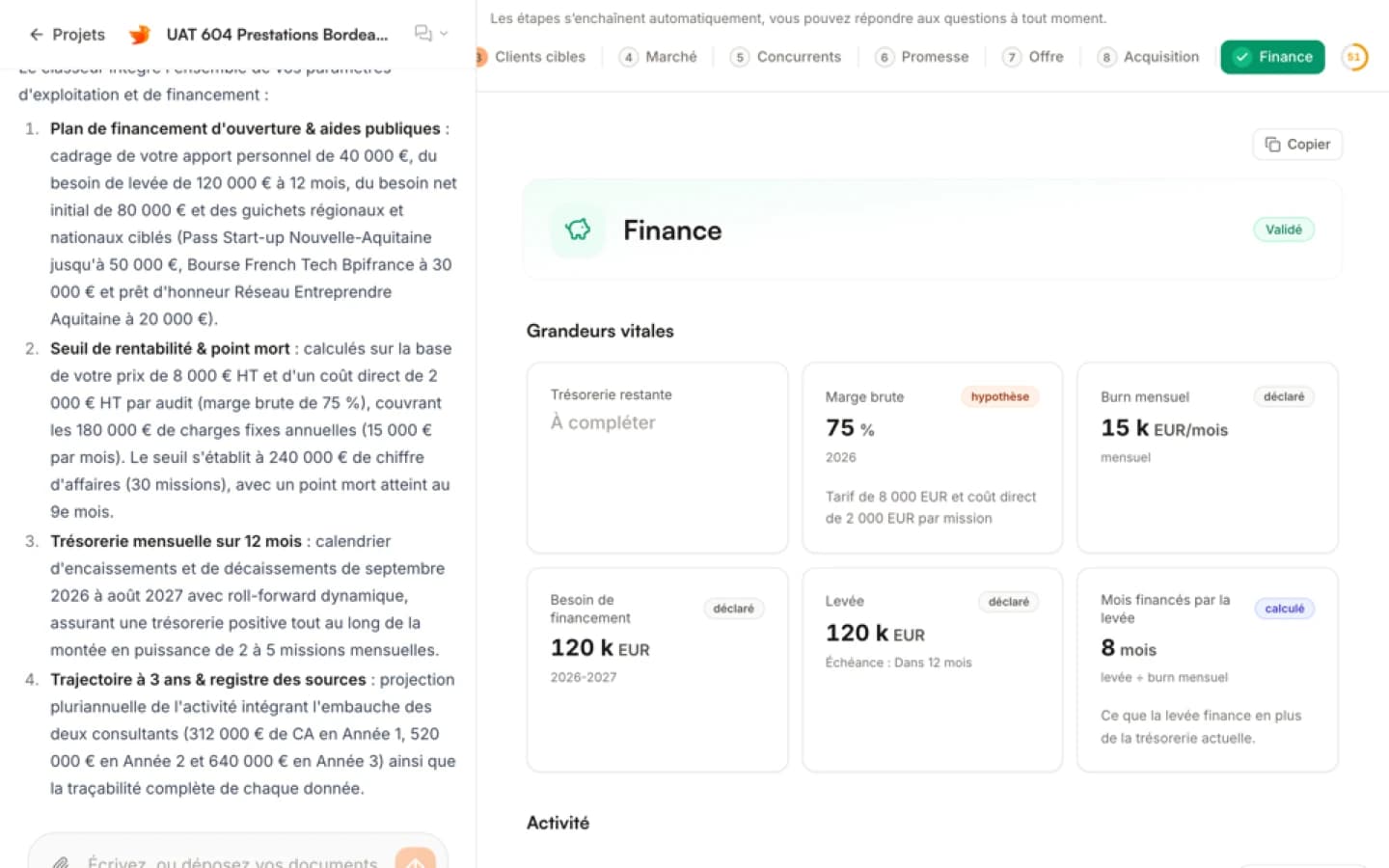
A third signal is internal contradiction. With static documents and disconnected spreadsheets, it is hard to see how a change in one assumption, for example revenue growth, affects another, such as the hiring plan. Investors notice these inconsistencies quickly, and it is better to find them yourself first. Ember's Fund Your Growth links the pieces of a project (project, why, ideal customer, market, competitors, promise, offer, acquisition and finance) in a living graph where the weak points come up first, so you can strengthen them before the meeting. It also organises documents (finance, legal, commercial, market) in a Data Room linked to the file.
A short self-check helps to see where you stand. Can you say, in two sentences, who your first customer is and why they buy now? Can you show where each figure in the deck comes from? Can you explain the ownership of the company after the round without opening a spreadsheet? Do the deck, the financial model and the cap table tell the same story? Each "no" is a preparation task, and it is far cheaper to find it a week before the meeting than during it.
To place this decision in context, the Knowledge guides for finance bring together deeper guidance on the same field.
What changed
Investors have grown weary of polished slides that lack substance. According to the expectations gathered by Seedblink, several investors now stress execution speed and capital efficiency, clarity on who will pay first, the credibility of the path to sustainable performance, and operational discipline: an 18-month plan with measurable milestones, burn discipline and runway management.
The same article mentions defensibility as increasingly important for long-term value, and a grounded operator mindset: founders involved in sales themselves, who understand their unit economics and run intentionally small teams. One contributor also advises considering liquidity and exit questions earlier, from the seed or Series A stage rather than later.
The Startup Mountain Summit guide on early-stage investing points the same way from a different angle: it says early-stage investors weigh team quality above all other factors, often over the idea itself, and that they look for a real problem with a genuine market, some traction even if modest, an honest view of competition, and a fundable business model with a specific use of funds tied to milestones.
What this means for preparation: the expectation is no longer just a story, but a defensible position where financial projections, customer traction and legal structure fit together. A tool such as Creation helps a presentation build understanding, but the work that matters happens in the underlying logic.
Three consequences follow for a founder. First, evidence matters more than polish: a modest but real piece of traction, such as a few engaged early users, a waitlist or a letter of intent, communicates more than an elaborate slide. Second, the plan matters as much as the vision: investors want to see how the next months are financed and what will be learned by when. Third, honesty about competition and unknowns is read as a sign of judgment, not weakness.
For a first meeting, this translates into a simple rule: show that you can execute with what you have. A lean plan with clear milestones is more convincing than an ambitious plan whose costs you cannot explain, and a founder who knows the unit economics of the current customers is easier to trust than one who quotes a market size.
This does not mean that every founder must have all of these elements before a first meeting. It means that you should know which ones you have, which are missing, and how you plan to get them.
Facts and sources
Three kinds of facts support this guide, and each has limits worth stating.
First, the investor expectations reported by Seedblink come from named practitioners quoted in a 2026 article. They reflect individual views, not a measured survey of all investors, so treat them as signals to prepare for rather than rules.
Second, the Startup Mountain Summit guide is general advice on early-stage investing. It states qualitative priorities and gives no numerical threshold for funding or traction; nothing in this guide should be read as a required number of customers or revenue.
Third, the description of Ember's Fund Your Growth comes from the product itself: it guides a founder through nine building blocks of a project, each with its versions, evidence and status, and the founder approves, rejects or edits each proposal before it enters the file. The module prepares a file; it does not guarantee funding or any investor decision.
Because none of these sources measures outcomes, the guide avoids any figure on success rates or the number of meetings needed. If you see such figures elsewhere, ask what dataset supports them before relying on them.
Why the common explanation is incomplete
The usual advice is to perfect the deck: tighten the story, improve the design, rehearse the pitch. That advice is not wrong, but it treats the first meeting as a presentation when it is a conversation. The deck opens the door, and the investor's questions decide what happens next.
If team quality weighs most at this stage, as the Startup Mountain Summit guide argues, then the investor is also testing how you think under questioning: how you handle a question you cannot answer, whether you know your numbers, whether you can say what you do not know yet. A flawless deck says little about these points.
Preparing only the deck also hides a practical risk: the founder rehearses the answers on the slides and not the ones off them. The most useful rehearsal is the list of questions the deck does not answer.
A useful exercise is to take the best deck you have and ask what questions a sceptical investor would still have after the last slide. Most founders find that they concern four areas: why this team, why this market now, how the money will be used, and what could go wrong. If the deck answers none of them, it is a presentation; if it answers all of them, it is closer to a file. The goal for the first meeting is to be able to answer these four areas out loud, with evidence, in the order the investor chooses.
Note also that the order of questions is chosen by the investor. Some start with the team, others with the market or the numbers. Being ready for any starting point matters more than a perfectly ordered narrative, and it is one reason to prepare answers that stand alone rather than a script that depends on the sequence of slides.
When you do not know an answer, a short formula works well: say what you know, say what you do not know yet, and say how and when you will find out. It is honest, it shows method, and it keeps the conversation moving instead of pushing you to improvise a figure you cannot defend later.
The real problem
The real problem is not the quality of the presentation but the lack of an organised, defensible file behind it. A founder who cannot show where a number comes from, how two assumptions relate, or what has been validated versus assumed, forces the investor to do that work, and most will not.
There are three parts to it. Evidence: what you can show for the problem, the customer and the traction. Logic: how the pieces of the plan depend on each other. Readiness to answer: whether the founder can explain the cap table, the use of funds and the milestones without leaving the room to look for documents.
Declared figures, estimates and confirmed data should stay separate. An assumption presented as traction is the fastest way to lose credibility once the investor asks how it was measured.
In practice, three habits make the difference. Keep one source of truth: a single version of the numbers, updated in one place, that the deck and the model both read from. Date your evidence: note when a conversation, an estimate or a document was obtained, because an investor will ask how recent it is. And write your unknowns down: a list of what you have not yet validated, with the way you plan to validate it, shows method and reduces the temptation to cover gaps with confident wording.
How the mechanism works
Preparation works best as a loop with four steps.
First, list the questions an investor is likely to ask, drawn from the criteria above: who pays first and why now, what you replace, how the team is suited to this problem, what the first eighteen months look like, and what the funds will be used for.
Second, attach evidence to each answer. A customer conversation, a letter of intent, a waitlist or a document is stronger than an assertion. Where evidence is missing, say so and describe how you will get it.
Third, check consistency. Read the plan as an investor would, looking for numbers that do not match across the deck, the financial model and the cap table.
Fourth, keep everything in one place that you can open during the meeting. In Ember, Fund Your Growth works this way: the agent asks only the questions still useful, the finance block reuses answers from the other blocks with visible, editable assumptions, and after the last decision the Data Room opens linked to the file with seven folders: file, identity, market, commercial, finance, legal and documents.
A simple format keeps answers short and checkable: state the answer in one sentence, give the evidence in one or two, then say what remains open. For instance, on the market question: the first customer type, why they buy now, what they use today, and what you will still test. Practising this format on the ten questions from your list produces a set of answers you can reuse in every meeting, and it leaves room for the investor's follow-up rather than filling the time with a monologue.
A question bank makes the loop concrete. On the team: why are you the right people for this problem, what have you already done together, and which role is missing? On the problem and market: who feels the problem most, what do they use today, who pays first, and why now? On traction: what have customers said or done, what is the strongest piece of evidence, and what is still an assumption? On the model and the funds: how do you make money, what does the next eighteen months cost, which milestones will the funds reach, and what happens if they are reached later than planned? On risk: which two assumptions carry the plan, and how are you testing them? Write one short answer per question, with its evidence, and mark the questions where the honest answer is that you do not know yet.
Concrete examples
Example 1, the cap table question. An investor asks who owns what after the round. The unprepared founder gives a rough answer and promises a spreadsheet. The prepared founder opens the cap table, explains the equity distribution and the ESOP plan, and says which points are still to be settled with a lawyer.
Example 2, the market question. The investor asks who will pay first. Instead of describing the whole market, the founder names one type of customer, says why they buy now and what they use today, and cites one or two real conversations. This answers the "clarity on the first market" expectation reported by Seedblink.
Example 3, the plan question. The investor asks what happens over the next eighteen months. The founder shows three or four milestones with dates, the resources each needs, and what the funds cover. If a figure is an estimate, it is labelled as one.
These are illustrations of how to prepare, not accounts of real meetings.
Example 4, the risk question. The investor asks what could make the plan fail. Rather than answering that nothing can, the founder names the one or two assumptions that carry the plan, says how each is being tested, and what would make the team change course. Investors reading this see a founder who knows where the plan is fragile, which is often more reassuring than a claim of certainty.
Example 5, the follow-up. Two days after the meeting the investor writes to ask for the financial model. The founder who kept one source of truth sends it the same day with a short note listing the assumptions that are still estimates. The response time and the clarity of the note become part of the impression, before any second meeting is scheduled.
When to use this diagnosis
Use this diagnosis when you have a deck and a first meeting on the calendar, but no written list of the questions the deck does not answer. It also fits founders who have had a first meeting that went well on the slides and stalled on the follow-up questions.
It is most useful when the plan involves several moving parts, for example a financing round, a hiring plan and a go-to-market motion that depend on each other. In that case the risk of internal contradiction is real, and a structured file, in a spreadsheet or in a tool such as Fund Your Growth, saves time.
Signs that it applies to you: your deck has been reviewed many times but nobody has challenged the numbers; you have not yet spoken with anyone who plays the role of a sceptical investor; or the person who built the financial model is not the one who will present it. In each case, a preparation session focused on questions, not slides, is likely to bring more than another round of design changes.
A practical list of what to have ready on the day: the deck, the numbers behind it in one file, the cap table, a short list of the evidence for the main claims, and your list of open questions. Keep documents in a form you can share quickly after the meeting, since a prompt and organised follow-up is part of the impression you leave. If you use Fund Your Growth, the founder's own documents can be stored in the Data Room, with versions and a revocable sharing link valid for thirty days.
If several people will attend on your side, agree beforehand who answers which type of question, so that answers do not overlap or contradict each other. A founder who handles the market and product questions and a co-founder who handles numbers and legal structure is a common split, as long as both know the whole file.
When not to use it
This approach is not needed for an informal introduction where the aim is only to get to know an investor, or when the round is already led by an investor who has done their diligence and asks for little.
It also does not replace legal or accounting advice. Questions about equity structure, ESOP terms or exit and liquidity provisions depend on the law that applies to your company, and are to be validated with a lawyer.
Finally, no preparation guarantees that an investor will fund you. Fund Your Growth prepares a file and does not promise financing or a decision from a third party.
There is one more case: if your company is not yet defined enough to answer basic questions about customer and offer, the priority is not investor preparation but clarifying the project itself. Meeting investors too early can cost credibility that is hard to rebuild. Use the time first to talk to customers and to write down what you have learned, then come back to the investor questions.
Finally, do not use the preparation as a reason to postpone the meeting indefinitely. Preparation aims at a good first conversation, not a perfect one; a date on the calendar is the best way to make it finish.
Next step
Choose one action for this week. Write the ten questions your deck does not answer. For each, note the evidence you have and the evidence you lack. Then put the answers and documents in one place, and rehearse aloud with someone who will interrupt you.
If you want a structure to hold the file, Fund Your Growth links hypotheses, evidence, funding needs and the action plan in one context, and keeps declared figures, estimates and confirmed data apart.
After the meeting, write down within the hour what was asked, what you could not answer, and what the investor seemed to care about most. Send the follow-up material you promised, no more. Then update the file: each unanswered question becomes a task with an owner and a date. Over several meetings this record shows which parts of your story are solid and which need work, and it turns each conversation into preparation for the next one.
A one-page summary is a good final product of the preparation. It holds four short blocks: who the first customer is and why they buy now, the evidence you have for the main claims, the eighteen-month plan with its milestones and the use of funds, and the list of what is still unknown. Keep it in the same folder as the deck and the numbers. It serves as your reference during the meeting and as the base for any follow-up message.
Sources and methodology
This guide draws on two external articles opened and read for this version: the Seedblink piece on what investors expect from founders in 2026 and the Startup Mountain Summit guide on what investors look for in early-stage startups. Both express views and general advice, not measured results, and neither gives thresholds. The description of Fund Your Growth comes from the product's documented behaviour. The examples and the preparation loop are editorial suggestions.
Sources
FAQ
Mini audit
Test your Business Plan
Identify strengths, missing proof and the next priority.