
Joining a top-tier accelerator remains one of the fastest ways for early-stage founders to secure initial capital, validate an early product, and access an institutional network. However, the legal and financial structures used by top programs are not standard priced equity rounds. Instead, they rely on combinations of fixed-percentage instruments and uncapped Most Favored Nation (MFN) Simple Agreements for Future Equity (SAFEs), which postpone exact ownership calculations until your next equity round.
Choosing between programs like Techstars and Y Combinator (YC) requires looking past headline checks to evaluate how these instruments convert, how MFN clauses interact with subsequent angel or pre-seed checks, and how much equity you retain before raising a Series A.
The Financial Architecture: How Accelerator Checks Are Split
Modern accelerators rarely invest through a single, simple valuation cap. Instead, both Techstars and Y Combinator divide their total investment into two distinct tranches: a fixed-equity tranche that locks in a baseline percentage regardless of your initial traction, and an uncapped MFN SAFE designed to ride along on whatever terms you negotiate with later investors.
An MFN provision allows an uncapped SAFE holder to automatically adopt the most investor-friendly terms, such as the lowest valuation cap or highest discount rate, negotiated on any subsequent convertible instrument before a priced financing round. According to Y Combinator's Post-Money SAFE User Guide, an MFN SAFE carries no valuation cap and no discount initially, but permits the investor to amend their instrument to mirror more favorable terms issued in later convertible notes or SAFEs.
This split creates a dual dilution dynamic. You take an upfront ownership haircut to join the program, and you introduce an uncapped instrument that reprices dynamically based on your subsequent pre-seed or seed fundraising performance.
Techstars Investment Structure: $220,000 for 5% Plus MFN
Techstars announced updated terms on April 17, 2025, structuring its standard offer as a total of $220,000 split across two instruments and a side letter, as detailed on the Techstars investment terms update.
The investment breaks down into two distinct vehicles:
- A $20,000 Post-Money Convertible Equity Agreement (CEA) that converts into 5% of common stock.
- A $200,000 uncapped MFN SAFE that adopts the terms of the lowest-cap convertible instrument issued prior to your qualified priced round.
Under the Techstars investment terms page, the $20,000 CEA converts into common stock equal to 5% of the company's equity (including the existing option pool) upon a priced round of at least $1 million, executed after all SAFEs and convertibles have converted. Techstars also notes that its accelerator programs in the Asia-Pacific region provide a $100,000 uncapped MFN SAFE instead of the $200,000 vehicle.
Conversion and Dilution Mechanics
The dilution from Techstars depends directly on the valuation cap you set for other investors between joining the accelerator and closing your qualified priced round. As outlined on the Techstars newsroom investment terms, if your next round prices at a $20 million pre-money valuation, the $200,000 MFN SAFE converts into 1% additional ownership. Combined with the 5% CEA, Techstars would hold 6% of the company prior to dilution from the new cash and option pool expansion in that round.
Both the CEA and the SAFE are diluted alongside founders by new capital entering during the priced round and by any unallocated option-pool expansions required by the lead investor. Additionally, Techstars requires passing compliance checks, such as background, incorporation, and IP verification, before funding is wired, and participants sign a side letter granting information rights, pro rata rights, and drag-along provisions.
Y Combinator Investment Structure: The $500,000 Standard Deal
Y Combinator operates on a significantly larger headline check. According to Y Combinator's standard deal page, YC invests $500,000 in every accepted company using two concurrent post-money SAFEs:
- A $125,000 post-money SAFE that converts into a fixed 7% of equity.
- A $375,000 uncapped SAFE with an MFN provision.
Similar to the Techstars CEA, the 7% tranche applies post-conversion across all convertibles, including the existing employee stock option pool. The investment is not tied to operational milestones, and YC commits to the funding upon acceptance into the batch.
Dilution Scenarios Under the YC Model
Because the second tranche is an uncapped MFN SAFE of $375,000, your subsequent pricing choices heavily influence your remaining founder equity. As illustrated on the Y Combinator deal terms page, if you raise subsequent SAFEs at a $15 million post-money valuation cap, the $375,000 MFN SAFE converts into 2.5% of the company ($375,000 divided by $15,000,000). Adding the initial 7% brings YC's ownership to 9.5% before the priced seed or Series A round introduces new shares.
The MFN safe converts on the terms of the lowest valuation cap or best discount agreed to between the start of the batch and the priced round. YC also secures pro rata rights via its side agreement, allowing it to invest in future priced rounds to maintain its proportional stake. Program timing also shapes fundraising momentum; for instance, YC scheduled its 2026 Demo Day dates with Summer Demo Day on September 10, 2026, and Fall Demo Day on December 2, 2026.
Comparing Financial Terms and Structural Tradeoffs
When comparing both options, founders must balance capital runway against cap table compression. The following comparison summarizes the standard terms published by each organization.
| Parameter | Techstars Accelerator | Y Combinator |
|---|---|---|
| Total Investment | $220,000 | $500,000 |
| Fixed Equity Tranche | $20,000 for 5% common | $125,000 for 7% post-money SAFE |
| Uncapped MFN Tranche | $200,000 SAFE | $375,000 SAFE |
| Regional Tranche Variants | $100,000 MFN SAFE in Asia-Pacific | Standard $500,000 across cohorts |
| Priced Round Trigger | At least $1 million for CEA conversion | Qualified equity financing |
| Pro Rata Participation | Standard via side letter | Standard via YC Agreement |
For founders seeking further context on structuring early capitalization tables alongside specialized equity management tools, reviewing SeedLegals vs Ember: Choosing the Right Funding Platform offers useful insights into operational workflows.
Capital Runway vs. Early Dilution
The primary advantage of the YC structure is liquidity. A $500,000 balance sheet allows founders to hire key early engineers, pay market-rate legal fees, and achieve product-market fit without needing immediate follow-on checks. However, if your market traction requires you to raise subsequent pre-seed SAFEs at modest caps (for example, $6 million to $8 million), the $375,000 MFN tranche will convert into a sizable additional percentage, pushing total accelerator dilution above 11% to 13% before your Series A.
Techstars takes significantly less fixed equity (5% via its CEA), and its $200,000 MFN tranche creates less absolute dilution if you end up converting at lower caps. However, with $220,000 in total gross cash, founders must maintain a tighter burn rate or raise intermediate angel checks sooner to reach their next milestone.
The MFN Trap in Downstream SAFE Rounds
A common mistake founders make after joining an accelerator is issuing small, high-discount or low-cap SAFEs to early angels to close fast bridge checks. Because both Techstars and YC hold MFN rights, granting a single angel a favorable valuation cap immediately pulls the accelerator's uncapped SAFE down to that same valuation.
If you issue a $25,000 check to an advisor at an $8 million valuation cap, both the Techstars $200,000 SAFE or YC's $375,000 SAFE will convert at that $8 million cap, significantly increasing your effective dilution. When managing multiple convertible instruments, reviewing strategic guidelines in the Knowledge guides for founders can help protect early equity distributions.
When Each Accelerator Makes Financial Sense
Neither accelerator model is universally superior. The right choice depends on your cash burn, access to local networks, and downstream fundraising strategy.
Techstars is frequently well suited for:
- Founders targeting industry-specific verticals (such as fintech, mobility, or energy) where Techstars operates specialized corporate and regional programs.
- Teams that already have intermediate angel backing lined up and prefer to minimize fixed accelerator dilution to 5%.
- Founders based outside major venture hubs who benefit from regional network integration across North America, Europe, or the Asia-Pacific region.
Y Combinator is frequently well suited for:
- Software, consumer, and deep-tech teams requiring maximum upfront capital ($500,000) to de-risk technical execution without pausing to fundraise.
- Founders confident in their ability to command high post-money valuation caps ($15 million or higher) during Demo Day, which keeps the conversion dilution of the $375,000 tranche minimal.
- Teams targeting Silicon Valley institutional venture funds for their institutional Seed and Series A rounds.
Stress-Testing Scenarios Before Signing
Accelerator agreements are binding commitments that influence your ownership profile through exit. Before executing an investment agreement or signing an uncapped MFN instrument, founders should model how both tranches convert under varied downstream scenarios: a high-cap priced round, a conservative bridge note round, and an intermediate SAFE round with valuation discounts.
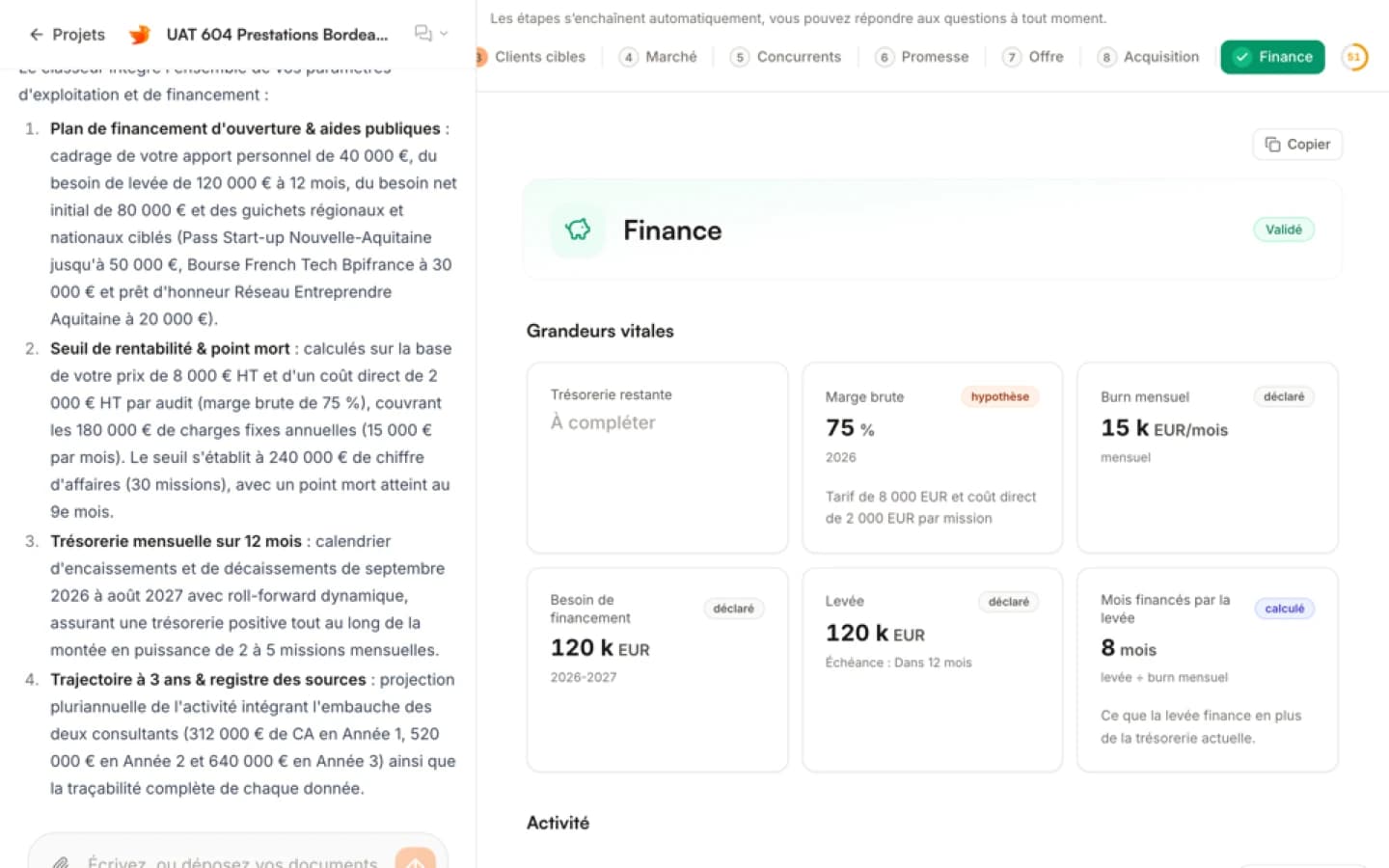
For founders structuring their venture thesis, financial forecasts, and investor documentation, Ember's AI business plan architecture provides a structured environment to pressure-test project assumptions, model financing requirements across stages, and assemble an organized, audit-ready data room before engaging outside institutional capital.
Sources
- Techstars accelerator terms: $220,000 as a $200,000 uncapped MFN SAFE plus a $20,000 convertible equity agreement for 5% common: source S1
- Techstars accelerator terms: $220,000 as a $200,000 uncapped MFN SAFE plus a $20,000 convertible equity agreement for 5% common: source S2
- Y Combinator's standard deal: $500,000 as a $125,000 post-money SAFE for 7% plus a $375,000 uncapped MFN SAFE: source S1
- Y Combinator's standard deal: $500,000 as a $125,000 post-money SAFE for 7% plus a $375,000 uncapped MFN SAFE: source S2
- Y Combinator, how the SAFE converts into equity
- Ember Finance ta croissance, stratégie de financement
FAQ
Mini audit
Test your Business Plan
Identify strengths, missing proof and the next priority.