
A B2B founder should transition from founder-led outbound to their first dedicated sales hire only when three specific conditions are met: the core value proposition closes deals without relying on founder equity or personal network, the objection patterns have stabilized into predictable categories, and the founder understands the unit economics of a closed account. Delegating outreach too early transfers product-market discovery to an employee who lacks the authority to change the product, the pricing, or the target market.
Hiring an account executive or sales development representative (SDR) before validating an outbound motion is one of the most expensive ways to fail in early-stage commercial development. When a founder sells, a prospect's objection is strategic market feedback. When a new sales hire encounters the same objection, it is simply a lost commission.
The Unscalable Foundation: Why Founders Must Sell First
Before outbound can be handed to a sales team, it must exist as a proven, repeatable set of human interactions. In his July 2013 essay on startup growth, Paul Graham observed that the most common unscalable thing founders have to do at the start is to recruit users manually. Graham documented how Stripe's early team manually installed their payment software directly on prospective users' laptops during meetings, while Viaweb built online stores for merchants by hand to uncover software friction firsthand.
This manual phase is not an operational failure; it is an informational necessity. Early prospects buy into the founder's vision and depth of technical domain knowledge rather than a mature product. According to an analysis of early customer acquisition by Y Combinator Startup School, early customer acquisition typically follows a distinct progression: customers one through three almost universally originate from the founder's warm network and second-degree connections, while customers four through ten come from unscalable manual actions such as industry events, direct interactions, and targeted community discussions. Only once a company reaches roughly customer ten do dedicated outbound tools and structured prospecting cadences begin to make sense, because only then has the company discovered a message that converts strangers.
Founders who attempt to bypass this manual legwork frequently hire sales reps to run outbound campaigns around untested messaging. The result is almost always pipeline churn: hundreds of messages sent to poorly defined personas, yielding no useful qualitative feedback about why the market is indifferent.
The Three Operational Triggers for the First Sales Hire
Knowing when to step back from running every discovery call requires monitoring workflow constraints rather than arbitrary calendar deadlines. Three distinct operational gates indicate that the founder-led motion is ready for replication:
1. Repeatable Objection Resolution
If prospective buyers ask questions that require product adjustments or founder-level roadmap promises to close, the commercial playbook is not ready to be delegated. An initial sales hire requires documented responses to regular commercial friction: pricing tiers, implementation schedules, competitive trade-offs, and compliance constraints. If closing a contract still requires custom engineering commitments, the company requires further product iteration, not quota carriers.
2. A Proven, Compact Outreach Cadence
An external rep cannot guess what tone of voice resonates with your ideal customer profile (ICP). According to guidance from Y Combinator Startup School, outbound messaging to cold contacts works best when messages are kept under 75 words, centered around a single clear call to action, and followed up three or four times over a couple weeks before abandoning the lead. When a founder has proven that a concise, specific cadence produces qualified discovery calls across a defined target list, that process can be packaged into an operating procedure for a hire.
3. Founder Calendar Saturation on Closing, Not Prospecting
When a founder spends their days executing qualified product demonstrations and negotiating commercial terms, their time is well allocated. However, if the founder is spending fifteen hours a week manually finding corporate registry updates, hunting for email addresses, and drafting initial outreach messages, commercial growth stalls. When pipeline execution conflicts with product delivery, the business is ready to split prospecting intelligence from closing.
The Prospecting Workload Reality Facing Sales Hires
Many founders assume that hiring a sales professional immediately solves outbound pipeline generation. The operational reality inside modern sales organizations tells a different story.
According to the seventh edition of the Salesforce State of Sales report, which surveyed 4,050 sales professionals across 22 countries, sales reps spend almost one full day of their workweek on prospecting. The same report found that 47% of sales reps consider cold outreach one of the worst parts of their job, while another 47% report that their team lacks the bandwidth to conduct cold outreach at all.
| Transition Stage | Primary Responsibility | Critical Success Factor | Common Operational Risk |
|---|---|---|---|
| Founder-Led Outbound | Founder personally conducts research, drafts copy, and takes calls | Direct feedback loop into product positioning and pricing | Founder calendar bottleneck stalling customer onboarding |
| Transition Phase | Founder defines playbooks while systems automate signal discovery | Documented qualifying criteria and clear rejection reasons | Delegating pipeline generation before message-market fit |
| First Sales Hire | Dedicated rep executes structured cadences on qualified targets | Consistent meeting volume and strict adherence to ICP | Rep burns runway researching accounts instead of selling |
When an early-stage company brings in a sales hire without providing pre-qualified target lists or structured account intelligence, that rep spends up to 20% of their working hours manually gathering data and guessing who to prioritize. A new hire forced to prospect from scratch under high friction often experiences early fatigue, extending ramp times and burning cash.
Before posting a job description, founders must examine how they manage data capture, lead enrichment, and cadence tracking. Reading the Knowledge guides for founders provides structured frameworks for documenting operational workflows before adding payroll overhead. Similarly, founders evaluating data stacks can review our breakdown of HubSpot Breeze or Clay for Outbound Sales Prospecting to understand how data orchestration functions in growth-stage teams.
Designing the Playbook: What Your First Hire Must Inherit
To ensure your first sales hire achieves quota before their runway expires, deliver an operational system on day one rather than an empty customer relationship management (CRM) dashboard. That onboarding foundation requires four discrete deliverables:
- A Documented Ideal Customer Profile with Explicit Disqualifiers: Sales reps often waste time on accounts that look viable on paper but never purchase. Document exact negative signals: company size thresholds that lack budget, legacy technical stacks that cannot integrate, or titles that lack procurement sign-off.
- Recorded Founder Discovery Calls: Give the new hire ten recordings of successfully closed deals and five recordings of deals that stalled. Hearing real prospects articulate business pain provides more nuance than any static slide deck.
- Verified Outreach Cadences: Hand the hire proven templates across email and LinkedIn that follow validated norms: short messages, distinct pain points, and natural conversational openings.
- Curated Lead Queues Driven by Market Timing: Rather than demanding that your new hire spend hours each morning scraping contact lists, feed their pipeline with verified accounts showing active hiring, technology adoption, or management turnover.
Scaling Outbound with Ember Lead Intelligence
Transitioning out of manual prospecting does not mean handing over an unmonitored script to an outsourced agency or leaving a junior hire to navigate market noise alone.
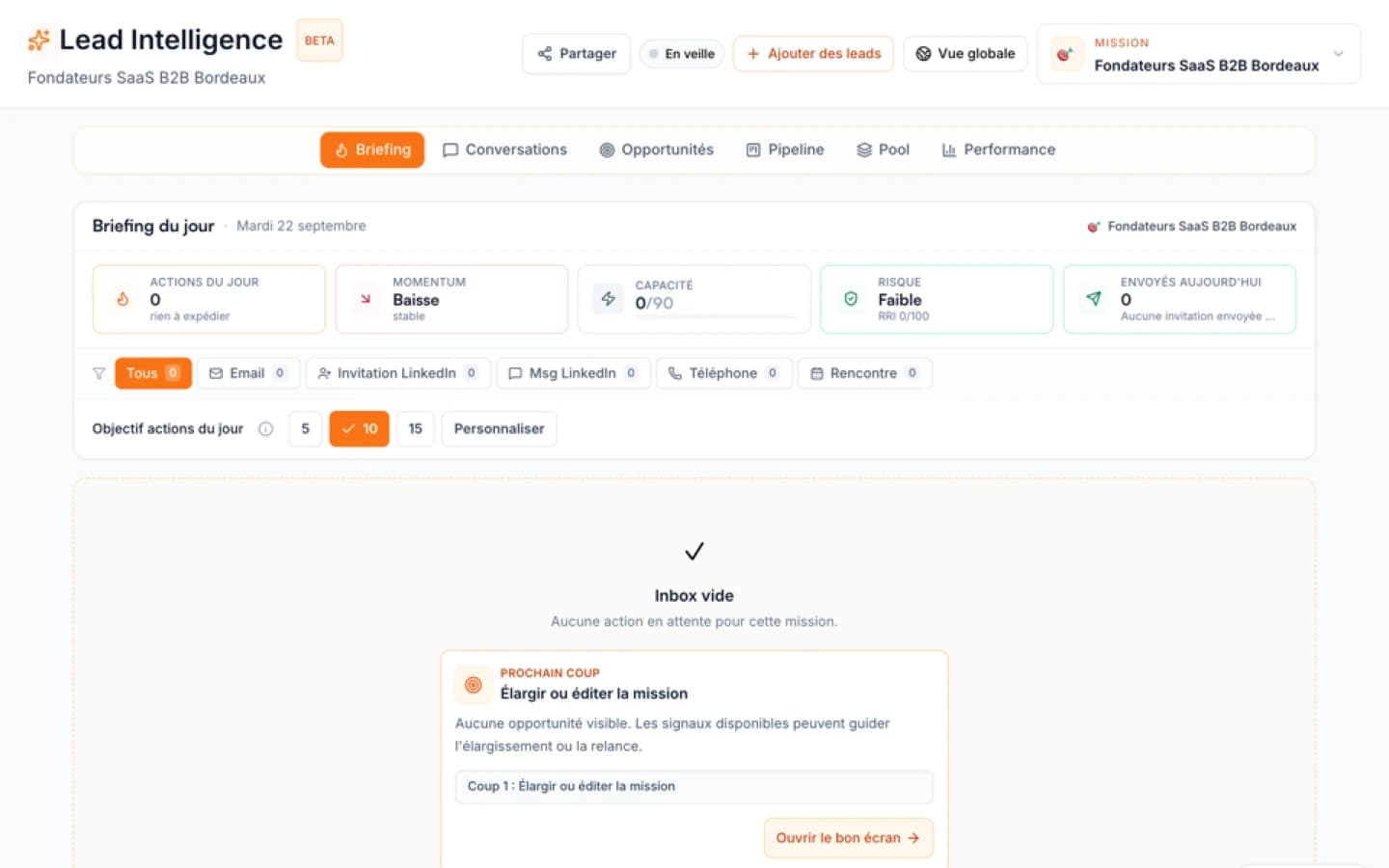
Ember Lead Intelligence bridges founder strategy and sales execution by turning business context into qualified commercial meetings. Drawing directly from your business plan, defined customer profiles, and strategic criteria, the platform identifies high-fit accounts, tracks public signals across platforms, and prioritizes outreach based on timing.
Instead of your first sales hire spending twenty percent of their week manually assembling spreadsheets and hunting for contact details, Ember structures discovery, flags actionable account triggers, and prepares suggested outreach in your mission language. Every communication remains strictly under human control: cadences propose draft messages, but actions require manual user scheduling or approval, supported by a ten-second cancellation window to preserve total oversight.
By automating account research and contextual qualification, founders can either extend their own outbound capacity without hiring prematurely, or provide their incoming sales hire with an operational launchpad that turns early conversations into predictable revenue.
Sources
- Acquisition initiale, Paul Graham
- Y Combinator on the first 10 customers: network and presence before any outbound tool: source S1
- Salesforce State of Sales, seventh edition: prospecting load and cadence pressure: source S1
- Page publique Lead Intelligence : reçu S8
- Page juridique données prospects : reçu S9
FAQ
Free diagnostic
Test your sales file
Drop an Excel or CSV and check its readiness without sending its rows to Ember.