
Definition
Lead conversation prioritisation is the strategic process of identifying and ranking sales opportunities based on their immediate readiness to engage, rather than relying on raw outreach volume. For scale-up teams, this practice marks the transition from broad, uncoordinated prospecting to highly targeted, context-driven sales.
Traditional Business-to-Business (B2B) platforms often focus on database size and credit consumption. For example, Apollo highlights access to 240 million contacts and 30 million companies on its homepage, and its pricing page states that an export credit is consumed whenever a contact is exported outside Apollo. This kind of tool is built primarily for high-volume outbound prospecting run by Sales Development Representatives (SDRs), as noted by Coldreach. While this volume-heavy approach works for mature outbound teams with dedicated Revenue Operations (RevOps) managers, it frequently introduces significant noise for growing businesses.
True prioritisation requires analyzing company signals, relationship history, and situational context to determine exactly who to contact, why they should be contacted now, and what message will resonate. By focusing on opportunity readiness rather than list size, founders and sales teams can protect their brand reputation and focus their energy on the conversations most likely to convert. This is the exact challenge that Ember addresses through Lead Intelligence, which replaces generic lists with a clear, context-grounded strategy to prioritise the conversations that deserve attention now.
To place this decision in context, the Knowledge guides for founders bring together deeper guidance on the same field.
Why this category exists
This shift in focus is driven by a fundamental tension in traditional sales technology. For years, the market has been dominated by volume-oriented sales engagement and prospecting platforms. Established tools like Apollo are highly effective for outbound sales teams running high-volume prospecting, particularly when those teams already know their Ideal Customer Profile (ICP) cold, as highlighted by Coldreach. With access to 240 million contacts and 30 million companies advertised on its site (apollo.io), Apollo illustrates the weight of database-driven outreach.
However, for scaling businesses, relying solely on raw volume creates severe operational drag. Credit-based pricing models turn every prospecting action into a metered decision, where exporting contacts consumes credits. On its pricing page, Apollo states that an export credit is consumed whenever a contact is exported outside Apollo. This constant calculation forces Sales Development Representatives (SDRs) and founders to spend valuable time auditing database usage rather than engaging with prospects.
The category of lead conversation prioritisation exists to solve this exact bottleneck. Instead of treating sales as a game of sheer numbers, scale-up teams need a way to filter out the noise and focus on high-intent opportunities. This is why Ember introduces Lead Intelligence. By leveraging the strategic context, business plan, and target audience definitions already established within the workspace, Lead Intelligence helps teams identify who to contact, why the timing is right, and which angle to use. This approach moves the focus from credit consumption to meaningful engagement, ensuring that every conversation started is one that actually deserves attention.
To explore this point further, Creation Use Cases for Founders Launching a New Offer details a step directly related to this decision.
How it works
The practical execution of lead prioritisation operates as a continuous cycle that replaces guesswork with context. Instead of forcing sales representatives to sift through thousands of unverified records, the process filters out the noise to highlight immediate opportunities. This systematic approach is particularly critical for scale-up teams as they transition from founder-led sales to structured, repeatable team outreach.
The workflow begins by establishing a deep, strategic foundation. Traditional prospecting tools often require teams to build lists from scratch using generic filters, which frequently leads to mismatched targets. Effective prioritisation starts by aligning the sales mission directly with the company's established business plan, Ideal Customer Profile (ICP), and core offering. By anchoring the search in this existing strategic context, the system ensures that every discovered account is fundamentally relevant to the business.
Once the target parameters are set, the process shifts to active signal monitoring. Rather than treating prospect data as a static spreadsheet, the system tracks real-time movements across target companies and individual decision-makers. This includes monitoring job changes, company milestones, and public business developments. These signals are then verified against reliable public sources to ensure accuracy before any outreach is planned.
The next phase is contextual prioritisation, which translates these signals into clear, explainable opportunities. Instead of assigning an arbitrary numerical score, the system categorises accounts into distinct groups: those to watch, those to act on immediately, and those to set aside. This categorization is fully transparent, allowing sales teams to understand exactly why a lead has been prioritised and what makes them receptive at this specific moment.
Finally, the system converts these prioritised opportunities into a concrete next action. Sales representatives and founders do not have to spend time deciding how to initiate contact. The workflow provides a clear recommendation detailing who to reach out to, why the timing is optimal, which communication channel is most appropriate, and what specific angle to use in the message.
Ember facilitates this entire workflow through its Lead Intelligence capability, helping teams master the art of prioritising lead conversations without wasting valuable resources. By reusing the strategic context, business plan, and target profiles already defined within the workspace, Lead Intelligence prepares a tailored sales mission. It discovers relevant accounts, monitors active signals, and classifies opportunities based on their readiness. Teams can import existing contacts from Comma-Separated Values (CSV) files or search for profiles directly through LinkedIn or Sales Navigator. This structured approach allows scale-up teams to bypass the noise of high-volume outbound platforms and focus their efforts on the conversations that deserve attention now.
Difference from the classic approach
The classic approach to business-to-business (B2B) sales relies heavily on volume-oriented databases and outbound sequencing. Platforms like Apollo have mastered this model, serving as highly effective tools for outbound sales teams running high-volume prospecting, especially when those teams already know their ideal customer profile (ICP) cold (https://coldreach.ai/blog/apollo-io-alternatives). This traditional database-first model has met with wide adoption: Apollo highlights access to 240 million contacts and 30 million companies (Apollo). For organizations built around massive outbound campaigns, this scale and data depth are highly valuable.
However, scale-up teams often encounter structural friction when applying this high-volume playbook. The primary tradeoff of the classic database model is its credit-based pricing, which turns every single sales action into a metered decision. On its pricing page, Apollo states that an export credit is consumed whenever a contact is exported outside Apollo. This model forces sales representatives to spend valuable time managing credit budgets and filtering through noisy, unverified lists rather than engaging in meaningful conversations.
The modern alternative shifts the focus from database extraction to context-driven prioritisation. Instead of treating prospecting as a game of exporting thousands of cold contacts, scale-up teams can focus on immediate readiness to engage. This is where Ember Lead Intelligence changes the dynamic. Rather than forcing teams into metered database exports, Ember allows users to search and import profiles through LinkedIn or Sales Navigator from a connected account, leveraging the existing context within the workspace to identify and prioritise the conversations that deserve attention right now. By grounding sales activity in actual project context rather than raw database volume, teams can bypass the noise of traditional outbound sequences and focus their energy where it is most likely to convert.
This approach also connects with How B2B Sales Teams Use Content as a Pre-Call Trust Tool?, which clarifies the next choice.
Concrete example
To understand how this works in practice, consider a scale-up team selling specialized software to mid-market logistics companies. Under a traditional volume-based model, the sales development representative (SDR) team might use a classic business-to-business (B2B) sales engagement platform like Apollo to build a massive list of contacts. This platform is highly effective for outbound sales teams running high-volume prospecting, especially when they already know their ideal customer profile (ICP). Apollo highlights access to 240 million contacts and 30 million companies (Apollo). For a revenue operations (RevOps) manager looking for broad pipeline coverage, this is a proven and powerful approach.
However, for a scale-up team with limited sales resources, executing broad outbound campaigns on hundreds of unverified leads often creates more noise than revenue. If the SDR team receives a massive list of contacts with no context, they are forced to spend hours researching each company individually or risk sending generic, low-conversion emails.
A context-driven prioritisation model changes this dynamic entirely. Instead of treating all contacts equally, the scale-up team filters the list based on active signals, such as recent leadership changes or new technology implementations. This allows the team to focus their energy on the top tier of accounts that show immediate readiness.
Ember Lead Intelligence helps scale-up teams execute this transition seamlessly. By reusing your existing business plan, ICP, and strategy, Lead Intelligence filters out the noise and prioritises the conversations that deserve attention now. Rather than guessing which lead to call first, your sales team receives clear recommendations on who to contact, why the timing is right, and which message angle will resonate most, turning raw data into meaningful business conversations.
Limits
While modern prioritisation frameworks and agentic workflows offer a significant advantage, they operate within clear boundaries. Understanding these limitations helps scale-up teams choose the right tool for their specific operational stage.
For organizations focused purely on massive outbound campaigns, traditional databases remain the standard. For instance, Apollo presents itself as a volume-oriented platform, with access to 240 million contacts and 30 million companies (Apollo). These platforms are highly effective when a team needs to export thousands of contacts for broad email sequencing. However, they often lack the deep, real-time context required to determine which specific conversations deserve immediate attention.
Ember takes a different approach, focusing on depth and context rather than raw database size, which comes with its own set of operational parameters. To begin with, Ember does not automatically synchronise with every Customer Relationship Management (CRM) system. Teams looking for automatic, bi-directional background syncs across any legacy database will find that Ember requires a more deliberate setup.
Furthermore, the provider Application Programming Interface (API) diagnostic feature within Lead Intelligence is currently subject to functional limits. This diagnostic is not enabled by default. The initial version relies on a temporary or dedicated API token and does not synchronise any CRM. To ensure data security, the API connection is never transferred silently and must be entered manually within the Ember account after signing in.
Similarly, when working with local files such as Comma-Separated Values (CSV) or Excel spreadsheets, the raw file and its rows do not cross the network or leave the browser before sign-in. The parsed draft of rows remains local to the browser temporarily, allowing the user to resume their work without a second upload once they authenticate.
These boundaries reflect a conscious design choice. Instead of trying to build another massive, uncurated contact directory, Lead Intelligence is built to help sales teams and founders identify who to contact, why now, and with which message. By focusing on the quality of the signal rather than the sheer volume of the database, the platform helps teams avoid the noise of unstructured outreach and focus on the conversations that actually move decisions forward.
In practice, What Does the Perfect B2B Sales Pitch Actually Look Like? completes this framework with another angle on the same topic.
When to use it
Choosing between a volume-first database and a prioritisation-first workflow depends entirely on your scale-up stage, your available resources, and how you manage your sales pipeline.
When to choose a volume-first platform
A traditional high-volume platform is the right choice when your primary goal is to build massive lists and run broad outbound campaigns. If you already know your Ideal Customer Profile (ICP) cold and have the Sales Development Representative (SDR) capacity to sift through large databases, these platforms are highly effective coldreach.ai/blog/apollo-io-alternatives.
For example, Apollo operates as a classic Business-to-Business (B2B) sales engagement platform designed for outbound sales teams running high-volume prospecting coldreach.ai/blog/apollo-io-alternatives. Apollo highlights access to 240 million contacts and 30 million companies (Apollo). If your workflow relies on exporting thousands of contacts and running automated email sequences, this volume-oriented model is a proven fit.
When to choose a prioritisation-first workflow
A context-driven prioritisation workflow is better suited for scale-up teams and founders who need to focus their limited time on the conversations most likely to convert. You should choose this approach when:
- You want to avoid metered friction: In traditional databases, credit-based pricing turns every export into a metered decision. On its pricing page, Apollo states that an export credit is consumed whenever a contact is exported outside Apollo. A prioritisation-first approach removes this friction by focusing on lead intelligence rather than raw data exports.
- You need immediate, actionable focus: Instead of spending days cleaning lists, you need to know exactly who to contact, why now, and which angle to use. Ember's Lead Intelligence helps sales teams and founders prioritise the conversations that deserve attention now.
- You want to leverage existing strategy: If you have already structured your business plan, target audience, and offering, you can reuse this context directly. Ember connects your strategic foundation to your sales mission, ensuring your outreach remains aligned with your overall growth strategy.
- You work with variable list sizes: You do not need a massive database to start. Lead Intelligence is highly relevant regardless of volume, finding and prioritising contacts itself whether your team starts with a small pool or a larger list, with no minimum contact threshold.
When not to use it
A prioritisation-first approach is not a universal remedy for every sales organization. If your primary customer acquisition strategy relies on raw volume and broad-market saturation, a traditional database-first platform is often the more practical choice.
For instance, companies running structured outbound campaigns with large teams of sales development representatives (SDRs) are usually better served by classic business-to-business (B2B) sales engagement platforms like Apollo. These platforms allow you to build massive lists and run automated sequences: Apollo's Chrome extension, for example, lets you add prospects to a list or a sequence. This volume-oriented model is highly effective for teams running high-volume prospecting that already know their ICP cold, according to this Coldreach Apollo alternatives guide. If your organization has a dedicated revenue operations (RevOps) team and a VP of Sales focused primarily on raw pipeline coverage, a massive platform like Apollo, which highlights access to 240 million contacts (Apollo), fits perfectly into a highly structured outbound machine.
You should also avoid a prioritisation-first workflow if your team is not set up to act on dynamic, real-time signals. If your sales process is rigid and relies on pre-scheduled email sequences that cannot be paused or adjusted based on company changes, the insights from a prioritisation engine will simply create operational friction. Furthermore, if you have already invested heavily in complex database integrations and are comfortable with credit-based pricing, switching models may not make sense. While credit-based pricing can turn every action into a metered decision, some teams prefer this predictability even though costs can grow with volume, as highlighted in this Factors.ai alternative analysis.
However, if your scale-up team is tired of chasing cold databases and wants to focus limited resources on high-intent opportunities, a shift in strategy is required. Instead of managing complex credit math and filtering out noise manually, you can use Ember to identify the prospects that are actually ready for a conversation. Through Lead Intelligence, Ember helps you move away from raw volume to focus your energy on the conversations that deserve attention now.
Before deciding, What to Verify Before Choosing Creation as a Founder? helps connect this method with adjacent priorities.
Honest relationship to Ember
Massive outbound databases like Apollo, which highlights access to 240 million contacts and 30 million companies (Apollo), solve a different problem than prioritisation. For scale-up teams, the challenge is rarely a lack of raw contact names, but rather knowing which conversations to start today. Ember approaches the sales pipeline from a different angle. Instead of focusing on raw database volume, Lead Intelligence is built to reduce noise by focusing attention on the opportunities that deserve action now. It does this by reusing the business plan, ideal customer profile (ICP), offer, and strategy already defined in your Ember workspace to prepare a targeted sales mission. This approach is highly flexible. Lead Intelligence finds and prioritizes contacts itself whether your team starts with 10, 100 or 1,000 contacts, meaning there is no minimum contact threshold required to make the tool relevant. Once you set up a mission with a usable targeting context, the first prioritized leads can appear in about 30 minutes, rather than requiring days of manual filtering. However, scale-up teams should understand what Ember does not do. Ember does not automatically synchronise every customer relationship management (CRM) platform. While Lead Intelligence offers a diagnostic feature that can read samples from platforms like HubSpot, Salesforce, or Pipedrive to identify missing data, this initial version uses a temporary or dedicated application programming interface (API) token and does not perform a continuous CRM synchronisation. It is designed to help you decide who to contact, why now, and with which angle, rather than acting as an all-in-one database administrator. This prioritisation workflow is supported by a shared context across the entire Ember workspace. For instance, the Second Brain is available to answer questions and guide your team using the context stored in your workspace. If your sales conversations lead to a strategic pitch or a funding round, Creation helps build presentations that move decisions forward beyond visual polish, while Fund Your Growth helps structure your funding strategy and next steps.
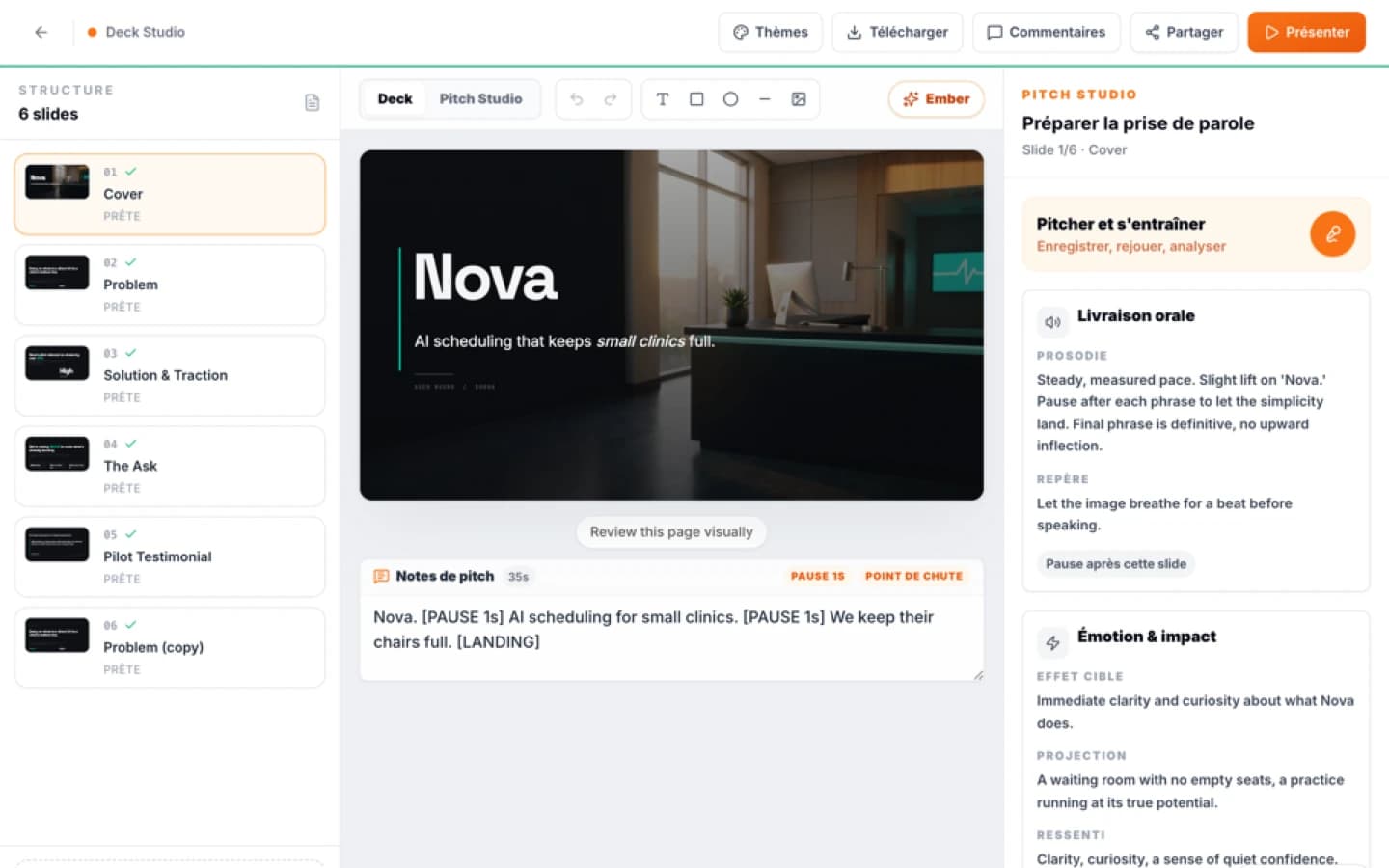
To move from analysis to action, Creation presents the corresponding Ember workflow.
Sources and methodology
This guide is built on a comparative analysis of modern sales workflows, contrasting high-volume outbound systems with prioritisation-first methodologies. The information on Apollo (access to 240 million contacts and 30 million companies, and an export credit consumed whenever a contact is exported outside Apollo) comes from its official website and its pricing page, consulted on 28 September 2026. Apollo's positioning for high-volume outbound prospecting is described in the alternatives guide by Coldreach, and the frameworks for moving a sales team on from founder-led sales draw on research from Pipedrive. Ember, the publisher of Lead Intelligence, describes its own capabilities and limits as they exist in the product today. This sourcing standard gives scale-up teams verifiable insights to guide their commercial decisions.
Sources
FAQ
Mini audit
Test your Pitch Deck
Get an initial diagnosis of substance, form and impact.