
Presenting a B2B venture to investors requires anchoring the opportunity in credible macroeconomic reality. The OECD provides that foundation: SME financing is the subject of an OECD Council Recommendation, a sign the topic is treated as a structural issue rather than a market episode.
The analysis published on 4 December 2025 on the OECD's Cogito blog, "Reigniting investment: How SMEs can lead the way", quantifies the diagnosis. Business investment across OECD countries remains 23% below its pre-2008 financial crisis trend, and no OECD economy has returned to its previous growth path. The micro, small and medium enterprise finance gap reaches USD 5.7 trillion, nearly 19% of GDP across the 119 emerging and developing economies measured, and 40% of formal SMEs are credit-constrained, per IFC data cited by the article.
Highlighting this gap positions the venture as an answer to an institutionally recognized bottleneck. Citing the OECD turns a product presentation into a discussion of market effectiveness, provided you then show that your own funding plan accounts for the same frictions.
To place this decision in context, How to Manage Runway with 13-Week Cash Discipline for SMEs? brings together complementary analysis in the same field.
What the OECD Diagnosis Actually Says
The OECD analysis details the barriers producing this deficit: high transaction costs, limited financial literacy, and heavy reliance on traditional bank lending while alternative options are rarely used. Many firms struggle to secure even basic working capital, let alone loans or venture capital for strategic investment.
The article also cites a 2025 C2FO survey in Mexico: SMEs there use early payments to cover operational costs such as inventory and payroll, with the smallest businesses most affected. Short-term financing serves the everyday, not strategic purchases: a useful detail for calibrating the reality of the problem addressed.
The analysis further sets three priorities for coordinated public-private action: building financial systems that work for SMEs rather than only large firms, bringing down the cost of finance and facilitating timely payments, and addressing the regulatory frictions that fall hardest on the smallest structures.
| Barrier noted in the analysis published by the OECD | What it means for your case |
|---|---|
| $5.7T MSME gap (~19% of GDP across 119 economies), an IFC figure | A globally recognized problem: your market is not an anecdote |
| 40% of formal SMEs credit-constrained | The customer you serve struggles to finance what you sell: anticipate the objection |
| Reliance on traditional bank loans, alternatives rarely used | Your own plan gains from combining equity, debt, and non-dilutive funding |
| OECD investment 23% below pre-2008 trend | Investors fund proof before promises: measurable traction required |
| Early payments covering inventory and payroll (C2FO, 2025) | Short-term finance serves the everyday: show how your offer reduces that need |
Using the Diagnosis Without Overplaying It
Correct use borrows the frame, not the figures. The $5.7 trillion gap measures a worldwide deficit concentrated in emerging economies: a founder raising in Europe uses it to establish the scale of the problem, then moves immediately to their market, customer, and solution. The citation opens the frame; it does not prove the product.
The documented barriers translate into diligence questions: if 40% of formal SMEs are credit-constrained, how does your customer finance your solution? If alternatives to bank lending remain rare, your own funding strategy can credibly combine equity, debt, and non-dilutive instruments. The founder who answers these questions with their own data moves from an OECD finding to an investment case.
This approach also connects with How to Build a 13-Week Cash Forecast for SME Leaders?, which clarifies the next choice.
From Institutional Finding to Funding Plan
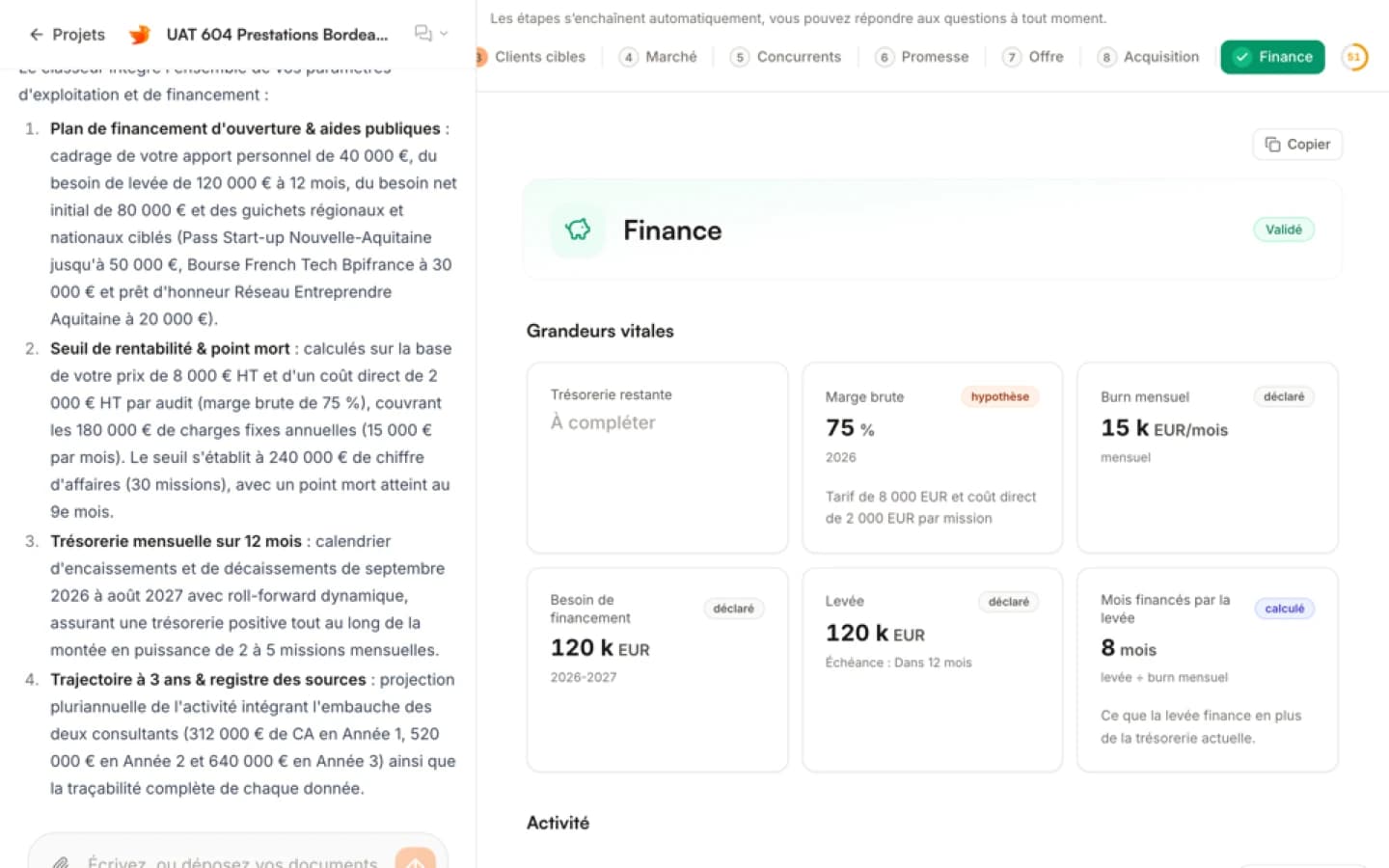
To turn the OECD frame into a plan, Fund Your Growth, Ember's financing module, replaces the generic options list with a funding path coherent with the project. It connects business modules in a living graph where weak points surface as priorities: the gaps in your case become ordered actions before investor meetings.
The platform also organizes finance, traction, legal, and investor documents into a Data Room tied to the case: each claim in the pitch, including the institutional citation, can be tied to accessible, verifiable evidence rather than decorative framing.
Before deciding, Market Validation Use Cases of Fund Your Growth for You helps connect this method with adjacent priorities.
Sources
FAQ
Mini audit
Test your Business Plan
Identify strengths, missing proof and the next priority.