
Context and ICP
For early-stage founders, validating the market is not a single event but a continuous process of aligning assumptions with what customers actually say and do. Before looking for outside capital, a founder has to show that the solution answers a real need. This is where Ember's Fund Your Growth helps: instead of treating a business plan as a static document, the founder uses it to map the way into the market and to structure validation milestones.
A first use case is aligning the funding strategy with the current stage of validation. Stripe's guide on raising capital for a young company describes five stages (pre-seed, seed, Series A, Series B and beyond) and seven sources of funding, from self-funding and friends and family to angel investors, venture capital, crowdfunding, government grants and bank loans. Its recommendation is to match the source to the stage of development: self-funding and friends and family to get started, angels at seed, venture capital for fast expansion, loans for established companies with steady revenue. It also warns that venture capital takes an equity share that can be substantial and can reduce the founders' control, while grants and self-funding avoid that dilution.
Fund Your Growth structures funding options from the context of the project, so the founder can see which paths are realistic given the traction reached so far. It links hypotheses, evidence, funding needs and the action plan in one context.
A second use case is consolidating first evidence. Founders looking for their first customers should collect proofs of demand in an organised way; Ember's guide on what evidence to check before choosing Fund Your Growth lists what to look at. The Data Room opens linked to the file and organises the file's documents, so that each claim in front of investors rests on documented feedback.
The seven sources in Stripe's guide each come with a trade-off. Self-funding gives full control but limited resources and possibly slow growth. Friends and family can be quicker and more flexible, with the risk of straining relationships and limited amounts. Angel investors bring mentoring, advice and networking, in exchange for equity. Venture capital brings substantial amounts and professional expertise, in exchange for significant dilution. Crowdfunding can validate the market and create visibility, but success is not guaranteed and copying is a risk. Government grants are non-dilutive and need no repayment, but the processes are complex and competition is strong. Bank loans offer a predictable structure without equity dilution, but require guarantees and strict criteria.
A validated file helps to weigh these trade-offs on facts. A founder who can show first traction may reasonably look at angels; one who can only show interviews may be better served by self-funding, a grant or a small loan while collecting more proof.
Whichever path you choose, the principle stays the same: know what you have proven before deciding what to ask for.
To place this decision in context, the Knowledge guides for finance bring together deeper guidance on the same field.
Problem
The obstacle is usually a gap between the founder's convictions and the realities of the market. Many early teams write a static plan that treats unverified assumptions as established facts. That approach builds on weak ground and makes it harder to secure seed capital or to build lasting momentum.
Three symptoms are common. First, the plan mixes what is proven with what is hoped: a market size taken from a report sits next to an unconfirmed willingness to pay, with no visible difference between them. Second, the funding path is chosen before the stage is known: a founder targets venture capital when the evidence available fits an earlier source better. Third, the material is scattered: interview notes, first projections, legal documents and early customer feedback live in different places, which prevents a coherent file for outside partners.
Stripe's guide points to the consequence: aligning the stage of a company with the right sources of funding requires a realistic assessment of its maturity. A founder who cannot say which stage the company is at cannot choose a source with confidence.
The consequence is often wasted effort. A founder who prepares an investor deck for a source that does not match the stage spends weeks on a document that the first reader sets aside. Another founder collects large amounts of feedback but never writes down which statement each piece supports, and ends up unable to answer a simple investor question.
It also shows in conversations. When an investor asks what is validated, a founder with a mixed plan answers with enthusiasm, and one with a clear file answers with a list. The second answer is easier to trust, even when the list is short.
Prerequisites
Before using Fund Your Growth to validate a market, a few foundations should be in place.
The first is raw material. Gather the qualitative and quantitative data you already have: customer interview notes, landing-page conversion data, feedback from early testers. Even a small amount is enough to start, provided each item is dated and you can say where it comes from.
The second is a clear objective. In Fund Your Growth the founder chooses a goal that becomes a file: test my idea, raise funds, loan or grant, business plan, or bootstrap, and gives the country of the project (France or the United States directly, or another country from a list). The objective determines which funding paths and which documents are relevant.
The third is time to review. Each proposal is approved, rejected or edited by the founder before it enters the file, so the founder must read what is proposed and correct it with what he or she knows from customers.
Before opening a file, it helps to read Ember's checklist of evidence to verify before choosing Fund Your Growth. Once the raw material is gathered, Ember makes visible the evidence available, the assumptions and what remains to be validated, and it links decisions to an action plan.
A fourth foundation is honesty about what you do not know. The tool works better when unknowns are entered as unknowns: an empty field is named as empty, and a validated block with no filled field produces no invented line. Do not fill gaps with plausible values just to move on.
If you have several documents, note that files are read separately: readable files continue if another one fails, and if none is available, no work starts and the reason for each is displayed. Prepare documents in common formats and check that they open.
Workflow
The path has three stages, each with a concrete output.
Stage one, map the hypotheses. Rather than writing a document that assumes success, the founder works through the nine blocks of the project (project, why, ideal customer, market, competitors, promise, offer, acquisition, finance). Each block has its versions, its evidence and its status, and the agent asks only the questions still useful. This first diagnosis prevents presenting unverified ideas to investors.
Stage two, turn gaps into tasks. The platform links decisions to an action plan and to items to validate. If the size of the target market or the willingness to pay is not yet proven, the action plan lists the customer interviews or landing-page tests needed to obtain the proof. As these validation steps are completed, the founder files the documents in the Data Room, organised in seven folders: file, identity, market, commercial, finance, legal and documents.
Stage three, carry the validated context into action. Once the strategy is validated, the same context feeds other Ember modules. Lead Intelligence can reuse the business plan, the ideal customer profile, the offer and the strategy to prepare a sales mission, so outbound prospecting rests on decisions made during planning rather than on generic templates. Lead Intelligence works whether the team starts from 10, 100 or 1,000 contacts, enriches them in waves of at most 200, and leaves the sending of messages to the founder.
Stripe's guide adds a discipline to all three stages: build a detailed budget covering setup costs and operating expenses, and diversify the sources of funding rather than depend on a single investor.
In practice, the loop should stay short. Do one round of interviews, update the blocks, look at what the action plan asks for next, and repeat. A small loop repeated is more useful than a long analysis done once, because each round changes what you know.
A living graph links the blocks, and the weak points come up first, so you know where to spend the next hour. If a customer interview contradicts an assumption in the offer block, the link shows which other blocks are affected.
Expected result
The expected result is a move from speculative hypotheses to a structured, defensible market-validation strategy. Instead of static documents that treat unverified ideas as facts, the founder has a clear, living view of the project.
First, the available evidence, the assumptions and the points still to be validated become visible. This prevents presenting unverified assumptions to investors or partners, and lets the founder focus scarce resources on the most critical uncertainties.
Second, decisions are linked to an action plan and to precise items to validate. Market feedback is not only collected: it is translated into strategic adjustments. The resulting business plan serves to fund and develop the project under realistic conditions, aligning the founder's vision with the traction actually observed. The Stripe guide's message on matching sources to stage points the same way: a preparation that fits the stage is what makes a funding conversation productive.
Third, the file's documents sit in a Data Room linked to the file, as described on Ember's business plan page. Each document, proof of traction and financial model stays in one place, ready for outside review.
The result is not a guarantee of funding. It is a file where each claim can be traced to a proof or is labelled as an assumption.
This approach also connects with What Angel Investors and Pre-Seed VCs Screen in 10 Minutes?, which clarifies the next choice.
For the founder, the concrete result is a short list of what is proven, what is declared and what is assumed, with the next validation step for each. For a reader, it is a file where every important claim can be traced. Neither depends on the tool: the value lies in the discipline it supports.
One caution: the result depends on the quality of what you put in. A file built on weak interviews will show weak evidence, and it is better to see that early than in front of an investor.
Example Ember mission
To make the path concrete, take an illustrative founder building a niche software-as-a-service product. This is an example of how the tool can be used, not an account of a real customer.
She opens a file with the objective test my idea and enters her country. She loads her interview notes and a short landing-page test. Fund Your Growth reads the documents, proposes content for the project and customer blocks, and marks the evidence level of each statement: document, declared or hypothesis. She approves the customer block, corrects the market block with what she heard in interviews, and rejects a proposal that goes beyond what she knows.
The plan of action then lists what is missing: five more interviews with a second type of customer, and a price test. As she completes them, she files the notes in the Data Room. When the customer and offer blocks are validated, she opens a Lead Intelligence sales mission that reuses them, so the outreach to potential customers matches the positioning she has actually tested.
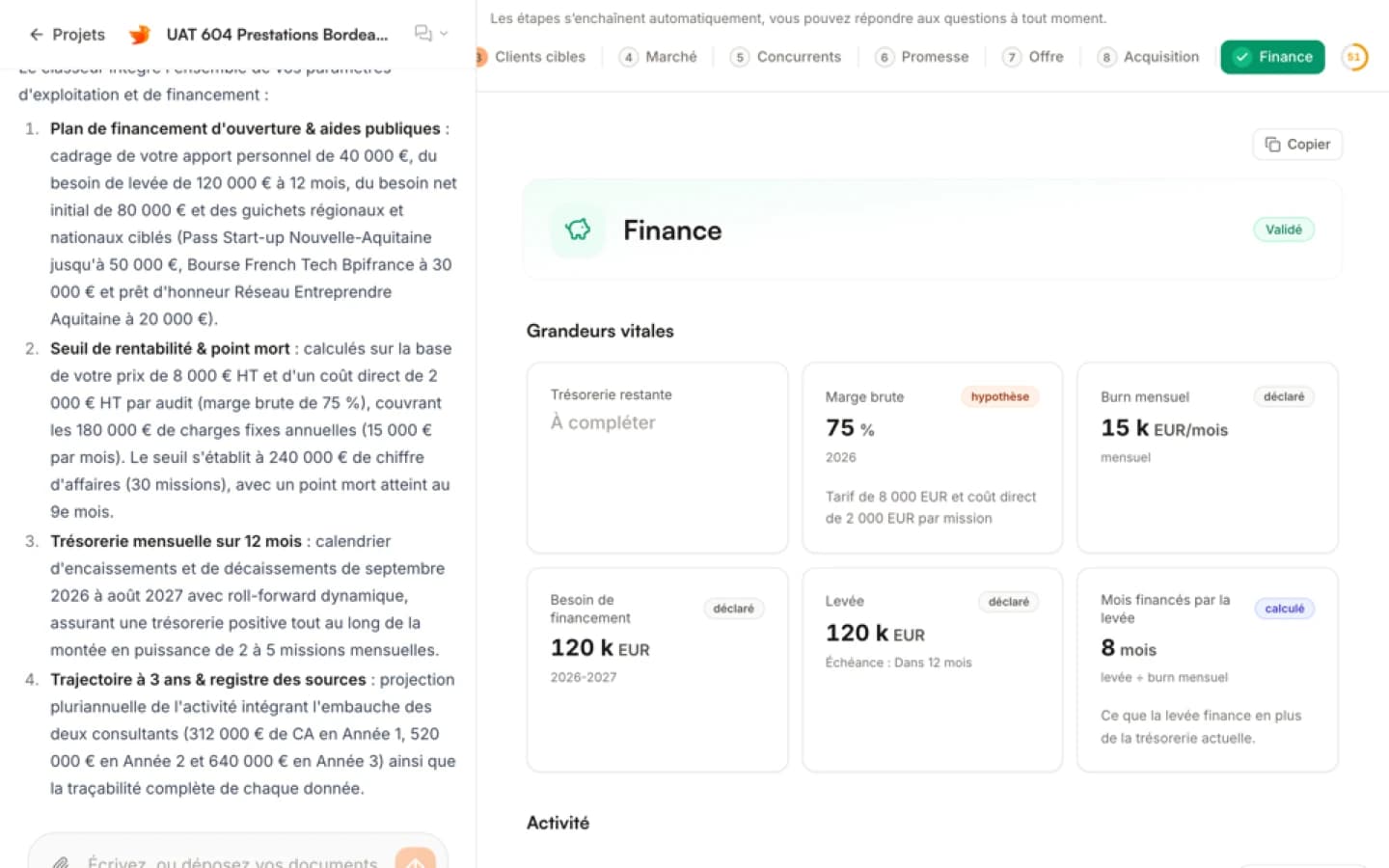
If she later decides to seek funding, the same file is the starting point: the finance block reuses the answers of the other blocks with visible, editable assumptions, and funding scenarios are adapted to the stage and the country. Aids remain to be checked against the conditions of the issuing body, and amounts not established stay marked to be confirmed.
A second illustrative case: a founder with interviews only, no revenue. The file shows customer and market blocks documented, the offer block declared, and the acquisition block as hypothesis. The funding paths proposed lean toward self-funding and, depending on the country, a grant or a small loan, and the action plan asks for a price test before any approach to investors. Again, this is an example of reasoning, not a real case, and the amounts of any aid stay to be confirmed with its issuing body.
Limits and non-fit
Several limits apply.
Access. Fund Your Growth is available progressively depending on the account and enabled rights. It is not open to everyone, and it is not offered in the iPhone and Android applications, where only Second Brain is available.
Coverage. The database of public aids is partial, with references in France, Germany and at European level. It is not exhaustive, and web leads remain to be verified.
Scope. A structured file is not an accounting certification, an investor decision or a guarantee of funds. Declared, estimated and confirmed figures stay separate, and an assumption is never presented as traction.
Non-fit. The approach is too heavy if you only need to test a landing page over a weekend, or if the project is not yet defined enough to name a customer. It also adds little if you already have a validated plan reviewed by an adviser and only need a presentation.
Legal, tax and accounting questions, such as equity structure or the conditions of an aid, are to be validated with the relevant professional.
One more limit concerns time. Structuring a file takes effort, and a founder in a very early phase may get more from ten conversations with customers than from a complete file. Start with the conversations, and open the file when you have something to put in it.
Finally, market validation is never finished. A file that was accurate at the time of a first raise may need updating before a second one, so plan regular reviews.
When to use it
Use it when you have a project idea and a first body of feedback, and you need to decide how far to go before seeking capital. It suits founders who must choose between several funding sources and want to compare them for their stage and country.
It also fits a team that needs a single file several people can read, or a founder who wants the plan, the Data Room and the sales mission to rest on the same validated context.
It is most useful when validation is still open: the tool makes it easy to see which assumptions are unproven and to turn them into tasks. Once everything is validated and stable, a simpler tracking method may be enough.
A good signal that it is time: you have feedback in several places, you cannot say quickly what is proven, or someone outside the team has asked to read your plan.
Next step
Choose one concrete action. List the five statements your plan depends on most, and mark each as proven, declared or assumed. For each assumed statement, write the interview, test or document that would prove it, with a date.
Then decide which funding stage your evidence supports today, using the stages and sources described in Stripe's guide as a reference. If you want a structure to hold this work, Fund Your Growth links hypotheses, evidence, funding needs and the action plan in one context.
Read next: Angel Investor Screening Criteria for Pre-Seed 2026, What Should SME Leaders Prioritize for 2026 Growth? and Cap Table Mistakes That Haunt Founders After a Seed Round.
Set a review date two weeks from now. By then, at least two assumed statements should have moved to proven, or been removed from the plan.
Sources
This guide draws on Stripe's guide on raising capital for a young company (stages and sources of funding, matching source to stage, dilution, budgeting), on Ember's own guide on evidence to verify before choosing Fund Your Growth, and on the documented behaviour of Fund Your Growth and Lead Intelligence. Stripe's guide is general and does not describe Ember. The example and the next-step questions are editorial suggestions, not measured results. Product availability can change: check the current state of your account.
Sources
FAQ
Mini audit
Test your Business Plan
Identify strengths, missing proof and the next priority.