
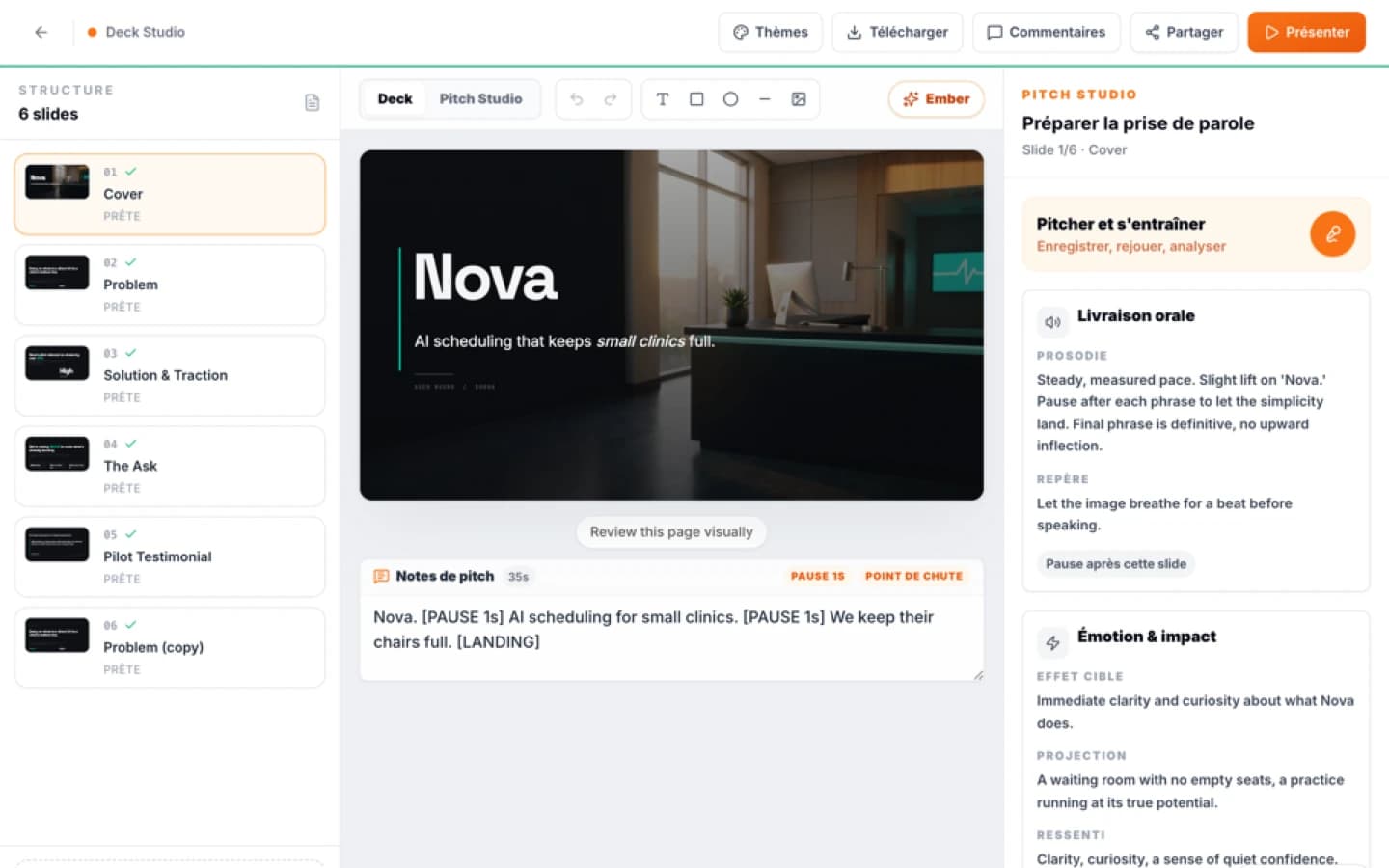
A founder can use Claude Projects to work with project documents and Ember's Second Brain to examine decisions in the context of a venture. The two tools answer different needs: one organizes a general-purpose document workspace, the other structures entrepreneurial judgment. Choosing between them depends on your daily constraint: synthesizing broad knowledge into working drafts, or pressure-testing operational decisions against your real project context.
What Claude Projects actually does
Claude Projects provides a workspace built around Anthropic's models. According to Anthropic's official documentation, projects are available to free and paid accounts, with free accounts limited to five projects. The RAG-enhanced knowledge base, which surfaces document excerpts as the context window fills, is reserved for paid Pro, Max, Team and Enterprise plans. Within these workspaces you set persistent instructions, upload source documents and run targeted threads that draw on that shared base.
Claude Projects is especially effective when an entrepreneur needs to:
- Produce interactive artifacts, code snippets or mockups directly in the interface, as described in Anthropic's Artifacts documentation.
- Run multi-step research that returns explicit citations, through the Research feature documented by Anthropic.
- Synthesize technical documentation or long-form text inside a clean, customizable document container.
What Second Brain does inside Ember
Second Brain, Ember's decision-support module, is designed around founder decision cycles rather than as a general document workspace. The Ember product page positions it as a decision layer that turns available context into clearer explanations and next actions.
Reasoning runs through three explicit modes the founder selects:
- Core: a direct answer grounded in available context, to clarify the immediate action.
- Deep: a deeper analysis for a complex trade-off. Ember can suggest it, but never changes mode or replays the request without explicit approval.
- Council: three developed opinions confronted before a clear conclusion. Council reads attachments, reads supplied public links, performs bounded web research and always remains manual. It produces no file and no media: it produces a debate and a conclusion.
Second Brain also retains durable instructions and context that the founder can read, correct or delete, and its library lets you attach existing images and documents as references without uploading them again.
Structural tradeoffs: document container versus decision layer
The operational difference shows in how context is processed. Claude Projects can restate what a document contains and generate an artifact from project instructions; strategic prioritization and founder-specific workflows depend on the framework you supply and the integrations you configure. Second Brain connects project context to action-oriented reasoning: it compares choices and identifies the next step, whose usefulness depends on the evidence actually provided.
The limitations are symmetric. On Claude's side, advanced capabilities depend on the plan: RAG, research and connectors remain conditioned by subscription and permissions. On Ember's side, Council debates without producing a deliverable, videos and slide collections in the library remain visible but cannot yet be attached to a conversation, and an interrupted image generation is not resubmitted automatically.
To place this difference between a decision copilot and an activity log, the analysis Prospecting Agents or Intelligent CRM: Which Architecture for an SMB? shows how the same trade-off appears in prospecting, while Back-Office Automation for Bootstrapped B2B Founders Before the First Hire illustrates a bootstrap founder's priorities.
Which tool for which founder
You do not always need to pick a single winner, but you do need clear swimlanes in your software stack.
Select Claude Projects if your priority is writing modular code, drafting campaigns, generating interactive components via Artifacts, or organizing a technical research library. It is a practical general-purpose workspace for processing raw information.
Turn to Second Brain when you need to break founder isolation, stress-test business decisions against actual venture constraints and turn project memory into concrete operational priorities. Second Brain anchors your everyday reasoning in the reality of your venture, to move from evaluation to action.
| Dimension | Claude Projects | Second Brain |
|---|---|---|
| Primary objective | Self-contained workspaces for writing, research and prototyping | Structured judgment and next-step operational decisions |
| Reasoning modes | Standard chat and multi-step research with citations | Core for direct answers, Deep for thorough analysis, Council for three-opinion debate |
| Context model | Project instructions and document base, RAG reserved for paid plans | Readable, correctable durable memory; attachable image and document library |
| Tangible outputs | Interactive artifacts, code snippets and text drafts | Reasoned answers, analyses and creations produced in conversation |
| Key limitation | Advanced capabilities conditioned by plan and account permissions | Council produces debate without files or media; videos and decks not attachable |
Sources
- Claude, projets, recherche et artefacts
- Retrieval augmented generation (RAG) for projects : réservé aux plans payants Pro, Max, Team et Enterprise
- Using Research on Claude : recherche agentique en plusieurs étapes avec citations
- Prototype AI-powered apps with Claude Artifacts : artefacts interactifs dans l'interface
- Second Brain, couche de décision d'Ember pour les fondateurs
FAQ
Second Brain
Decide with project context
Ask a question and connect the answer to decisions already made in Ember.