
The 90-Day Reality of Founder-Led Outbound
Landing your first 10 enterprise users requires manual, high-context customer discovery rather than automated volume. Early enterprise sales cycles stall when founders invest in multi-channel sequencing platforms before establishing which specific problem buyers will pay to solve. As Paul Graham documented in his July 2013 essay Do Things That Don't Scale, the most common unscalable task founders face at the start is recruiting users manually.
During the first 90 days, your objective is message validation and objection discovery. Setting up high-volume email sequencers during this initial window creates noise and risks burning your corporate domain before you understand the language of your buyer. Incumbent tools like Apollo or Clay excel once a message has demonstrated product-market resonance, but deploying them on day one substitutes distribution activity for customer learning. A structured 90-day outbound campaign advances through three sequential phases, moving from immediate relationships to unscalable manual outreach, and finally to disciplined qualification.
The Y Combinator Acquisition Sequence: Customers 1 Through 10
According to analysis compiled by Y Combinator Visiting Partner Max Kolysh in the YC Startup School guide on landing early customers, successful founders follow a distinct progression across their initial customer acquisitions.
Customers 1 to 3: The Warm Network
The first three enterprise accounts almost invariably come from direct personal relationships:
- Former colleagues and managers who trust your execution capability.
- Classmates and co-workers operating within target accounts.
- Direct introductions requested from mutual industry peers and second-degree LinkedIn connections.
These conversations test whether the underlying pain point resonates with people who already know your capabilities. They provide rapid, candid feedback on pricing, security requirements, and feature gaps without the friction of cold prospecting.
Customers 4 to 10: Manual, Unscalable Discovery
Moving past your personal circle requires manual legwork rather than mass outreach. Max Kolysh notes in the YC guide that customers four through ten emerge from focused, unscalable actions:
- Attending niche industry conferences and founder gatherings where your specific target stakeholders congregate.
- Directly answering detailed technical questions on forums, Reddit, or industry message boards where prospective buyers discuss operational blockers.
- Conducting on-site visits to observe target enterprise workflows firsthand.
The YC material recounts the experience of one founder who secured more business in three days attending a dedicated trade show than across three months of cold email outreach directed at the same legacy market. Meeting buyers where they operate allows founders to identify nuanced pain points that cold email templates routinely miss.
Customer 10 and Beyond: Qualifying Repeatable Signals
Only after securing your first ten reference customers does dedicated sales engagement tooling become genuinely useful. At this milestone, you possess reference accounts, measurable proof points, and real customer language. Deploying prospecting platforms prior to this stage scales an unvalidated pitch, whereas deploying them after customer ten amplifies a proven trigger. When structuring messaging for this next stage, founders benefit from studying how buyers evaluate technical vendors, as detailed in The Ember Brief #16 on reframing prospecting messages.
Outreach Tactics for Early Founder Conversations
When cold outreach becomes necessary to bridge the gap between network introductions and event discovery, the execution must remain focused, concise, and personal.
Message Construction and Length
Enterprise executives review dozens of unsolicited pitches each week. The YC Startup School framework outlines four operational rules for early outreach:
- Enforce a strict word limit: Keep cold messages under 75 words. Brief messages respect the executive's time and force clarity of thought.
- Present a single action: Propose one clear, low-friction next step, such as a brief introductory exchange or feedback request, rather than multiple links or calendar options.
- Audit message tone: Read the entire draft aloud before sending to ensure it sounds like an authentic peer-to-peer inquiry rather than marketing automation copy.
- Follow up systematically: Follow up three or four times over a couple of weeks before marking a lead inactive. Early enterprise buyers frequently miss initial notes while remaining receptive to polite persistence.
Framing Outreach Around Industry Dialogue
Framing your first outreach as a request for executive perspective often reduces initial friction. In the YC library entry, one founder recounted that approaching target executives for advisory input converted roughly 20% of accepted LinkedIn connection requests into exploratory calls, starting from a self-reported 50% acceptance rate on initial requests. While these metrics represent an individual founder anecdote rather than a controlled comparative study, they highlight how positioning outreach as peer collaboration opens doors that standard product pitches close.
Founders must also observe compliance requirements when identifying contacts. Sourcing executive addresses through unverified commercial scrapers carries enterprise risk, an issue covered in our analysis of buyer liability when purchasing contact lists.
Structuring the 90-Day Execution Calendar
To prevent prospecting from derailing core product development, organize your outbound cadence into three distinct 30-day operating blocks.
| Phase | Core Objective | Primary Channels | Target Milestone |
|---|---|---|---|
| Days 1 to 30 | Hypothesis Testing | Warm network, former colleagues, 2nd-degree introductions | 3 live design partners |
| Days 31 to 60 | Unscalable Field Sourcing | Trade conferences, community boards, founder roundtables | Accounts 4 through 7 committed |
| Days 61 to 90 | Controlled Manual Outbound | Targeted 1-to-1 emails, peer LinkedIn messages | 10 referenceable customers |
During the final 30 days, your focus shifts to converting validated conversational patterns into a repeatable outbound workflow. You will track which job titles engage, what business events trigger internal purchase reviews, and which objections recur across procurement teams.
Moving Beyond Spreadsheets: Contextual Outbound with Ember
Once you have verified your positioning across your first ten enterprise accounts, maintaining pipeline clarity requires structuring account research. High-volume sequencing suites often encourage spray-and-pray habits that risk executive relationships.
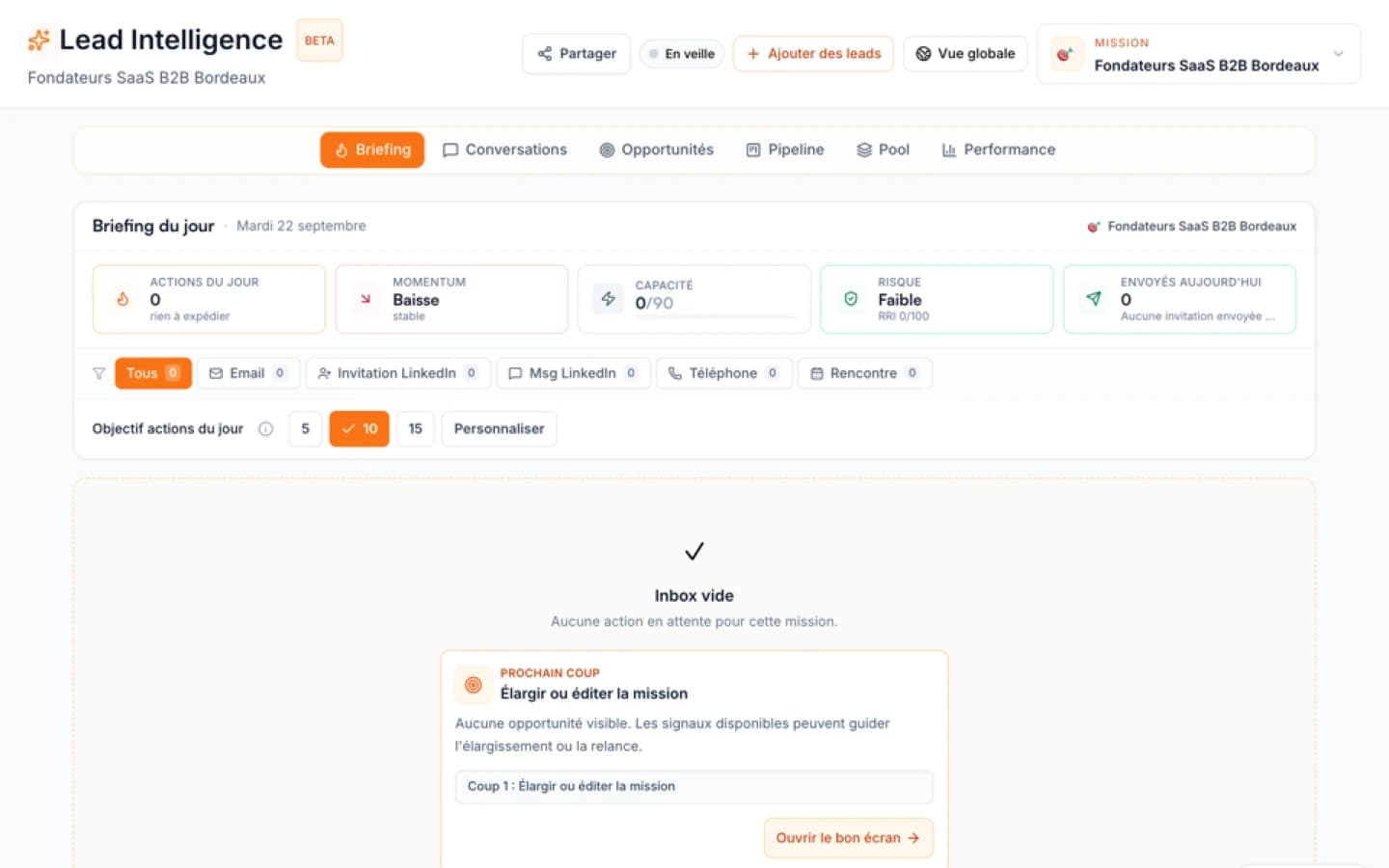
For founders scaling beyond manual tracking, Ember Lead Intelligence prioritizes accounts based on contextual timing rather than brute force volume. Ember connects directly to your existing workspace, supporting read-only imports of up to 500 contacts from Pipedrive, or CSV and Excel file uploads of up to 3,500 lines across 200 columns.
Rather than executing unmonitored automations, Ember implements manual approval by design:
- The system analyzes public business signals, executive movements, and communication styles to draft suggested outreach in your mission language.
- Every proposed message remains in draft state until you personally review it.
- When you click to validate and send via connected Gmail, Outlook, or LinkedIn accounts, Ember provides a ten-second cancellation window before dispatching.
- Contact exclusions and do-not-contact lists are enforced across email addresses, domains, and LinkedIn profiles, ensuring ongoing alignment with business-to-business legitimate interest practices under Article 6(1)(f) of the General Data Protection Regulation (GDPR).
Founders looking to expand their commercial workflow can explore the Knowledge guides for sales or review account qualification workflows on the Ember Lead Intelligence platform.
Sources
FAQ
Free diagnostic
Test your sales file
Drop an Excel or CSV and check its readiness without sending its rows to Ember.