
Signal of the week
Many B2B prospecting messages look alike: a company introduction, three features, a meeting request. The prospect reads what you sell, rarely what it changes for them.
The B4B model, for "business for business", has raised this problem for more than ten years. It was launched by J.B. Wood, president of the trade association TSIA, at the TSW 2013 conference, with the book "B4B: How Technology and Big Data Are Reinventing the Customer-Supplier Relationship", written with Todd Hewlin and Thomas Lah. The publisher's description sums it up in one sentence: the traditional world of B2B was designed to sell things to customers, whereas the new B4B model will be about delivering outcomes for customers.
What the model says
At the heart of B4B, TSIA describes what it calls "The Great Divide": suppliers focus on building and selling products, while their customers want to run a business and get great outcomes. The association distinguishes four supplier models, from Level 1 to Level 4. At Level 1, classic B2B is about selling something to someone. At Level 4, according to J.B. Wood, customers only pay for the outcomes they get.
A small team does not need to change its pricing model to benefit. The first useful change sits in the message: talk about the outcome the customer is after before talking about yourself.
Reframing a message in three steps
- The outcome, in the customer's words. Start from what the prospect is trying to achieve in their business: cut a delay, meet a deadline, secure a renewal. Avoid recasting your feature as a generic benefit.
- Today's gap. Describe the situation that keeps them from that outcome, with something you actually observed at their company or in their sector. This is what shows you understood their problem.
- A measurable first step. Suggest a short exchange to check the gap and what a first result could be. Do not promise a number you cannot prove.
A reframing example, for illustration. B2B version: "Our software automates your customer reminders with three features." B4B version: "Your teams probably spend time chasing late invoices at month end. I would like to understand how you handle it today and see whether a first gain is possible within a quarter."
What it changes during the call
A message centred on the outcome prepares a call centred on the prospect's problems. In its analysis of 519,000 recorded discovery calls, Gong finds that the most effective calls uncover between three and four business problems. A B4B message opens that conversation more naturally than a feature list.
The limits
TSIA's book and blog describe an analysis framework proposed by a trade association of the technology services industry. They are not studies measuring the effect of a message on a reply rate. Talking about outcomes also commits you: if the customer never sees that outcome, the message will backfire.
With Ember
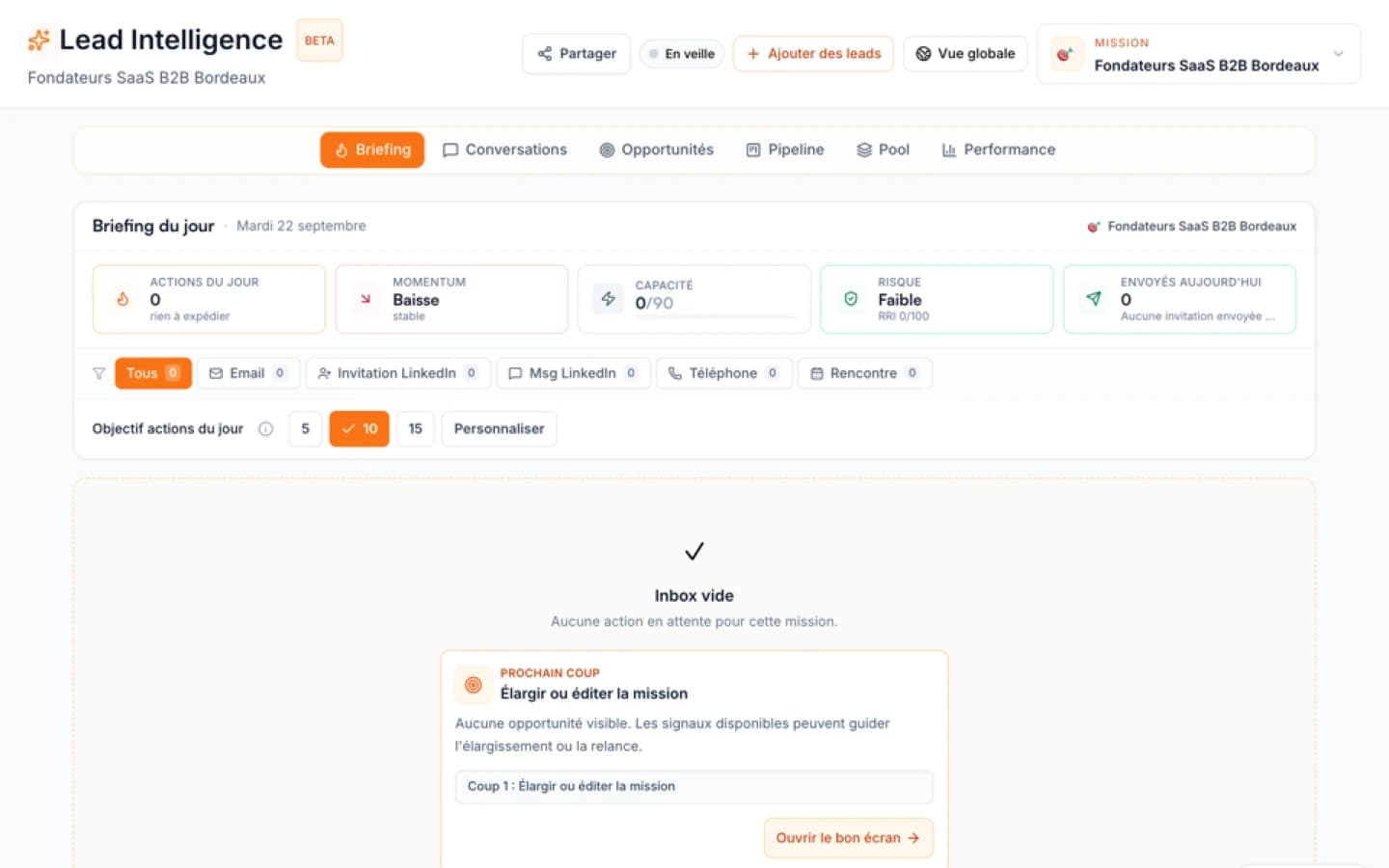
Lead Intelligence helps decide who to contact, why now and with which angle, by detecting changes across people and companies. That is the starting point of step 2: a gap observed rather than assumed.
Further reading
- Why Narrative B2B Sales Pitches Outperform Feature Lists extends the idea to the meeting.
- How to Build a B2B Pitch Deck Around Cost of Inaction? helps you state the gap.
- Build a 10-Slide Sales Deck That Drives Buyer Decisions covers what comes after the first call.
Sources
- TSIA, "B4B Business Era: Services and Outcomes", Stephen Fulkerson, updated December 17, 2014, accessed November 13, 2026: https://www.tsia.com/blog/success-in-the-new-b4b-era
- Publisher's description of the book "B4B", J.B. Wood, Todd Hewlin and Thomas Lah, no visible date, accessed November 13, 2026: https://shop.btpubservices.com/Title/9780986046209
- Gong, "Mastering discovery calls to close deals effectively", Chris Orlob, published July 5, 2017, last modified March 4, 2026, accessed November 13, 2026: https://www.gong.io/blog/deal-closing-discovery-call
Sources
FAQ
Free diagnostic
Test your sales file
Drop an Excel or CSV and check its readiness without sending its rows to Ember.