
Choosing between Apollo and Clay comes down to a fundamental architectural difference: whether your outbound operation needs an all-in-one contact database with built-in sequencing, or a flexible spreadsheet orchestrator that queries dozens of data vendors in sequence.
Apollo acts as a centralized prospecting engine with its own proprietary directory, dialing, and native email automation. Clay functions as a data integration canvas where you assemble custom prospecting tables, run waterfall enrichment across external vendors, and push clean records into external systems. Understanding the exact mechanical tradeoffs of both approaches will help you avoid paying for unnecessary credits or over-engineering a simple outbound workflow.
Architecture: Native Database vs Multi-Provider Waterfall
The core distinction between the two tools lies in how they source and verify prospect information.
Apollo operates as an integrated directory and execution platform. It provides company and contact discovery using job title, seniority, company size, industry, location, and intent filters, coupled with inbound enrichment and routing Apollo. Because the directory and outreach engine live in the same product, a sales representative can search for prospects, verify them, and add them directly into automated nurture and follow-up sequences without leaving the application Apollo. This tightly coupled model reduces tool switching and allows teams to prospect and execute campaigns inside a single interface.
Clay takes a modular approach focused on data aggregation and conditional logic. Rather than relying solely on a single internal repository, Clay lets users enrich records across 150 or more third-party data providers via waterfall workflows across all plans Clay Pricing. In a waterfall workflow, the platform checks a primary provider for an email or phone number; if that provider returns no match, it automatically queries a second or third vendor down the chain. Furthermore, if an enrichment step returns no result, Clay does not charge data credits or actions for that specific query Clay Pricing. Teams can also supply their own application programming interface (API) keys for supported providers to bypass platform data credits entirely, consuming only workspace actions Clay Pricing.
This architectural split means Apollo delivers speed and immediate convenience, while Clay delivers higher coverage and match depth for teams working across niche audiences or fragmented geographies.
Execution and Outreach Workflows
Finding a record is only half the battle; how that record moves into an active sales campaign determines your daily operating efficiency.
Apollo is built for immediate sales engagement. Its platform includes email sequences, task reminders, campaign workflows, and dialer functionality directly linked to contact records Apollo. Its pricing structure distinguishes between viewing data within the platform and taking it outside: users consume export credits whenever exporting a contact outside of Apollo via CSV files, customer relationship management (CRM) sync, or API enrichment Apollo Pricing. For revenue teams that execute their outbound directly inside Apollo, this setup minimizes data movement and keeps costs predictable.
Clay focuses strictly on intelligence gathering, data normalization, and payload preparation rather than native email delivery. Sales operations teams use Clay to pull lists from various sources, run automated research prompts, verify deliverability, and format personalizations before routing the enriched data to an external sending tool or CRM. For teams building complex territory strategies, examining guides such as using Business Formation Statistics for territory planning can help clarify when raw list volume must give way to strict market segmentation.
Credit Consumption and True Cost Structure
Both platforms rely on usage-based credits, but their billing mechanics, consumption rates, and rollover policies operate very differently.
Apollo prices primarily by user seats while allocating a pool of platform credits. When billed annually, its Basic plan costs $49 per seat per month with 30,000 credits per seat granted upfront, the Professional plan costs $79 per seat per month with 48,000 credits, and the Organization plan costs $119 per seat per month with 72,000 credits and a three-seat minimum Apollo Pricing. On monthly billing, Basic is $65 per seat per month with 2,500 credits, Professional is $99 per seat per month with 4,000 credits, while the Organization plan displays $149 per seat per month with a three-seat minimum marked as annual only Apollo Pricing. Apollo also offers a Free tier providing 900 credits per seat per year on annual display, or 75 credits per month on monthly display Apollo Pricing.
Inside Apollo, actions cost different credit amounts: finding an email costs 1 credit, accessing a verified phone number costs 8 credits, running artificial intelligence (AI) research costs 1 credit per run, and using the US dialer costs 1 credit per 30 seconds Apollo Pricing. Unused Apollo credits expire at the end of each billing cycle and do not carry over Apollo Pricing.
Clay separates its consumption into platform actions and data credits. Platform actions cover computational steps, formulas, and workflow runs, while data credits pay for information retrieved through Clay's native partner network Clay Pricing. On monthly billing, Clay's Launch plan costs $185 per month (or $167 per month billed annually) and includes 15,000 actions and 2,500 data credits Clay Pricing. Its Growth plan costs $495 per month (or $446 per month billed annually) and includes 40,000 actions and 6,000 data credits Clay Pricing. The Free plan provides 500 actions and 100 data credits per month, with tables limited to 200 rows and no phone enrichment Clay Pricing. Enterprise plans require a custom annual commitment Clay Pricing.
Unlike Apollo, Clay allows unused data credits on Launch and Growth plans to roll over up to two times the monthly credit allocation, though platform actions reset every billing cycle without rolling over Clay Pricing.
| Feature or Policy | Apollo | Clay |
|---|---|---|
| Primary Operating Model | Centralized database with native outreach | Spreadsheet interface for multi-source enrichment |
| Data Provider Sourcing | Proprietary native directory | Waterfall routing across 150 plus data providers |
| Phone Number Data Cost | 8 credits per phone number | Dependent on provider chosen in waterfall steps |
| Credit Rollover Policy | Unused credits expire at end of billing cycle | Data credits roll over up to 2x monthly amount |
| Failed Enrichment Charges | Charged per credit structure | No charge for data credits or actions on empty return |
| Third-Party API Key Usage | Standard plans for internal business use only | Bring your own API keys to bypass data credit fees |
| Free Tier Allowance | 75 credits monthly or 900 credits annually | 500 actions and 100 data credits per month |
Decision Framework: When to Choose Each Platform
Choosing the right tool depends on your team's existing software stack, technical comfort, and outbound volume.
When Apollo is the Practical Choice
Apollo is well suited for lean sales teams, early-stage founders, and sales development representatives who want a direct path from prospect discovery to email dispatch. If you need a comprehensive directory where an SDR can run filters, assemble a list of contacts, and trigger a multi-step sequence without setting up external webhooks or database connectors, Apollo provides that efficiency at an accessible seat cost Apollo. It eliminates the need to pay separately for a database, an email sequencing platform, and a sales dialer.
When Clay Fits Better
Clay is the stronger fit for growth engineering teams, RevOps professionals, and specialized outbound agencies targeting tight addressable markets. If your target buyers are difficult to locate in standard directories, or if you need to verify data points across multiple vendors before reaching out, Clay's waterfall enrichment ensures significantly higher match rates Clay Pricing. It is also the ideal choice if you already own dedicated API subscriptions to specialized data vendors and simply need an orchestration layer to clean and merge your prospect records.
Contextualizing Prospect Data with Ember Lead Intelligence
Both Apollo and Clay focus on discovering who a prospect is and how to reach them. However, turning a contact into a closed deal requires understanding whether an account genuinely matches your strategic positioning and timing.
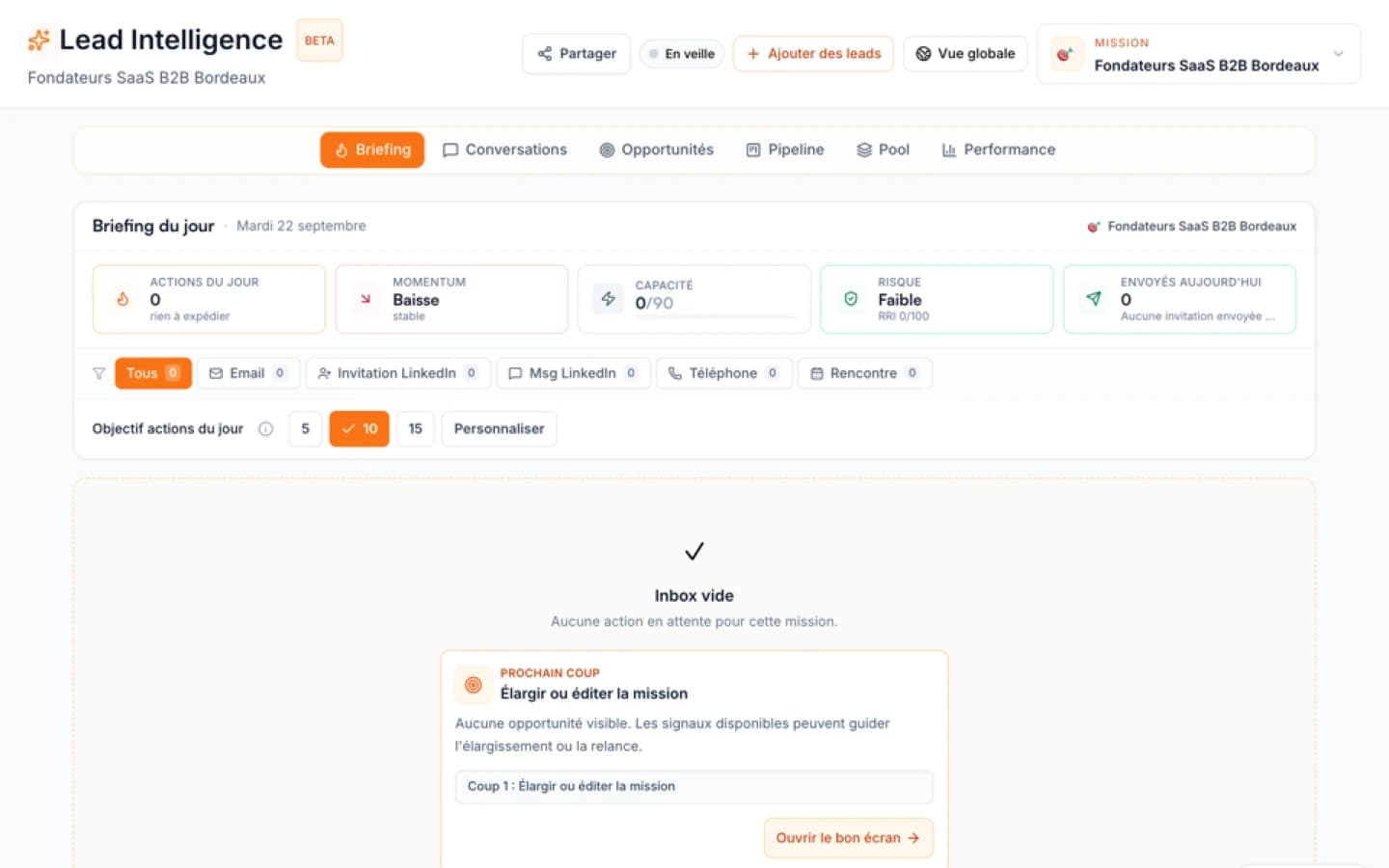
Ember approaches sales qualification from the perspective of commercial context rather than raw directory volume. Through Lead Intelligence, commercial teams analyze inbound and outbound opportunities against substantive qualification criteria, market signals, and strategic positioning frameworks. Rather than simply acquiring more unvetted email addresses, teams use Ember to evaluate account viability and ensure sales conversations focus on accounts with legitimate commercial fit. Readers auditing their qualification mechanics can explore BANT vs MEDDPICC evaluation criteria or consult the Knowledge guides for sales to refine how outbound discovery aligns with deal pipeline hygiene.
Sources
- Clay : plans Free, Launch, Growth et Enterprise, prix affichés en annuel et en mensuel, actions et crédits de données : source S1
- Apollo : grille tarifaire lue sur la page officielle, en facturation annuelle et mensuelle, et coût en crédits des actions : source S1
- Apollo: contact discovery, outreach and export-credit conditions: source S1
- Apollo price and term receipts
FAQ
Free diagnostic
Analyse your Apollo data
Check whether your Apollo contacts are complete and recent enough to prioritise.