
When a enterprise buyer enters a pitch call today, they rarely arrive empty-handed. Before speaking with your sales team, they have often prompted a large language model or an AI search engine with prompts like "Compare the top three vendors in this space" or "What are the common hidden costs of implementing this architecture?" As a result, the introductory slides that once carried a discovery call (the market trends, the category definition, the standard problem statement) are not merely redundant. They signal that the vendor is speaking to an imaginary novice rather than the prepared executive in the room.
To win deals against category summaries generated by machines, commercial teams must move from educational presentations to trade-off validation. The goal of the pitch is no longer to explain what the category does, but to audit the assumptions the buyer gathered before the call and anchor the decision in their specific operational reality.
The Synthetic Discovery Gap: How AI Search Pre-Conditions the Buyer
Modern enterprise buyers use answer engines to bypass traditional whitepapers and surface quick vendor matrices. According to HubSpot's survey of CRM buyers, 42% of CRM buyers used AI search during their evaluation, and those buyers were 36% more likely to purchase than those who didn't use AI search.
This shift indicates strong purchase intent, but it creates a specific friction point in the sales cycle:
- Illusion of complete knowledge: The buyer believes they understand your feature parity, tier structures, and drawbacks because a summary table listed them in four bullet points.
- Homogenized value propositions: Because generative engines train on public marketing materials, competitor websites, and general forum consensus, they compress differentiated philosophies into generic capability badges.
- Ghost objections: The buyer has absorbed uncited claims regarding deployment complexity, security gaps, or licensing friction that may belong to legacy versions or competing vendors.
If your reps open a call with a standard ten-slide corporate overview, they squander the elevated intent of that buyer. The pitch must immediately acknowledge the preliminary research and pivot to the structural nuances that public language models consistently miss.
What Machine Summaries Miss (and What Sellers Must Supply)
Generative summaries excel at synthesizing consensus, but consensus is precisely what fails to solve an edge-case implementation. Machine-generated overviews routinely omit three business realities:
- Contextual trade-offs: An AI summary can state that a platform offers custom reporting, but it cannot explain how that reporting engine behaves under complex multi-entity permission schemas.
- Organizational friction: Algorithms do not account for change management bottlenecks, internal political alignment across stakeholders, or legacy data debt.
- Conviction and stakes: As communication designer Nancy Duarte observes regarding business storytelling, effective persuasion requires one clear idea, stated as a point of view plus the stakes of taking or failing to take action. AI summaries provide neutral recaps; they do not supply an actionable point of view.
When sales teams rely on broad category claims, they validate the generic summary the buyer already holds. To break that frame, the conversation must zero in on the precise trade-offs of the buyer's operating environment. For teams exploring broader enablement strategies across the deal cycle, the Knowledge guides for sales provide additional frameworks for aligning go-to-market motions with changing buyer behavior.
Four Adjustments to Make in Your B2B Pitch Deck
Adapting a commercial pitch for the AI-briefed buyer requires structural changes to the slide deck and narrative delivery.
1. Delete the "State of the Industry" Section
Never spend the first five minutes explaining the macroeconomic trends or category drivers that the buyer has already queried. Instead, open with an immediate hypothesis regarding their operational bottleneck. If you sell data infrastructure, replace the slide on exponential data growth with a direct assessment of why hybrid query latency degrades their specific reporting pipeline.
2. Surface and Interrogate the Consensus View Early
Proactively state the common synthetic narrative about your space. You can say: "If you ask an AI engine how to choose between the vendors in our quadrant, it will tell you that Option A is for enterprise governance, Option B is for low cost, and we are built for rapid workflow deployment. That summary is roughly eighty percent accurate, but it glosses over where that division breaks down."
Framing the conversation this way immediately establishes senior domain authority. It tells the buyer that you understand the market landscape better than the aggregated web text they digested that morning.
3. Replace Feature Checklists with Architectural Decision Trees
When buyers believe feature lists are comparable, deals slide into commoditization and pricing battles. Your slides should focus on the architectural divergences that public summaries reduce to simple checkmarks. Show what happens when a process scales, how edge cases are routed, and where competing architectural choices create technical debt over time.
| Evaluation Angle | AI-Generated Category Summary | Account-Calibrated Commercial Pitch |
|---|---|---|
| Problem Framing | Broad category pain points and macroeconomic context | The buyer specific architectural or operational bottleneck |
| Solution Proof | Generic feature tables and standard parity matrices | Concrete scenario modeling grounded in customer source data |
| Competitive Angle | High-level strengths and weaknesses aggregated from the web | Direct examination of edge cases, architectural tradeoffs, and operational limits |
| Desired Outcome | Surface-level category orientation | An executive decision moving from evaluation to project validation |
4. Ground the Asset in the Buyer's Source Context
Generic presentation templates look identical to the summary materials generated by presentation software. For early-stage discovery or routine collateral, tools that generate quick slides can be entirely adequate; comparisons like Decktopus vs Gamma: Choose the Best Presentation Engine outline where lightweight template generators save time on basic outbound decks.
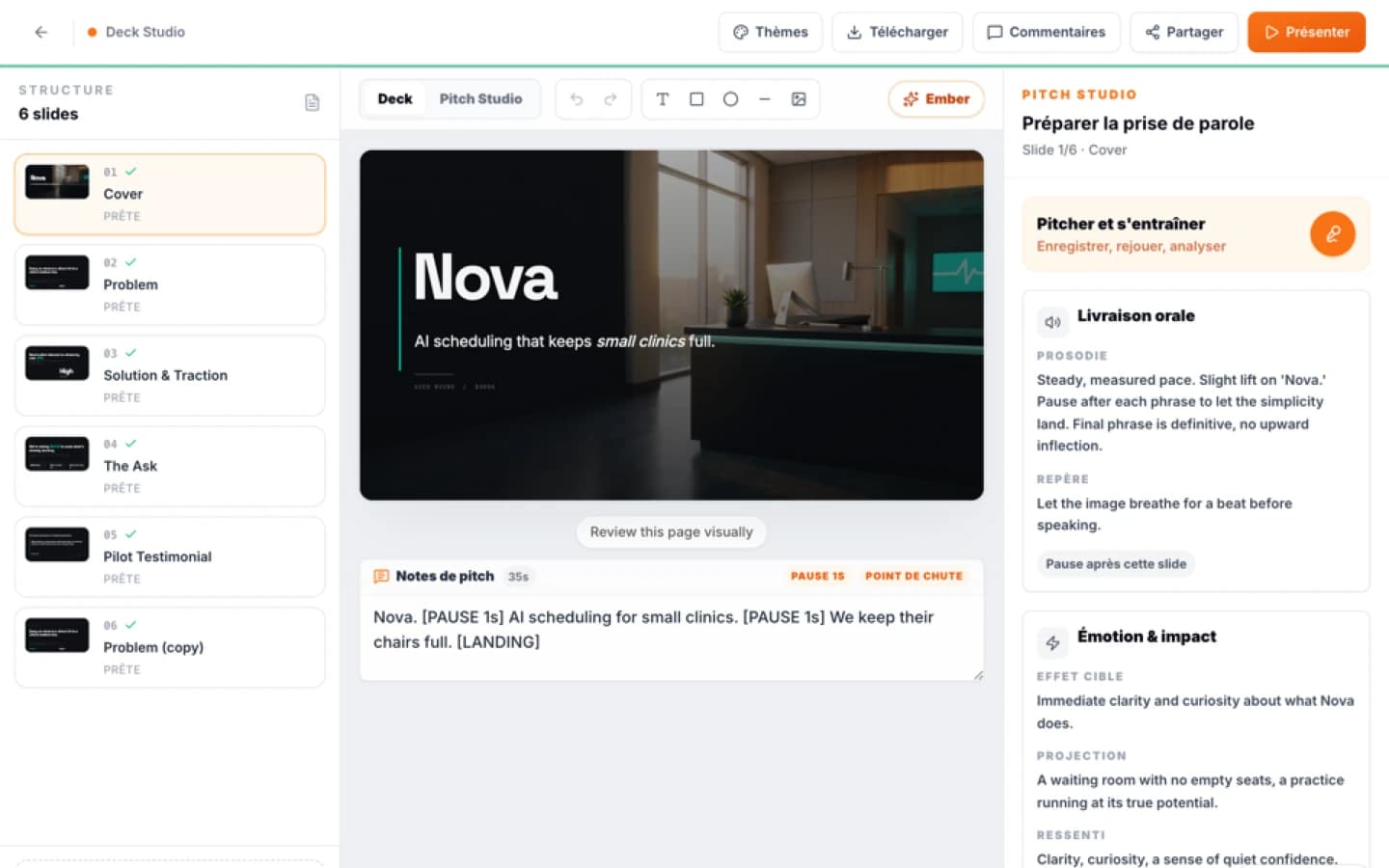
However, when pitching an informed buyer who has already digested synthetic summaries, visual polish alone will not win the room. Ember takes a fundamentally different path with its AI pitch deck capabilities: Creation starts from project context and data rather than a generic template. By translating raw strategic inputs directly into clear structural arguments, it helps the presentation build understanding and move a decision forward beyond visual polish.
Structuring the Meeting: From Discovery to Strategic Action
When your prospect arrives with synthetic pre-conceptions, run the meeting in three structured phases:
- The Context Audit (Minutes 0 to 10): Ask the prospect what their preliminary research highlighted about the category. Validate what they got right, and flag the two or three critical points where public market summaries produce misleading conclusions.
- The Operational Stress-Test (Minutes 10 to 30): Walk through how your approach handles their constraints. Use concrete data structures, workflow boundaries, and real deployment requirements rather than marketing mockups.
- The Next-Step Agreement (Minutes 30 to 45): Move past the demonstration into an agreed validation plan. Define the exact metrics, security requirements, or pilot scopes needed to substantiate the technical claims made during the call.
When buyers have access to instant synthesis, sellers who merely summarize will quickly find themselves replaced by the summary. Commercial teams that succeed do so by bringing proprietary perspective, testing assumptions against operational reality, and structuring decks that transform passive category knowledge into clear business decisions.
Sources
FAQ
Mini audit
Test your Pitch Deck
Get an initial diagnosis of substance, form and impact.