
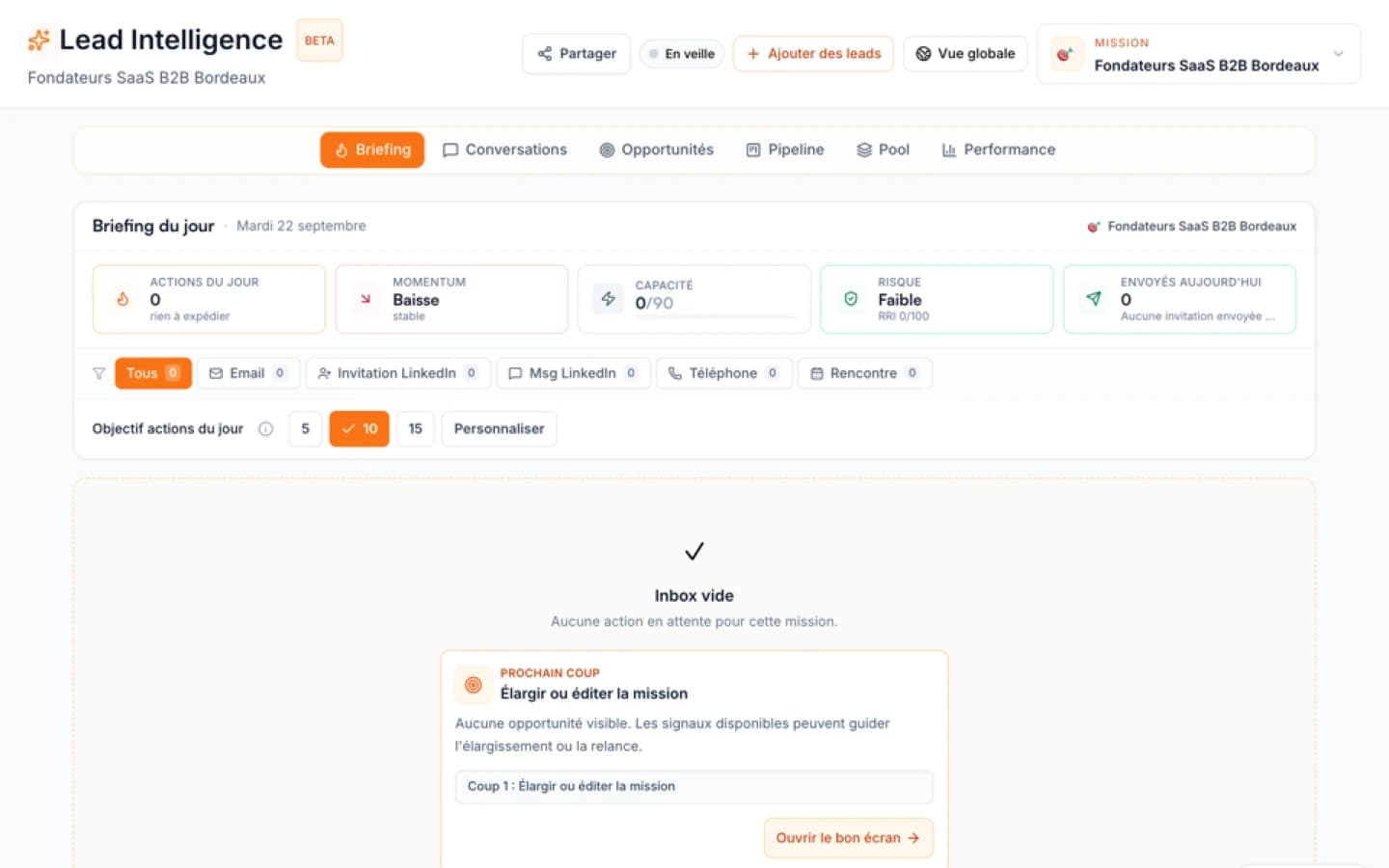
Outbound sales teams face a structural choice between two operational models. One path automates high-volume multichannel cadences across email and social profiles. The other prioritizes qualified accounts based on verified timing, signals, and buyer context before any draft is queued.
Lemlist is an established platform built to orchestrate multichannel sequences at scale across email, LinkedIn, and phone. Ember approaches outreach through Lead Intelligence, an acquisition intelligence layer designed to identify who to contact, why the timing fits, and which message angle makes strategic sense before a user approves outreach. Choosing between them depends on whether your revenue model requires broad sequence throughput or high-context qualification with intentional human review.
Where Lemlist Excels: Unified Multichannel Execution
If your growth strategy relies on building structured, multi-step campaigns across several touchpoints, Lemlist provides a mature operational engine. Lemlist allows teams to manage outreach campaigns across email, LinkedIn, phone calls, SMS, and WhatsApp Lemlist. The platform also consolidates responses into a unified inbox regardless of the channel or sender account Lemlist.
The software structures its commercial plans around specific delivery modes. On its pricing page, Lemlist lists an Email plan at $69 per month billed monthly or $55 per month billed annually, which includes 50,000 emails per month for unlimited users Lemlist Pricing. For teams requiring social outreach and phone workflows, Lemlist offers a Multichannel plan at $109 per user per month on monthly billing or $87 per user per month billed annually Lemlist Pricing.
Lemlist is well suited for organizations with dedicated sales development representatives who spend their days managing large prospect lists, scheduling sequence steps, and monitoring inbox delivery metrics. Its built-in email warmup tool, lemwarm, comes bundled across paid plans to safeguard domain reputation during ongoing campaigns Valley Pricing Breakdown. When a company has already validated its positioning and simply needs an execution tool to deliver hundreds of touchpoints per rep each week, Lemlist delivers reliable operational plumbing.
The Operational Tradeoffs of High-Volume Outreach
While sequence platforms automate scheduled touchpoints, managing outbound campaigns introduces operational friction around data meters, sending thresholds, and list decay.
Per-Seat and Credit Metering
In sequence builders, list preparation is separated from message delivery. On Lemlist, contact data enrichment operates as an add-on starting at $20 per month billed monthly, or $16 per month billed annually, which provides 2,000 credits Lemlist Pricing. A verified email search consumes 5 credits, while a phone number retrieval consumes 20 credits GenFlows. Buying intent signals represent another add-on starting at $29 per month billed monthly, or $21 per month billed annually, for 100 signals Lemlist Pricing.
As sales teams expand headcount, multichannel subscriptions scale per seat. Ten representatives on Lemlist's Multichannel plan represent an annual commitment of $870 per month before factoring in extra enrichment credits or external mailbox expenses GenFlows.
Deliverability and Platform Safeguards
Outreach volume faces strict platform constraints. Technical reviews note that Lemlist's documentation recommends maintaining roughly 50 email actions per day per account to avoid spam filters Activepieces. Reaching high monthly email volumes therefore requires orchestrating multiple secondary domains and mailboxes.
Social networks enforce even narrower boundaries. Analyses of Lemlist's recommended limits note caps of 30 profile visits, 30 messages, and 20 connection invites per day per account on LinkedIn Activepieces. When teams push raw volume without contextual qualification, low response rates can damage domain reputation and burn through addressable market lists. For strategic accounts, leaders often explore how RevOps uses lead intelligence for sales outbound to focus effort on verified accounts rather than unsegmented lists.
Ember Lead Intelligence: Contextual Timing and Intentional Sending
Ember approaches pipeline creation from a different premise. High volume often produces noise, whereas qualified pipeline emerges when you contact the right persona with an angle rooted in current company context.
Lead Intelligence connects your ideal customer profile, strategic value proposition, and buyer persona directly to outbound discovery. Rather than functioning as an unguided sequence engine, Ember evaluates accounts and prospects against explicit signals, explains why an opportunity warrants attention, and prepares contextual message drafts.
Grounded Context and Behavioral Profiling
Ember identifies candidate accounts from connected LinkedIn profiles, uploaded spreadsheets of up to 3,500 rows, or read-only Pipedrive imports capped at 500 records per batch. When evaluating targets, the system analyzes publicly available business data to produce communication style assessments based on DISC behavioral profiles. This allows founders and sales leaders to tailor message tone, structure, and brevity to the recipient's likely preferences before initiating contact.
Prospect evaluation remains fully auditable. Weaker prospects are rejected with a visible, logged explanation rather than silently discarded, allowing human operators to review and reinstate any profile.
Approval Safeguards and Direct Sending
Unlike automated sequence systems that release batches on automated schedules, Ember enforces intentional human review. Opening a prospect card never generates an unprompted message, and generating a personalized outreach draft occurs only when requested by the user.
When a message draft is approved, Ember sends the communication directly through the user's authentic personal channels:
- LinkedIn connection requests and messages route through the user's connected LinkedIn account via Unipile.
- Cold outreach emails send directly from the user's connected Google Workspace or Microsoft 365 mailbox.
- Every dispatch includes a 10-second cancellation window before transmission.
- Adding any company or individual to the do-not-contact list immediately cancels pending actions, halts scheduled follow-ups, and blocks future sends to that domain or profile.
Ember also aligns outbound activity with platform safety rules. For LinkedIn, Ember applies platform-conscious volume tiers: standard accounts run with quotas of 70 invitations and 50 messages, premium accounts allow 150 invitations and 80 messages, and Sales Navigator accounts permit 200 invitations and 100 messages, with a 0.75 multiplier applied during the first 14 days of activity. For teams monitoring territory limits, reviewing LinkedIn Sales Navigator European limits helps clarify how platform thresholds shape daily outreach.
Feature-Scope Comparison
The following table contrasts the functional orientation of both platforms:
| Evaluation Dimension | Lemlist | Ember Lead Intelligence |
|---|---|---|
| Primary Operational Goal | Automated multichannel sequence execution | Contextual prospect discovery and timing prioritization |
| Outreach Channels | Email, LinkedIn, phone calls, SMS, and WhatsApp add-on | Direct email and personal LinkedIn outreach |
| Sending Architecture | Scheduled sequence automation across mailboxes | Intentional human approval with a 10-second cancel window |
| Data and Research Model | Credit-based contact search and signal add-ons | Integrated signal verification and DISC communication analysis |
| Contact Discovery Ingestion | Lead database, CSV imports, and CRM integrations | Connected LinkedIn search, CSV imports, and Pipedrive import |
| Account Governance | Team-wide shared credit meters and unified inbox | Do-not-contact enforcement and local language mission controls |
Choosing the Right Outbound Engine
Selecting between Lemlist and Ember comes down to your sales philosophy, deal size, and team capacity.
Choose Lemlist if:
- You operate a dedicated outbound sales team running high-volume, multi-stage sequences across email, social, and phone.
- Your target addressable market is broad enough that automated volume outpaces the risk of burning prospect domains.
- You want an all-in-one execution stack that includes native dialer capabilities, SMS workflows, and automated inbox warmup via lemwarm.
- Your sales workflow relies on centralized team inboxes to triage incoming replies across multiple junior reps.
Choose Ember if:
- You are a founder, executive, or commercial lead who values relevance, timing, and precision over raw cadence volume.
- You want prospect recommendations grounded in your core value proposition and verified business signals.
- You require behavioral insights, such as DISC communication profiles, to personalize outreach style for strategic accounts.
- You want deliberate review controls where no email or LinkedIn message leaves your personal account without explicit human approval.
Organizations building their outbound motion can explore the Knowledge guides for sales for further strategies on pipeline design. When the objective shifts from sending thousands of generic sequence steps to starting qualified conversations with decision-makers, teams can deploy Ember Lead Intelligence to turn contextual timing into commercial meetings.
Sources
- Lemlist Pricing 2026: Every Plan and Cost Per User
- Lemlist Pricing 2026: Plans, Credits & Real Cost
- Lemlist Pricing 2026: $69 to $659 a Month, Real Team Cost
- Lemlist: contextual outbound and usage-based enrichment: source S1
- Lemlist: contextual outbound and usage-based enrichment: source S2
- Page publique Lead Intelligence : reçu S8
- Page juridique données prospects : reçu S9
FAQ
Free diagnostic
Analyse your Lemlist data
Review campaigns through context, interest and next-priority readiness.