
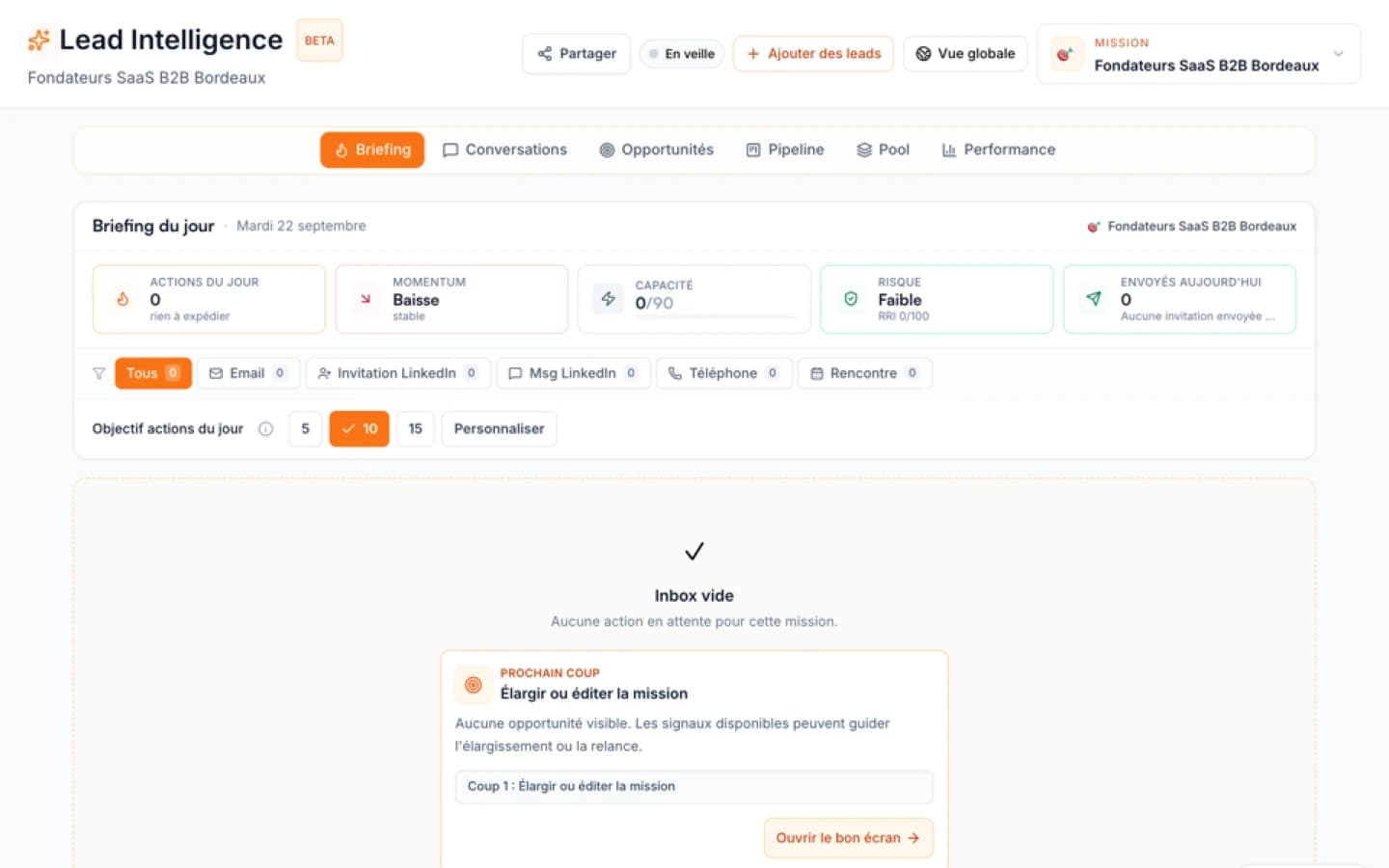
Lead Intelligence is a prospecting layer that evaluates public signals, ideal customer profile (ICP) fit, and context to rank who sales representatives should contact, why the timing makes sense, and which angle to use. For a Head of Revenue Operations (RevOps), its primary use case is replacing brute-force list distribution with explainable account prioritization, manual execution guardrails, and centralized opt-out control.
RevOps leaders frequently face outbound pipelines choked with generic contact exports. When sales development representatives (SDRs) blast flat lists, domain health degrades, reply rates plummet, and CRM data becomes cluttered with unworked or mistimed accounts. Deploying contextual lead intelligence addresses these structural operational bottlenecks.
Filtering Noise from Outbound Import Workflows
A recurring friction point in revenue architecture is the intake of sprawling prospect files. Teams often purchase broad company lists or pull raw spreadsheets that contain little operational context regarding account readiness.
Lead Intelligence acts as an evaluative gateway before outreach begins. For example, revenue operations can import flat files (such as CSV or Excel sheets up to 3,500 rows and 10 MB) or read account sets directly from connected environments like Pipedrive in read-only mode. Instead of releasing all records into a live pipeline simultaneously, the system processes accounts in controlled batches.
Weak matches are flagged and rejected with an explicit, visible reason rather than discarded silently. This design ensures that RevOps teams maintain transparency over why specific records were screened out, while retaining the manual ability to restore any rejected prospect back into the contact pool if strategic considerations demand it. By preventing unvetted accounts from flooding CRM stages, operations teams protect rep capacity and pipeline cleanliness.
Structuring Timing Signals and Multi-Source Research
Data enrichment tools often give operators access to raw contact fields without answering the question of timing. RevOps teams evaluating platforms like HubSpot Breeze or Clay for Outbound Sales Prospecting recognize that while large orchestration engines excel at multi-provider data pulls, sales teams still struggle to decide which account warrants immediate attention.
Lead Intelligence anchors prioritization on verifiable public signals gathered across multiple sources:
- Public web pages, press updates, and search results retrieved via live search services.
- Social discussions and public statements on platforms such as LinkedIn, Reddit, or X.
- Connected user accounts reading relevant prospect activities.
- Declared business context, company strategy, and ICP rules established directly within the system.
Instead of presenting an arbitrary numeric rank, the engine delivers explainable priority. Account records clearly cite the observed event, the date, and the underlying source. RevOps managers can therefore align territory assignments around objective indicators of readiness, ensuring outbound reps reach out with contextual relevance rather than cold interruptions.
Enforcing Account Safeguards and Outbound Cadence Governance
Unchecked sequence automation remains one of the largest risks to corporate domain reputation and social channel limits. When automated workflows blast high volumes of generic emails and connection requests, platform restrictions inevitably trigger.
To protect sales assets, Lead Intelligence applies strict execution boundaries by design:
Supervised Sending Cadences
Outbound messages are never dispatched autonomously. While the platform schedules follow-ups and proposes recommended cadence steps, every communication requires explicit user confirmation. When a user approves an action, a ten-second cancellation window is provided before the message leaves the connected corporate mailbox (such as Gmail or Outlook) or LinkedIn profile. Reps retain control over individual drafting, while RevOps gains the certainty that automated sequences cannot trigger runaway outbound sends.
Channel Limit Management
Social selling activities must respect platform thresholds. Lead Intelligence enforces account-level caps for connected profiles based on subscription tier:
- Standard accounts: 70 invitations and 50 messages.
- Premium accounts: 150 invitations and 80 messages.
- Sales Navigator accounts: 200 invitations and 100 messages.
During the first 14 days of account operation, system limits automatically apply a 0.75 dampening factor to protect newer connections. For operational teams monitoring enterprise limits, contextualizing these parameters against broader channel rules is critical; see LinkedIn Sales Navigator Teams Alerts and European Limits for related administrative constraints.
Centralizing Do-Not-Contact Lists and Data Governance
Regulatory adherence and brand integrity require airtight suppression management across every rep and campaign. When opt-out requests are trapped inside individual rep inboxes, organizations risk repeated unwanted contact.
Under the Lead Intelligence prospect data legal framework, commercial users operate as data controllers relying on legitimate interest for business-to-business prospecting, while Ember acts as a data processor. Operational compliance is supported through immediate exclusion mechanisms:
- Instant Suppression: Adding a company domain, email address, or individual LinkedIn profile to the internal do-not-contact list immediately halts all queued actions and scheduled follow-ups.
- Monitoring Freeze: Once an entry is placed on the suppression list, background enrichment and public signal monitoring are paused indefinitely until a user manually removes the entry.
- Automated Pause on Reply: Any direct prospect response detected within ongoing conversation threads automatically suspends planned follow-up reminders.
- Data Lifecycle Auditing: Prospect records remain associated with an active mission rather than being deleted on an arbitrary timer. System checks flag accounts that have remained without active contact for more than three years, providing RevOps with the operational audit trail required to prune stale records manually.
Integrating Lead Intelligence into the RevOps Stack
For teams balancing operational structure with frontline agility, implementing contextual intelligence shifts the sales motion from high-volume noise to verified outreach timing.
RevOps leaders can explore how contextual priority and timing signals operate by reviewing Ember Lead Intelligence and testing workflow configurations directly inside the Ember platform.
Sources
- Page publique Lead Intelligence : reçu S8
- Page juridique données prospects : reçu S9
- La plateforme est bien adaptée aux équipes d'opérations commerciales et de croissance qui veulent combiner plusieurs sources de données, écrire une logique d'enrichissement personnalisée et pousser les résultats dans leur stack existante. L
FAQ
Free diagnostic
Test your sales file
Drop an Excel or CSV and check its readiness without sending its rows to Ember.