
Why steering committees defer decisions to next quarter
The most common outcome of an SME board meeting or steering committee is not a definitive approval or an outright rejection. It is polite postponement: "Let us revisit this next quarter."
For a managing director or executive, this response represents stalled momentum, delayed capital allocation, and lost operational focus. A deferred decision almost never stems from a lack of technical detail or operational effort. Instead, it happens because executive presentations frequently treat the governing body as an operational audit team rather than a decision-making authority.
When a presentation opens with fifty slides detailing departmental activities, minor operational variances, and exhaustive context, committee members exhaust their cognitive bandwidth before reaching the actual trade-off. By the time the speaker reaches the request for capital, headcount, or strategic pivot, fatigue has set in. Faced with ambiguity and limited time, experienced directors default to the safest governance behavior available: requesting additional data and tabling the discussion until the next scheduled cycle.
To secure a decision on the day of the meeting, the presentation cannot function as a chronological status report. It must be engineered backward from the specific commitment required.
The decision-first narrative architecture
A board pitch must build around what communication strategist Nancy Duarte defines as business storytelling: one clear idea, stated as a point of view plus the stakes of taking or failing to take action.
Governing bodies exist to resolve dilemmas that cannot be settled at the operational management level. When framing an initiative, the narrative needs to articulate three components immediately:
- The current reality and its constraint: The baseline commercial or operational status, stated plainly with its limiting factors.
- The proposed change and the alternative: The specific decision requested, alongside the exact cost and consequences of inaction.
- The trade-offs and risks: What will not be done if this resource is committed, and what assumptions underpin the plan.
Every slide in the deck must serve this path. If a slide merely informs without shaping the choice, it belongs in an appendix. Distinguishing verified baseline numbers from forward-looking estimates is essential: when assumptions are presented disguised as established facts, committee members spot the discrepancy and halt the discussion to probe methodology, derailing the decision.
Splitting the agenda: the one-third status rule
A structural error in steering committee presentations is allocating meeting time chronologically according to operational updates. When the first forty-five minutes of an hour-long slot cover retrospectives, the core strategic debate is compressed into a rushed fifteen-minute finale.
In YC's guide on how to create and manage a board, documented practices from high-growth operating companies illustrate a far more effective allocation. The guide highlights Gusto's example agenda split, which caps highlights, lowlights, company performance, and key performance indicators together at under a third of the total meeting time. The remaining majority of the session is strictly reserved for one or two strategic topics requiring governance input, followed by a closed session.
Applying this proportion transforms steering committee dynamics:
| Meeting Phase | Maximum Time Share | Core Objective | Primary Deliverable |
|---|---|---|---|
| Retrospective and KPIs | Under 33 percent of time | Validate operational health and acknowledge variances | Written acknowledgment of status |
| Strategic Topic 1 | 35 to 40 percent of time | Resolve the primary capital or organizational dilemma | Formal go or no-go vote |
| Strategic Topic 2 or Closed Session | Remainder of time | Address secondary trade-offs or governance alignment | Clear ownership and milestones |
By capping status reporting at less than a third of the allotted slot, the leadership team signals control over daily operations and forces the conversation onto strategic resource allocation.
The pre-read protocol and operational rhythm
Achieving a productive discussion requires eliminating live presentation of descriptive data entirely. Committee members should not encounter baseline metrics or operational retrospectives for the first time on a projector screen.
The YC board management documentation details Gusto's practice of distributing the pre-read board deck at least a week ahead of the session and collecting written questions in a shared document three days before meeting. This enables leadership to answer routine data inquiries in writing before stepping into the boardroom, ensuring live dialogue centers exclusively on strategy and decision-making. For larger strategic items, structured timelines such as Brex's board-prep process, which initiates topic selection weeks ahead of drafting, demonstrate the value of front-loading alignment.
Implementing this pre-read discipline requires three practical steps:
- Distribute the deck five to seven business days prior: Accompany the document with explicit instructions highlighting the specific decisions to be made.
- Establish an asynchronous inquiry window: Invite committee members to log clarification questions regarding historical figures or data definitions well before the session.
- Open the live session on the decision slide: Assume the deck has been read. Summarize the decision request in ninety seconds, confirm receipt of pre-read inquiries, and transition immediately to committee feedback.
Reviewing how to safely share pitch decks provides useful patterns for controlling access, versioning, and document permissions when circulating sensitive governance materials.
Rehearsing the executive exchange before entering the boardroom
A steering committee deck cannot simply look neat; the speaker must command the transition between high-level trade-offs and detailed operational assumptions without hesitation.
Anticipating committee objections is where presentations succeed or fail. Committee members frequently challenge underlying capacity constraints, return on investment timelines, and alternative uses of capital. Practicing the spoken delivery against strict time limits ensures the presenter does not slip into defensive narrative habits or burn precious minutes on low-priority context. Exploring structured guidance on oral presentation techniques helps refine concise verbal transitions.
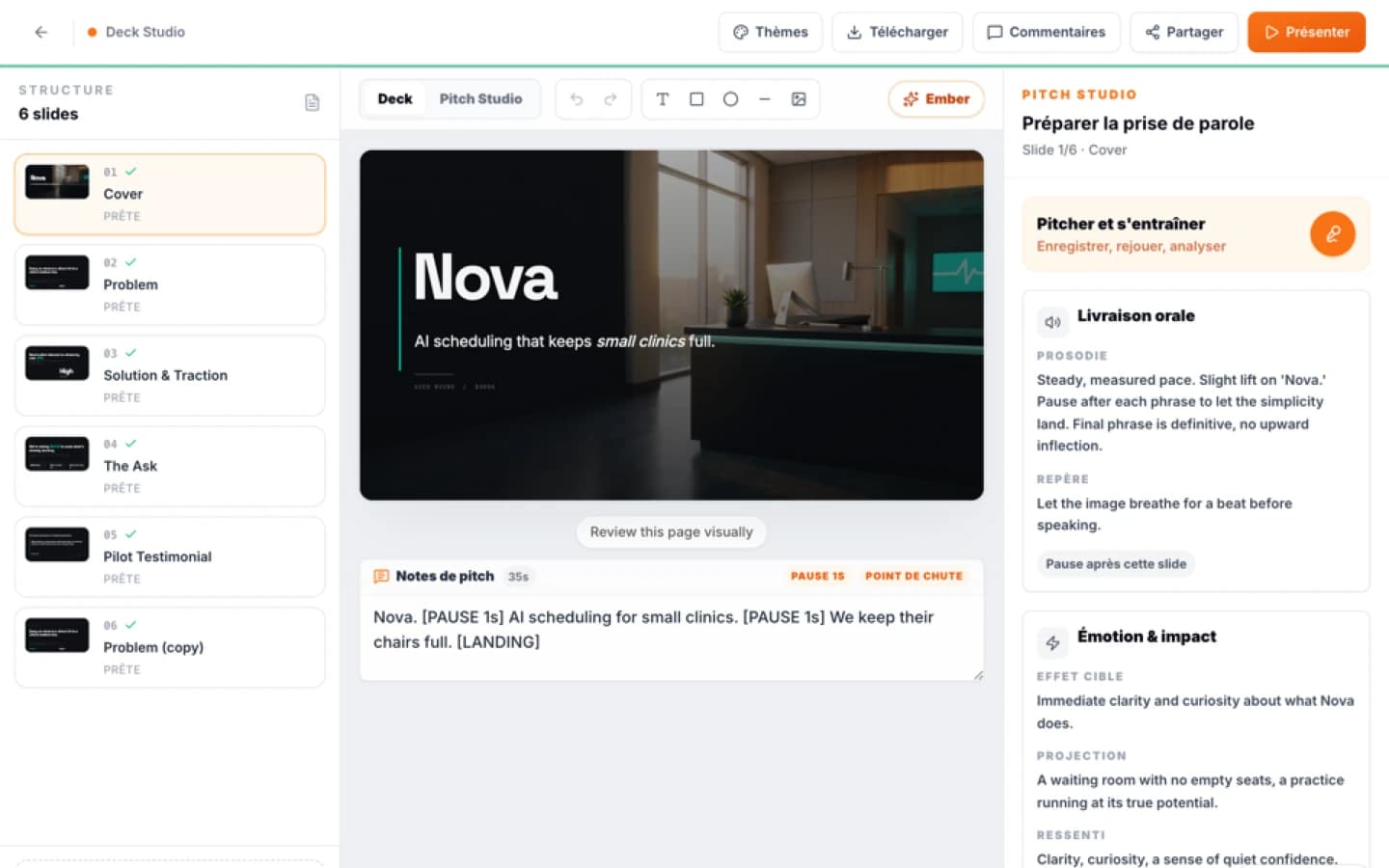
In Ember, teams structure decision artifacts using Creation, which builds complete presentation decks alongside formats like executive one-pagers and business model canvases directly from project context. For high-stakes presentations, the module includes dedicated speaking practice capabilities. Leaders can rehearse their board decks with an integrated timer and speaker notes, recording runs of up to fifteen minutes to receive structured diagnostic feedback on pacing, structural balance, rhetorical impact, and section-by-section clarity.
By combining disciplined narrative architecture, a strict one-third agenda cap on status updates, rigorous pre-read distribution, and deliberate spoken rehearsal, SME leaders transform governance presentations from passive operational reviews into reliable mechanisms for organizational decisions.
Sources
FAQ
Mini audit
Test your Pitch Deck
Get an initial diagnosis of substance, form and impact.