
What WCAG-EM 2.0 Changes for Enterprise Software Audits
Enterprise software audits often fail because teams cannot agree on what constitutes a fair, compliant sample of an entire platform. Evaluating every single screen across a complex B2B application or a deep archive of exported deliverables is technically and economically unfeasible. To resolve this challenge, the World Wide Web Consortium (W3C) published the WCAG Evaluation Methodology (WCAG-EM) 2.0 as a formal Group Note on 23 July 2026, as documented in the W3C WCAG-EM 2.0 specification.
While the original version was designed specifically for websites, WCAG-EM 2.0 expands the framework to native applications, kiosks, and other digital products, as detailed in the official W3C WAI announcement. For enterprise software buyers, procurement leads, and product managers, this methodology provides a repeatable, technology-agnostic roadmap. It ensures that an evaluation does not rely on subjective impressions or partial automated scans, but instead tests representative workflows against the Web Content Accessibility Guidelines (WCAG).
+-----------------------------------------------------------------------+
|                       WCAG-EM 2.0 AUDIT PHASES                        |
+-------------------+---------------------------------------------------+
| 1. Define Scope   | Product boundary, target level, baseline support  |
| 2. Explore Target | Key user views, essential workflows, technologies |
| 3. Sample Views   | Structured sampling, random screens, full paths   |
| 4. Audit & Test   | Criteria checks, alternate versions, processes    |
| 5. Report Results | Structured statements, issue logs, machine data   |
+-------------------+---------------------------------------------------+
WCAG-EM 2.0 is an informative methodology rather than a separate legal standard. It does not replace the normative success criteria of WCAG, nor does it guarantee automatic certification. Instead, it offers a defensible sampling and evaluation structure that procurement teams, internal auditors, and external service providers can rely on to verify accessibility claims.
The Five-Step WCAG-EM Evaluation Procedure
The core of the methodology consists of five structured stages designed to move an audit team from initial scope definition to documented findings, as explained in the W3C WCAG-EM 2.0 guidance.
Step 1: Define the Evaluation Scope
Before running any test scripts or manual keyboard reviews, the audit team must define clear boundaries:
- The digital product scope: Identifying exactly which modules, subdomains, native apps, or client portals are included under the principle of product enclosure.
- The conformance target: Defining whether the target benchmark is Level A, Level AA, or Level AAA under the relevant standard version.
- The accessibility support baseline: Documenting the operating systems, browsers, and assistive technologies (AT) that the product officially supports.
- Additional requirements: Specifying contractual criteria, corporate design rules, or specific user group needs.
Step 2: Explore the Target Digital Product
Auditors must review the platform to understand its functional landscape before picking individual pages. According to the W3C WCAG-EM 2.0 methodology, exploration involves identifying:
- Common views, such as dashboards, settings, and main navigation hubs.
- Essential functionality, including core business actions like creating a project, submitting an approval, or generating an invoice.
- Variety of sample types, such as data tables, interactive forms, rich media, and dialog modals.
- Technologies relied upon, such as HTML, Accessible Rich Internet Applications (WAI-ARIA), canvas elements, and Portable Document Format (PDF) exports.
Step 3: Select a Representative Sample Set
An audit cannot test every screen in an enterprise suite. WCAG-EM 2.0 establishes a disciplined sampling model that combines:
- A structured sample set representing all key views, templates, distinct page layouts, and primary business components.
- Complete processes, ensuring that multi-step tasks such as an onboarding flow or checkout journey are tested from start to finish without gaps.
- A randomly selected sample set, which introduces unbiased sampling to catch edge cases that structured exploration might overlook.
Step 4: Evaluate the Selected Sample Set
During the testing phase, auditors evaluate every sample against all target success criteria. This includes verifying conforming alternate versions, ensuring accessibility support across chosen tools, and verifying non-interference so that background scripts do not trap keyboard focus. Auditors also verify that complete user journeys function seamlessly from step to step, comparing issues found in the structured set against those discovered in the random set.
Step 5: Report the Evaluation Findings
The final stage translates raw audit logs into transparent business records. Evaluators can utilize the official W3C WCAG-EM Report Tool to structure their outputs, provide qualitative findings, record evaluation specifics, and issue formal evaluation statements for procurement and quality assurance teams.
Auditing Enterprise Deliverables and Documents
B2B software does not live solely inside web browsers. Many platforms generate customer-facing assets, including exported slide decks, analytics spreadsheets, contracts, and downloadable reports. Under WCAG-EM 2.0, these generated deliverables fall directly within the audit scope when they represent the primary output of the software.
When auditing client deliverables, software providers and enterprise buyers should evaluate three distinct areas:
- The creation environment: Can an author with visual or motor impairments navigate the editor, adjust slide layouts, format text, and add metadata using keyboard and screen-reading tools? Teams looking at design workflows can explore the Knowledge guides for marketing to understand how content presentation aligns with overall product positioning.
- The delivery interface: Does the platform reader or web-based viewer allow viewers to zoom content, adjust contrast, and access assistive navigation? For teams evaluating different web presentation architectures, comparing alternatives such as Pitch vs Gamma: Which Presentation Tool Fits Your Team? helps clarify how browser-native viewers handle slide structures.
- The exported artifact: Does an exported document contain structured semantic tags, correct reading order, and descriptive alternative text, or is it rendered merely as a flat collection of images?
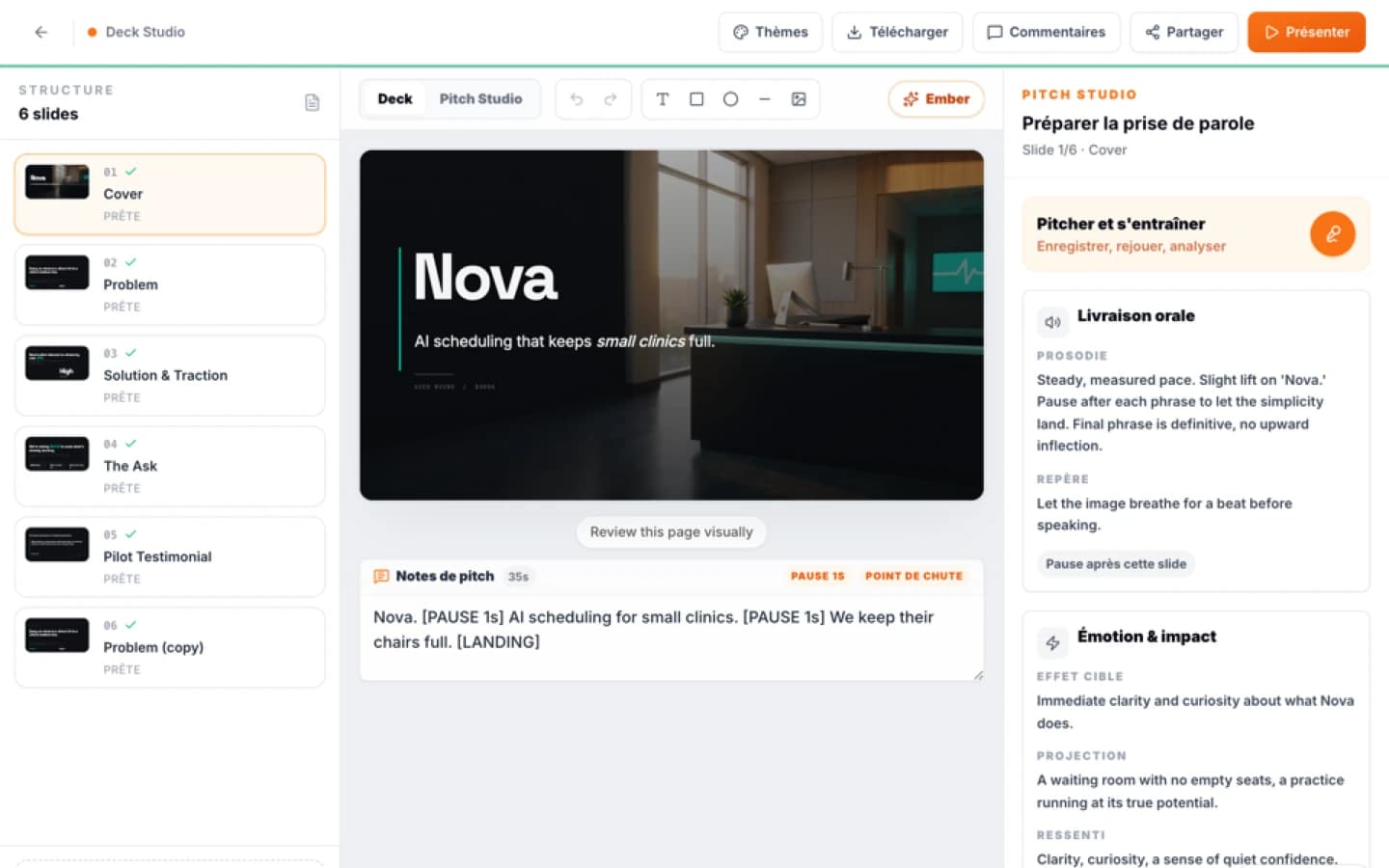
Enterprise presentation builders often handle exported outputs differently. For instance, in our own document-creation environment in Ember, the current documentation only proves contrast measurement on the rendered pixels of a text box; it does not claim automated WCAG 2.2 compliance testing, and pages exported as flattened page images do not include structural semantic tags. Teams needing fully tagged PDF outputs or screen-reader-ready slides must verify their exported files using specialized tagging remediation tools rather than assuming default compliance.
Navigating Regulatory Baselines and Standards
Enterprise procurement teams must distinguish between an evaluation methodology and legal regulatory standards. WCAG-EM 2.0 provides the audit methodology, but regional standards dictate the legal pass/fail criteria.
In Europe, the European accessibility standard EN 301 549 was updated with version 4.1.1 published on 7 September 2026, as reported by the AccessibleEU Centre. This revision adopts WCAG 2.2 as the accessibility benchmark for websites, software, and digital documents, adding six new requirements while removing the obsolete parsing criterion 4.1.1. However, the same announcement notes that until the European Commission formally cites EN 301 549 v4.1.1 in the Official Journal of the European Union, the binding legal reference remains EN 301 549 v3.2.1 from 2021, which relies on WCAG 2.1 Level AA.
| Evaluation Dimension | WCAG-EM 2.0 Framework | Legal Procurement Baselines |
|---|---|---|
| Document Type | Informative W3C Group Note | Harmonised European Standards or National Laws |
| Primary Purpose | Sampling and testing methodology | Legal compliance criteria and procurement mandates |
| Product Scope | Websites, native applications, and digital products | Regulated commercial and public-sector ICT services |
| Compliance Target | Flexible: Level A, Level AA, or Level AAA | Defined by statute, such as EN 301 549 v3.2.1 Level AA |
Understanding these distinctions prevents costly compliance mistakes. While product roadmaps should proactively adopt the newer WCAG 2.2 criteria to prepare for future enforcement, procurement contracts should continue referencing the legally cited version until formal publication occurs in the relevant official journal.
Practical Steps to Prepare Your B2B Product for an Audit
Implementing WCAG-EM 2.0 across an enterprise suite requires continuous alignment across product, design, and compliance teams:
- Conduct preliminary checks before scheduling a full audit. The W3C recommends performing rapid preliminary reviews on high-traffic templates to resolve obvious visual and keyboard barriers before investing in an extensive evaluation.
- Standardize structured deliverables. When presenting complex business cases to enterprise clients or investors, teams must ensure that presentations follow clean logical hierarchies. Resources such as Seed vs Series A Pitch Decks: How to Structure Slides and guidance on How to Calibrate Your Pitch Deck Length by Meeting Format? highlight how clear content structures benefit both human audiences and accessibility parsers.
- Combine automated testing with human expertise. Automated linting catches color contrast issues and missing labels, but only human auditors, ideally including users with disabilities, can evaluate whether complete business processes function logically.
- Maintain a living audit trail. Use the W3C WCAG-EM Report Tool to document every sampled view and track resolution over development sprints.
By adopting the formal five-step structure of WCAG-EM 2.0, B2B software vendors replace subjective claims with transparent, auditable evidence that satisfies institutional enterprise buyers.
Sources
- WCAG Evaluation Methodology (WCAG-EM) 2.0
- WCAG-EM Overview: WCAG Evaluation Methodology
- WCAG Evaluation Methodology (WCAG-EM) 2.0: Note ...
- WCAG-EM 2.0 : méthode d’évaluation de produits numériques : source S1
- AccessibleEU (Commission européenne), The European accessibility standard EN 301 549 has been updated : source S1
FAQ
Mini audit
Test your Pitch Deck
Get an initial diagnosis of substance, form and impact.