
The core difference between an impactful presentation and an audience checking their watches is calibration. Founders and business operators frequently make the mistake of creating a single thirty-slide deck and attempting to adjust their presentation length simply by talking faster or skipping slides. In practice, compressing a presentation does not mean rushing through your full backlog of ideas. It requires deliberately reducing your narrative scope to match what an audience can actually absorb and evaluate within the allotted window.
According to practical guidance on entrepreneurship preparation published by Bpifrance Création, slide presentations should prioritize brevity and clarity, recommending no more than 7 slides for a 5-minute presentation. The same institution identifies three distinct presentation formats based on who sits across the table: a 5-minute short format, an intermediate format lasting 7 to 12 minutes, and an extended format of 15 to 20 minutes. Calibrating your narrative depth across these tiers ensures that you address what your listeners need to decide, rather than overwhelming them with uncurated detail.
The 5-Minute Pitch: Sharp Framing for Competitions and Fast Screenings
A five-minute slot is standard for startup competitions, demo days, elevator pitches, and initial screening calls. In this setting, the goal is never to close a deal or finalize funding on the spot. The single objective is to secure the next meeting by proving that you have identified a meaningful problem, engineered a credible solution, and possess an unfair advantage in executing it.
As outlined by Bpifrance Création, an entrepreneur presenting within a 5-minute limit for pitch contests or rapid marathons should not exceed 7 slides. Every slide must deliver one clear conclusion:
- Company purpose and problem context: Who experiences this friction, and why is existing software or methodology insufficient?
- The core solution: A direct, visual demonstration of the value proposition without excessive architectural detail.
- Market sizing and addressable wedge: Why this specific market opportunity matters right now.
- Business model and unit economics: How the business captures value cleanly.
- Traction and operational validation: What has already been built, tested, or sold.
- Competitive positioning: What creates your operational moat or defensive wedge.
- Team and ask: Why your founding group can deliver, paired with the immediate operational milestone you are funding.
Attempting to cover comprehensive cash flow models, complex capitalization tables, or multi-year product roadmaps within five minutes only diffuses attention. If you are comparing stages, our analysis on Seed vs Series A Pitch Decks: How to Structure Slides provides complementary detail on how investor expectations evolve as traction replaces vision.
The 7 to 12-Minute Deck: Selection Committees and Accelerators
When pitching to incubator panels, accelerator admission boards, or public innovation grants, you typically receive an intermediate window. Bpifrance Création highlights this 7 to 12-minute window as the typical format for incubator selection juries, public grant panels, and specialized mentorship programs such as the Institut du mentorat entrepreneurial.
Unlike a rapid competition jury, an incubator or accelerator committee wants to evaluate execution competence, operational realism, and team coachability. You have room to explain your go-to-market mechanics and early technical architecture, but you must still protect time for questions.
Rather than cramming twenty slides into twelve minutes, treat the extra time as narrative breathing room. Expand on customer discovery and acquisition loops:
- Customer acquisition strategy: Clarify how you source leads, test marketing channels, and evaluate acquisition costs relative to lifetime value.
- Execution milestones: Outline the specific six-to-twelve-month roadmap that the program or seed capital will unlock.
- Governance and capability gaps: Articulate which operational competencies the team currently holds and exactly which capabilities you intend to recruit next.
While Bpifrance Création does not set an explicit slide count cap for this intermediate range, maintaining a deliberate pace where each slide remains on screen for roughly one minute prevents you from cutting short your concluding argument.
The 15 to 20-Minute Deep Dive: Banks, Honor Loans, and Due Diligence
The longest structured spoken format typically spans a quarter of an hour to twenty minutes. According to Bpifrance Création, an extended 15 to 20-minute format is standard for honor loan approval committees, commercial banking interviews, and formal investor pitches before business angels or venture funds.
In this forum, committee members already assume that the broad vision is plausible. Their focus shifts directly toward financial viability, risk mitigation, and operational resilience. For commercial lenders and honor loan committees, the dominant question is debt-service capability and working capital management. For equity investors, the focus rests on defensibility, margin expansion, and scalable unit economics.
To structure this extended window effectively:
- Deepen the financial narrative: Discuss historical burn, gross margins, breakeven projections, and sensitivity analysis regarding delayed sales cycles.
- Address commercial friction honestly: Highlight known customer adoption barriers, regulatory hurdles, or supply dependencies, along with your planned mitigation strategies. Understanding modern buyer research habits can refine this section, particularly when reviewing How to Pitch B2B Buyers Who Use AI Search Engines? to map out how buyers vet vendors before speaking with sales reps.
- Map the use of proceeds: Detail precise capital allocation across hiring, engineering, inventory, and working capital buffers.
Even in an extended format, slides serve to illustrate the spoken narrative rather than provide a script to read aloud. Keep background text minimal and rely on clear visual exhibits, reserving tabular accounting details for appendix slides that can be brought forward during subsequent discussion.
| Pitch format | Recommended duration | Typical audience | Core narrative objective |
|---|---|---|---|
| Short format | 5 minutes | Pitch competitions, marathons, elevator sessions | Hook interest and prove problem-solution fit to secure a follow-up |
| Intermediate format | 7 to 12 minutes | Incubators, accelerators, innovation committees | Demonstrate execution realism, distribution loops, and team coachability |
| Long format | 15 to 20 minutes | Banks, honor loan committees, angel and fund meetings | Defend unit economics, capital allocation, debt service, and risk resilience |
Choosing Between Spoken Decks and Standalone Documents
Pitch decks designed for spoken delivery operate under different constraints than documents intended to be read independently. A projection deck requires clean layouts, high visual hierarchy, and minimal body copy, allowing listeners to focus on your spoken delivery.
Conversely, if an analyst or banking officer requests material in advance of a meeting, sending a minimal visual deck without its accompanying voice track leaves critical gaps. In these scenarios, a structured one-pager or an executive summary bridges the gap far more effectively than an overloaded slide deck.
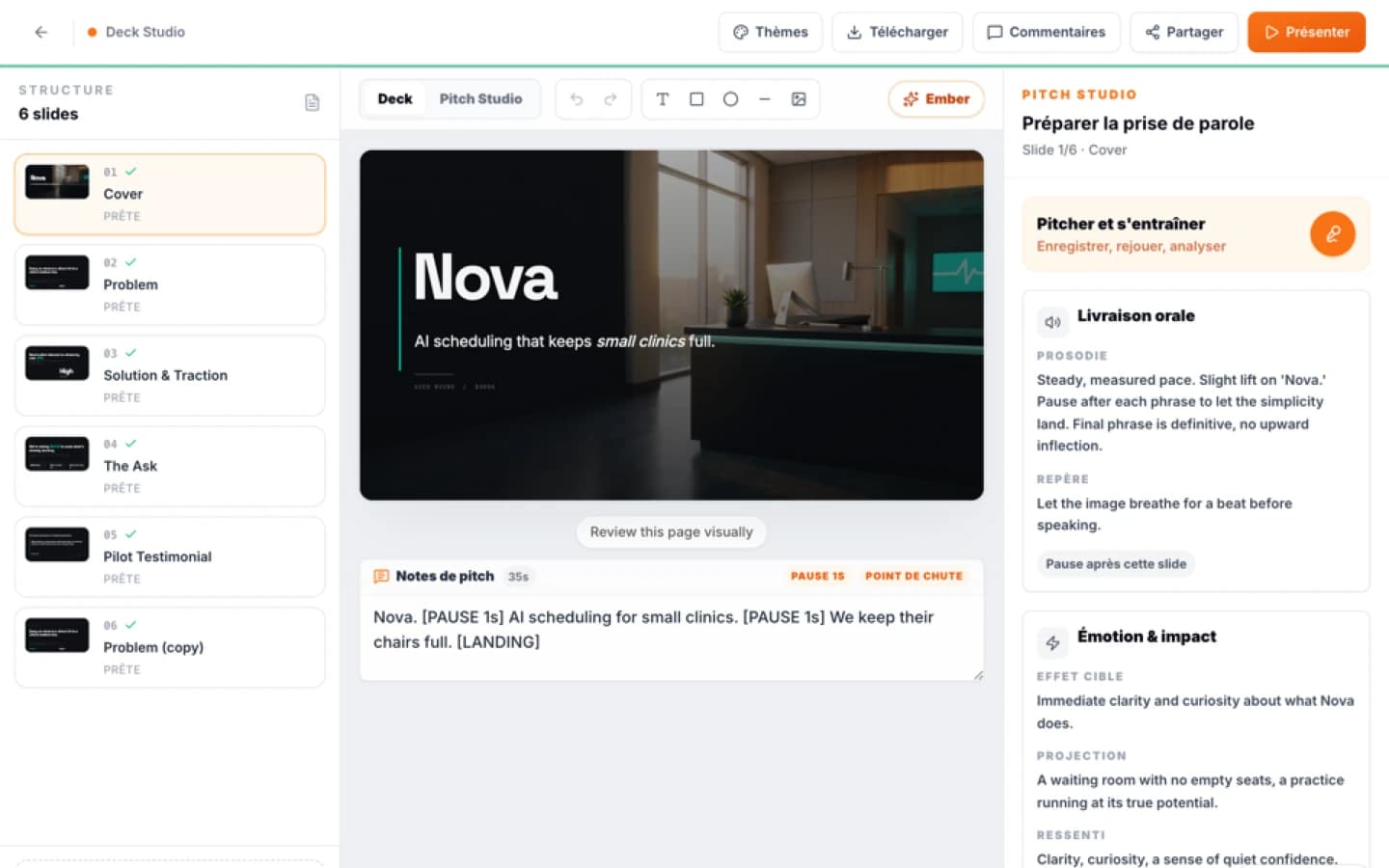
When generating presentation material within Ember Creation, the narrative architecture is structured directly from verified project context before visual layouts are rendered. The module allows founders to define target page counts, selecting specific options such as 5, 8, 10, 12, 15, or 20 slides depending on the exact meeting format, and supports dedicated one-pager visual documents when a single-sheet overview is more appropriate than a slide deck. Presenters can also use the integrated speaking practice workspace to rehearse decks against an active timer, review structured pacing diagnostics across individual slides, and calibrate their rhythm before presenting to selection committees.
Calibrating a pitch is ultimately an exercise in restraint. By matching slide volume and analytical depth to the meeting duration, you respect the audience's time, protect space for meaningful dialogue, and present your business with the clarity expected by serious evaluators.
Sources
FAQ
Mini audit
Test your Pitch Deck
Get an initial diagnosis of substance, form and impact.