
Sharing an external investor pitch deck involves a direct operational trade-off between control and convenience. Sending an editable PowerPoint file hands over raw content that the recipient can adapt, inspect, or reuse, but it exposes internal revision trails, speaker notes, and layout shifts caused by missing local fonts. Conversely, distributing a read-only web presentation or an exported static document locks visual integrity and conceals private preparation notes, but limits how analysts dissect model inputs or integrate slides into internal investment memos.
Choosing the proper distribution alternative during external investor due diligence requires understanding what each file type reveals, how platform permissions function, and when web handovers provide sufficient governance without introducing friction.
Information Exposure Risks in Raw Presentation Files
A standard editable presentation contains far more information than the rendered slide area. When teams collaborate internally on a fundraising narrative, slide decks collect iterative comments, tracked adjustments, and draft figures that should never reach an external review team.
According to Microsoft documentation on inspecting presentations, collaborative editing can leave comments and digital ink annotations that reveal the specific edits made and the names of the individuals who contributed. Furthermore, the Notes section of a presentation often contains talking points or internal strategic cues intended strictly for the speaker. While utilities like the Document Inspector help scrub these elements, Microsoft notes that the Document Inspector cannot remove pictures that have been inserted directly into the Notes section.
Passing a raw presentation file without meticulous sanitation creates two clear vulnerabilities:
- Attribution leakage: Author names, reviewer identities, and resolved commentary threads remain inspectable within the object tree.
- Narrative leaks: Speaker notes detailing valuation sensitivities, negotiation reserves, or unresolved operational bottlenecks can be read by external associates during screening.
Font Rendering and Visual Layout Degradation
The second major drawback of distributing raw presentation formats is typography drift. If an investor opens a file on an operating system lacking your specific brand fonts, the host software substitutes those fonts with default system typefaces, often wrapping lines unexpectedly, breaking data card layouts, and truncating text blocks.
As noted in Microsoft guidance on embedding custom fonts, embedding fonts within a document helps ensure that layout, styling, and characters remain identical for recipients who do not have the original typefaces installed. However, Microsoft details several explicit operational boundaries:
- Embedding permissions depend on the font creator, with access categories spanning non-embeddable, preview and print, editable, or installable formats.
- Choosing the option to embed only the characters used in the deck lowers overall file weight, but it restricts subsequent editing by the recipient using that typeface.
- Heavy font files increase total attachment weight significantly, and legacy PostScript formats (.PFB, .PFM) should be avoided in favor of TrueType (.TTF) or OpenType (.OTF).
When preparing slide distribution, knowing how to calibrate your pitch deck length by meeting format also helps determine whether an external reader will scan the material independently or view it in a structured partner meeting.
SharePoint Publish to Web: Capabilities and Enterprise Constraints
For organizations operating entirely within the Microsoft 365 environment, SharePoint offers an integrated path to generate read-only links that suppress editing artifacts.
According to Microsoft documentation on publishing to the web, this feature allows users to share finalized presentations or workbooks with external clients and stakeholders without revealing sensitive edit history, comments, or tracked changes. The resulting link opens a view-only version by default, with access controls managed through the standard sharing permissions interface.
This mechanism carries distinct enterprise requirements:
- The feature is restricted exclusively to enterprise accounts.
- Files must be stored directly on SharePoint and opened through the web versions of Word, Excel, or PowerPoint.
- Dynamic synchronization is not automatic; reflecting recent slide revisions requires an explicit republish action, and distributing updates necessitates manual link management or republication.
For corporate teams with established tenant governance, this approach solves comment exposure without converting the deck into an external image stack. For teams outside enterprise Microsoft tenants, alternative distribution channels are required.
Comparing Distribution Formats for Investor Due Diligence
Selecting between an editable file, an enterprise web link, a static document export, or an interactive web reader depends on where the prospective investor sits in your deal funnel.
| Distribution Format | View Control | Comment and Note Exposure | Font and Layout Integrity | Recipient Friction |
|---|---|---|---|---|
| Raw Editable Presentation (.PPTX) | Low | High unless manually scrubbed | Low unless all fonts are supported and embedded | Lowest for financial analysts building memos |
| SharePoint Web View | High | Low | High | Medium due to enterprise tenant boundaries |
| Standard Static Export (PDF) | High | None | High | Low across all desktop and mobile devices |
| Public Web Presentation Link | High | None | High | Lowest for rapid partner screening |
While static formats prevent unwanted disclosure, reviewing broader strategic distribution across platforms like Pitch vs Gamma helps clarify how interactive web readers compare with traditional file handovers.
Operational Decision Rules for Due Diligence Handover
To maintain document security without alienating investment committees, apply these guidelines at each stage of external diligence:
1. Initial Screening and First Contact
Never send an unscrubbed editable slide deck to an investor who has not signed an engagement letter or advanced past initial screening. Provide a clean public web link or an exported PDF. This ensures brand typography renders accurately on any mobile device or tablet while completely removing personal metadata, draft commentary, and speaker notes. When structuring the narrative for early meetings, review how to convince investors in an oral pitch to keep supporting collateral focused on key metrics.
2. Confirmatory Diligence and Partner Reviews
When partners request source decks to review models or combine excerpts into internal investment memorandums, an editable presentation is often requested. Before emailing the raw file:
- Execute the Document Inspector to strip reviewer identities, comment chains, and non-essential properties.
- Verify that custom fonts are licensed for redistribution or stick strictly to universal system fonts to avoid layout degradation.
- Audit the Notes section manually to ensure that no operational scratchpads or embedded screenshots remain behind.
3. Asynchronous Portfolio Reviews
If ongoing updates must reach multiple co-investors simultaneously, centralized web links reduce version fragmentation. When corrections occur, updating the underlying asset avoids sending out revised attachments labeled with conflicting revision numbers.
Presentation Distribution with Ember
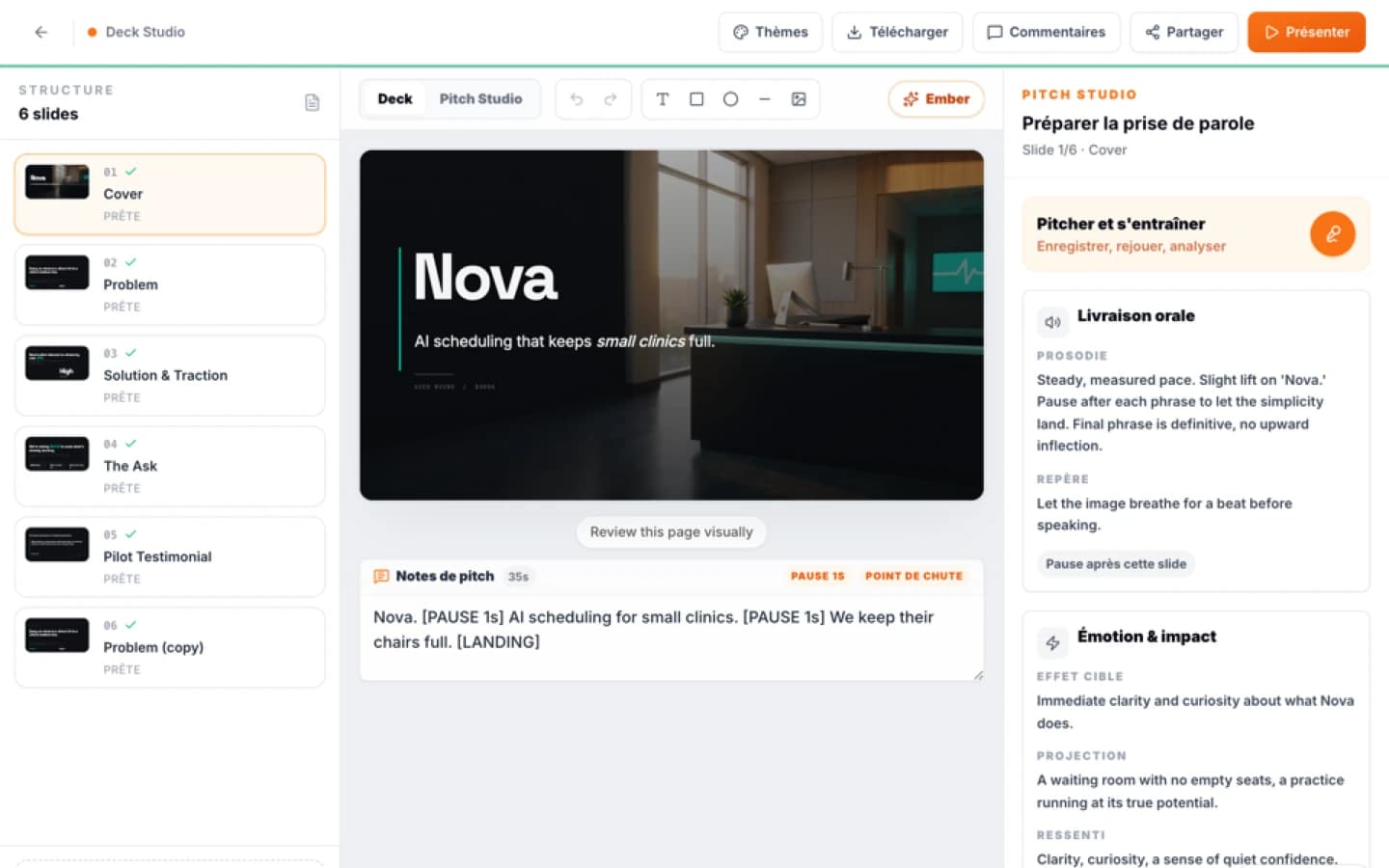
Managing external presentations requires balancing rapid distribution with information security. Within Ember, Deck Studio exports the presentation to PowerPoint or PDF.
When you export to PDF from Deck Studio, the system compiles the deck as clean page images, ensuring that no internal notes, active editing states, or comment markers can be extracted by external readers. For scenarios requiring live navigation without file attachments, Deck Studio allows the creation of a standalone, read-only public web link that presents slides in a clean fullscreen viewer without requiring recipient logins or exposing private speaker cues.
If you are structuring an upcoming round and need clean presentation assets that transition smoothly from internal draft to investor review, build your next narrative with the Ember AI pitch deck generator.
Sources
FAQ
Mini audit
Test your Pitch Deck
Get an initial diagnosis of substance, form and impact.