
Early-stage founders convince investors during an oral pitch by speaking with direct clarity, eliminating buzzwords, and demonstrating complete command of their operating reality. Convincing an audience in venture capital (VC) begins with convincing yourself through verifiable facts, then explaining those facts in the exact plain language you use when discussing strategy with your cofounders.
The Core Principle: Concision as a Test of Understanding
In his essay titled How to Convince Investors, published in August 2013, Paul Graham observed that many investors treat concision as an indicator of mastery. As Graham noted, if you cannot explain your plans concisely, you do not really understand them.
Vague and grandiose phrasing usually signals that a team is substituting narrative style for market substance. When founders resort to marketing adjectives during a partner meeting, experienced allocators assume the underlying mechanics cannot withstand scrutiny. The remedy is simple:
- Identify the core problem you solve and state it in common business terms.
- Articulate why your approach functions technically and economically.
- Share your current traction and validated metrics without embellishment.
Pitching becomes persuasive when you know your assumptions, understand your unit economics, and state your conclusions directly.
Translating Operational Reality into Plain Spoken Language
Founders frequently speak two distinct languages: the clear, pragmatic language used internally with their engineering and operations teams, and an artificial, grandiose dialect reserved for pitch decks. This separation weakens oral presentations.
Internal discussions focus on concrete tasks: customer acquisition bottlenecks, retention drop-offs, and software delivery timelines. In contrast, pitch jargon replaces these specific operational challenges with sweeping abstractions. Replacing abstractions with everyday language immediately strengthens your credibility:
| Spoken Jargon | Plain Operational Language |
|---|---|
| We leverage proprietary paradigms | We built software that automates manual reporting |
| Disrupting legacy ecosystems | Selling directly to regional freight brokers |
| Hyper-scalable platform dynamics | Adding enterprise accounts without hiring account managers |
| Mission-critical synergy engine | Connecting inventory software with local accounting systems |
Incumbent presentation software such as traditional slide editors or general visual design suites provide capable tools for assembling slides. However, clean slide design cannot substitute for genuine clarity in your spoken narrative. If a slide contains complex terminology that you cannot restate in simple terms, the slide requires revision.
Structuring the Spoken Narrative Around What Deserves Investment
Graham outlined three distinct stages for securing backing: build something worth investing in, understand why it is worth investing in, and explain that reality clearly to investors. Each stage depends directly on the previous one.
When structuring your meeting, ensure the spoken narrative aligns with the visual materials supporting it. A dense deck often encourages founders to rush through slides rather than engaging in a focused discussion. Calibrating slide density and narrative pacing to the meeting length prevents rushed explanations, a topic detailed in our guide on how to calibrate your pitch deck length by meeting format.
To keep your oral delivery focused during initial conversations:
- Explain what your product does within the opening moments of the conversation.
- Provide your customer traction, customer profiles, and pricing mechanics.
- State your distribution model and why your channel yields sustainable growth.
- Acknowledge your principal risks candidly, describing the exact experiments you run to resolve them.
Acknowledging unresolved risks demonstrates intellectual honesty. Investors know early-stage companies face substantial unknowns; disguising those unknowns under sweeping claims merely undermines your credibility.
Rehearsing Oral Delivery to Eliminate Verbal Crutches
A pitch deck represents a visual anchor, yet your spoken delivery determines how investors evaluate your competence and leadership. Reading bullet points off a screen creates distance between you and the audience. Successful founders rehearse their spoken arguments until their delivery feels natural, conversational, and direct.
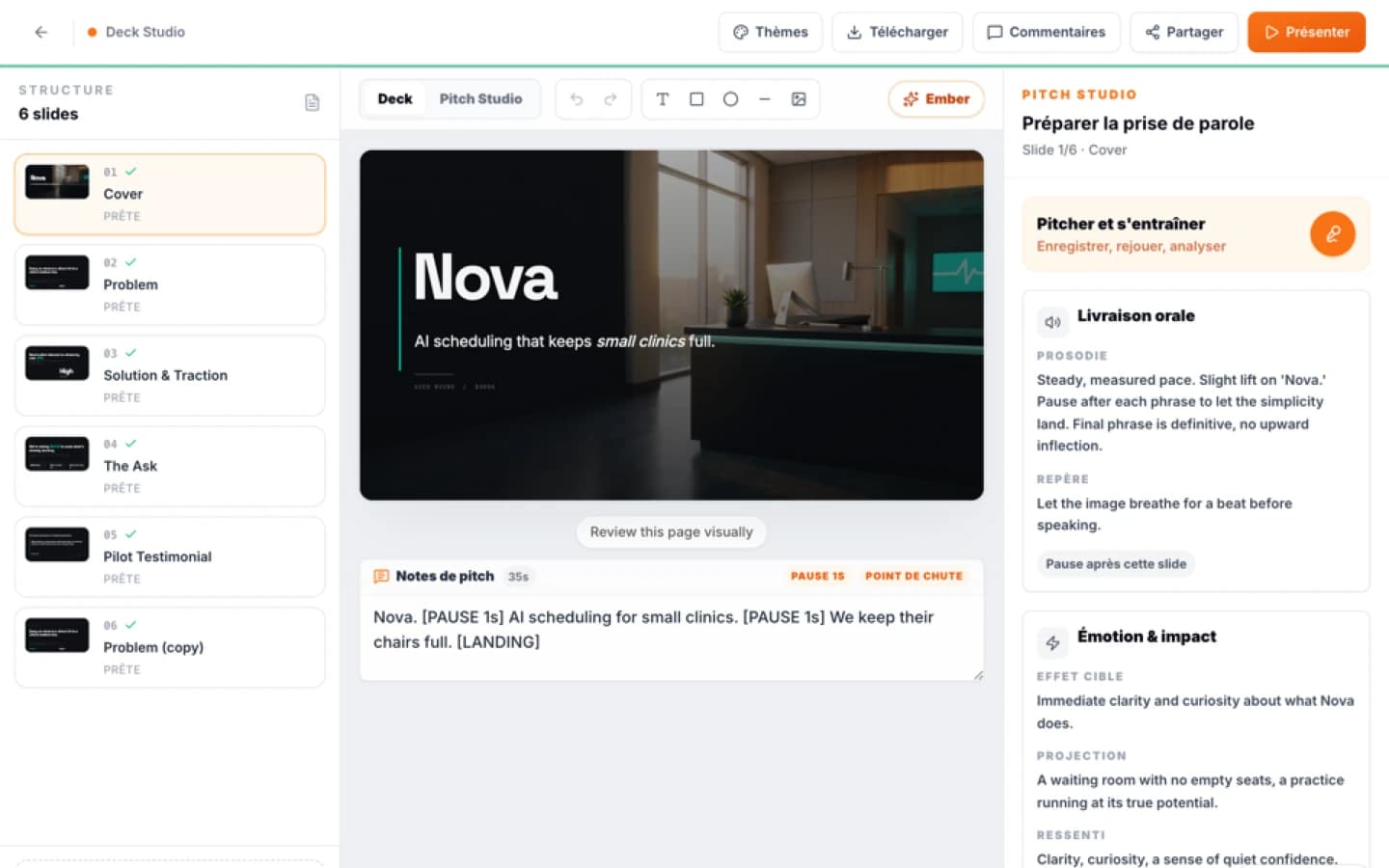
Rehearsal should expose verbal hesitations, bloated transitions, and instances where jargon creeps back into the narrative. To refine spoken pacing, the Creation module in Ember includes a dedicated Speaking practice workspace. Founders can record, replay, and review their deck presentations in takes lasting up to 15 minutes, analyzing pacing, structure, and verbal clarity across every individual slide.
Practicing your delivery out loud ensures that when you enter a partner meeting, your spoken words remain grounded in truth, clarity, and genuine conviction.
Sources
FAQ
Mini audit
Test your Pitch Deck
Get an initial diagnosis of substance, form and impact.