
The European Accessibility Act (EAA) applies to digital services consumed within European Union member states regardless of where the provider is incorporated. For United States software companies selling into the European market, meeting this regulatory threshold requires auditing customer-facing web applications, administrative portals, and client deliverables against the Web Content Accessibility Guidelines (WCAG) 2.1 Level AA standard. Because the legal obligations took effect on June 28, 2025, engineering and product teams must establish formal testing protocols and ongoing conformance records to satisfy enterprise buyer scrutiny and market surveillance authorities across Europe.
Who Falls Under the European Accessibility Act?
A common misconception among software leaders is that non-European companies are exempt from regional accessibility legislation. According to Accessible.org, the EAA became applicable on June 28, 2025, and regulates digital services offered within EU member states regardless of where the provider maintains its corporate headquarters. If a software-as-a-service provider based in the United States serves paying users or business clients in an EU country within covered categories, that provider falls within the scope of the directive.
The directive was designed to remove trade barriers created by divergent accessibility rules across member nations. As outlined by the European Commission, member states were required to incorporate the European Accessibility Act into their national law by June 2022, and the European Commission actively monitors the complete and correct implementation of the Act across the internal market.
Covered service areas include e-commerce, banking and financial services, electronic communications, and access to audiovisual media services. For modern enterprise software teams, this perimeter encompasses not only external marketing landing pages, but the operational software itself:
- Authentication screens, account creation flows, and single sign-on redirects
- Application dashboards, data reporting grids, and administrative settings panels
- Billing management interfaces, subscription checkouts, and invoicing modules
- In-app onboarding sequences, modal overlays, and integrated user assistance
- Digital deliverables and customer documentation distributed through customer portals
Enterprise procurement teams across the EU increasingly require documented proof of accessibility before finalizing software purchases. B2B vendors who cannot show compliance face deal disqualification alongside potential regulatory penalties administered by national market surveillance bodies.
Establishing the Technical Standard: WCAG 2.1 AA and the Evolution of EN 301 549
The technical foundation for digital accessibility in Europe is harmonized under European standard EN 301 549. Understanding which iteration governs current compliance is critical for engineering teams planning their roadmaps.
According to AccessibleEU, an updated version of the standard, EN 301 549 v4.1.1, was published in September 2026. This release adopts WCAG 2.2 as the accessibility benchmark for websites, software, and digital documents, adding six new criteria from WCAG 2.2 while removing the obsolete 4.1.1 parsing criterion. However, as AccessibleEU clarifies, until the European Commission formally cites EN 301 549 v4.1.1 in the Official Journal of the European Union, the current legal reference remains EN 301 549 v3.2.1 from 2021, which relies on WCAG 2.1 Level AA.
For engineering teams conducting audits today, WCAG 2.1 AA provides the immediate legal baseline, while aligning with WCAG 2.2 ensures forward compatibility as the updated standard approaches formal citation in the Official Journal.
| Evaluation Area | Practical Focus | Regulatory Baseline |
|---|---|---|
| Web Portals and SaaS Apps | Keyboard navigation, contrast, dynamic updates | WCAG 2.1 Level AA |
| Exported Deliverables | Structured tags, machine-readable text, reading order | EN 301 549 alignment |
| Compliance Documentation | Accessibility Conformance Reports, remediation logs | Member state surveillance |
Teams structuring enterprise audits can review how WCAG-EM 2.0 structures enterprise software audits to build an evaluation methodology that matches formal procurement expectations.
Why Automated Tooling Cannot Replace Manual Auditing
Engineering organizations frequently attempt to address compliance through automated scanning suites integrated into continuous integration pipelines. While automated linters and headless browser tests are valuable for catching basic syntax issues, they cannot evaluate functional accessibility on their own.
According to Accessible.org, automated scans can only detect approximately 25% of accessibility issues. Real accessibility barriers, such as dynamic focus management in modal dialogs, contextual alt text adequacy, screen reader announcement ordering, and interactive keyboard operation, require qualified human evaluation across representative user flows.
An effective audit protocol requires three distinct assessment layers:
- Representative Scope Sampling: Tech teams must map core user pathways, prioritizing high-traffic workflows such as user provisioning, checkout or billing, and data exports.
- Manual Assistive Technology Testing: Evaluators must navigate interactive flows using screen readers, keyboard-only controls, and screen magnification software to verify that dynamic states remain perceivable and operable.
- Deliverable and Asset Verification: Many B2B platforms generate reports, slides, or billing statements for end users. If these exports are rasterized as flattened graphics without underlying tag hierarchies, screen readers cannot parse the content. Engineering teams must ensure that exported assets contain machine-readable text and accessible reading structures.
Teams looking for broader operational guidance on software governance can consult the Knowledge guides for founders to organize their internal compliance frameworks.
Maintaining Defensible Documentation and Ongoing Compliance
The EAA imposes ongoing record-keeping responsibilities on service providers. Simply conducting a single point-in-time review does not shield an organization from regulatory review or enterprise procurement friction.
To maintain a defensible position, engineering organizations should assemble a compliance binder containing:
- An Accessibility Conformance Report (ACR), typically formatted using the Voluntary Product Accessibility Template (VPAT) mapped to EN 301 549 criteria.
- A public accessibility statement detailing current conformance levels, known limitations, and dedicated contact channels for users encountering barriers.
- An active remediation backlog where identified defects are categorized by severity, assigned directly to feature squads, and tracked through regular release cycles.
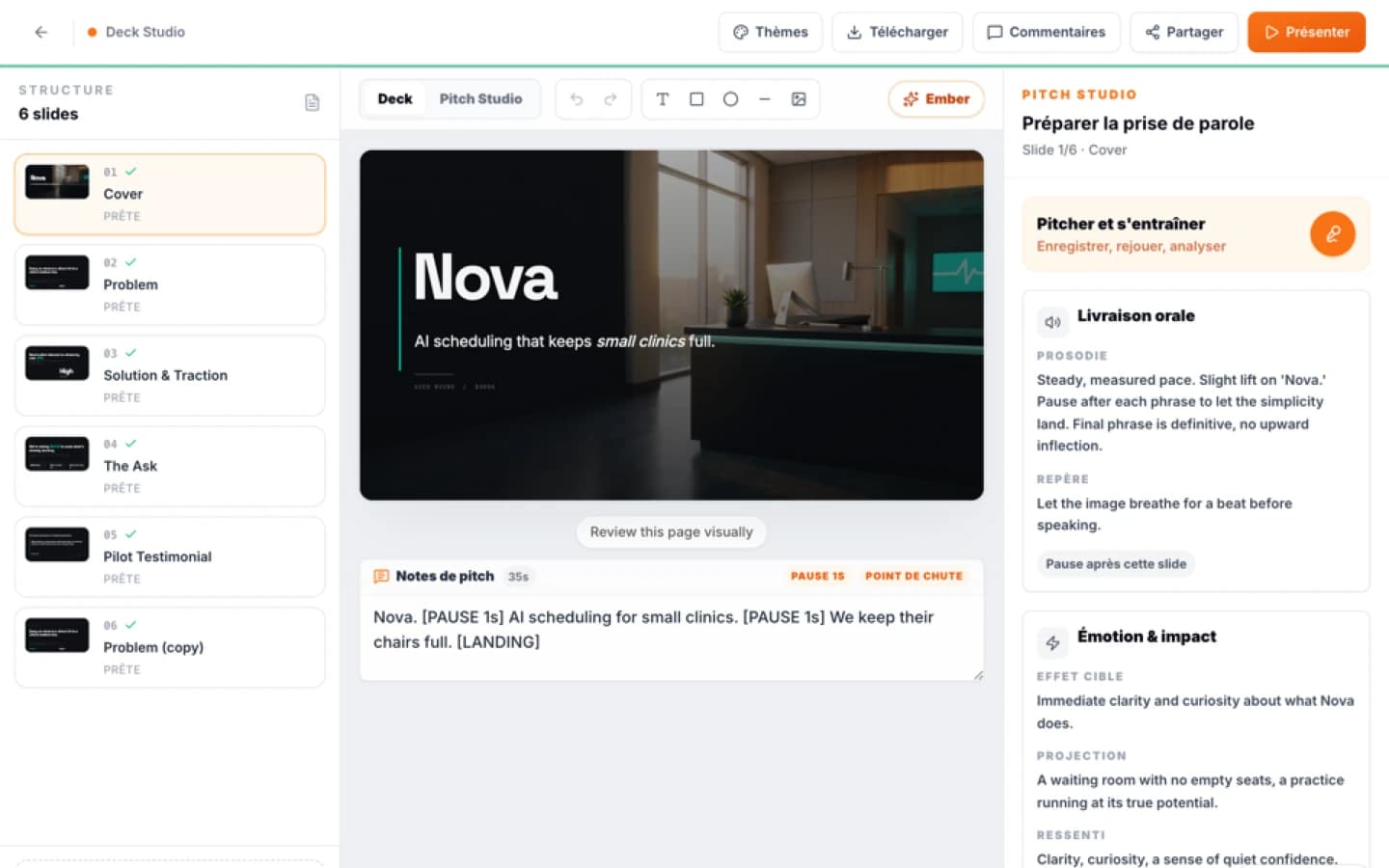
Accessibility debt compounds with each product sprint. When product teams treat accessibility as an architectural requirement rather than an ad hoc response to prospective sales blocks, they protect their pipeline and secure frictionless access to the European single market. At Ember, presentation and document generation workflows are structured to help teams produce clear, professional assets while maintaining full visibility over formatting standards.
Sources
FAQ
Mini audit
Test your Pitch Deck
Get an initial diagnosis of substance, form and impact.