
Modern outbound revenue teams face two distinct bottlenecks: coordinating structured follow-ups at scale across large sales organizations, or discovering exactly when and why a prospect wants to speak. Sales engagement platforms and intelligence engines address these problems from opposing operational philosophies.
Deciding between enterprise sequence orchestration and buying signal prioritization requires understanding where your pipeline generation truly breaks down.
Two Different Answers to the Outbound Dilemma
Enterprise outbound operations often assume that volume and structured cadence adherence drive conversions. Under this model, success hinges on enforcing multi-touch outreach across phone, email, and social channels, ensuring that enterprise sales development representatives execute prescribed steps on every account.
Salesloft positions its platform around this execution discipline. As stated on the official Salesloft homepage, the vendor describes its offering as the predictive revenue system, organized around creating, converting and growing revenue, and says it captures revenue signals across your stack and turns them into the next move for revenue teams. Its platform includes multi-channel cadences with a built-in dialer, alongside conversation intelligence. For commercial costs, the official Salesloft pricing page does not publish fixed tier numbers and instead routes prospective buyers directly to its sales organization.
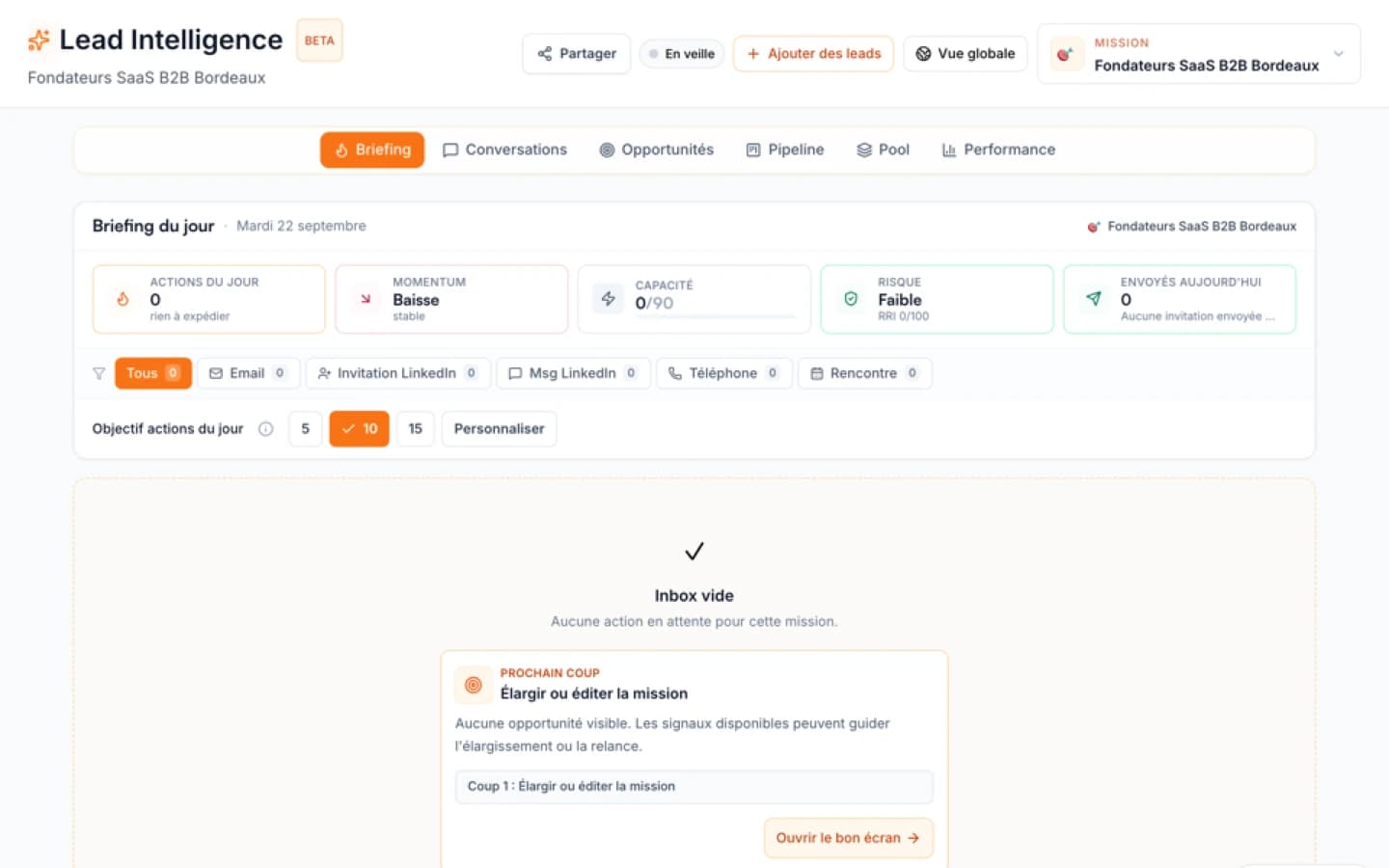
By contrast, Ember Lead Intelligence approaches outbound from the prior question of contextual relevance. Rather than treating pipeline generation as an execution marathon of automated steps, it acts as an acquisition intelligence layer that transforms commercial or fundraising missions into contacts, timing signals, and prioritized next actions. The system is designed to resolve four operational questions before outreach starts: who to contact, why reach out now, through which channel, and with what angle.
Understanding this distinction helps revenue leaders determine whether they need a command center to organize dozens of representatives or an analytical engine to filter out noise and identify real market timing.
Execution Cadences versus Acquisition Intelligence: Understanding the Architecture
To evaluate the operational difference, consider how each approach handles data, contacts, and daily representative tasks.
Sales engagement platforms function as execution engines. Once a list of target accounts and buyer personas enters the system, the platform orchestrates repetitive touchpoints. It prompts representatives to make calls through integrated dialers, send sequenced emails, and complete manual tasks. This framework ensures adherence to process across large, distributed teams, but the timing of each step follows the sequence configuration.
When teams push cold contacts through structured email cadences without real timing signals, they frequently face inbox placement friction. Understanding The New Rules for Outbound B2B Email Deliverability has become critical, because internet service providers and email service providers increasingly penalize rigid, unprompted volume.
Ember Lead Intelligence operates upstream from cadence execution. Rather than demanding strict minimum thresholds to launch a campaign, the platform works whether you begin with 10, 100, or 1,000 starting contacts. Teams can import up to 3,500 valid contacts from spreadsheet files into their pool, with enrichment waves of up to 200 contacts.
Instead of asking reps to execute generic templates, the engine evaluates organizational strategy, business plans, and ideal customer profiles. It searches accounts and decision-makers via a connected LinkedIn or Sales Navigator profile, analyzes signals across companies and individuals, and provides an explained priority alongside a recommended next action.
Where Enterprise Engagement Platforms Excel
Enterprise cadence orchestration platforms exist for clear operational reasons, and incumbent tools remain the right fit for specific organizational stages.
Salesloft is purpose-built for complex, multi-tiered enterprise revenue teams where sales operations leaders need granular visibility into rep activity. If your organization employs dozens of dedicated business development representatives who need daily task queues, integrated telephony, and rigorous activity compliance synchronized with a central customer relationship management system, an enterprise engagement platform provides that infrastructure.
Furthermore, when an organization already knows its exact target universe, possesses validated intent data, and merely requires a standardized framework to govern how enterprise account executives follow up on inbound inquiries or renewals, structured cadence software fulfills that role effectively.
However, deploying an enterprise engagement tool does not solve the upstream problem of relevance. If reps are simply feeding unverified lists into standard sequences, the result is often high activity volume paired with low reply rates. When outreach lacks genuine buying signals, relying on arbitrary volume benchmarks can distort pipeline health, as explored in Why Static Pipeline Coverage Ratios Fail Revenue Teams.
Signal Detection and Prioritization: Deciding When to Reach Out
The alternative philosophy prioritizes context over activity volume. Instead of sending five automated emails over two weeks hoping to catch someone at their desk, signal-driven intelligence seeks out the underlying events that make a conversation timely.
Signal detection focuses on observable changes:
- Strategic shifts, executive movements, and organizational changes within target accounts.
- Active discussions and topics surfaced through connected professional networks.
- Precise alignment between a company's current operational hurdles and your specific offering.
When representatives reach out on social channels, quality and targeting matter far more than bulk volume. Using targeted signals helps teams operate sustainably while respecting platform constraints, a balance detailed in our guide on LinkedIn Outreach Limits and Safe Quotas for Sales Reps.
Additionally, focusing on relevance rather than blanket broadcasting helps maintain legal and technical standards across jurisdictions, as outlined in Why Legal CNIL B2B Cold Outreach Gets Blocked by ESPs?.
Ember Lead Intelligence anchors outbound around these triggers. Ember connects executed actions, replies, meetings and outcomes to identify the situations that convert. This lets sales leaders evaluate which market triggers actually yield productive meetings, helping founders and sales teams build focused campaigns rather than burning their market reputation with untargeted sequences.
| Decision Criterion | Enterprise Cadence Orchestration | Buying Signal Intelligence |
|---|---|---|
| Core Operational Objective | Standardizing multi-channel outreach activities across sales teams | Identifying relevant timing, decision-makers, and contextual angles |
| Primary User Focus | Sales development reps following structured daily activity queues | Founders and commercial leaders seeking validated conversation entry points |
| Starting Data Requirement | Target account lists loaded into cadences for multi-step execution | No minimum contact threshold; imports up to 3,500 valid contacts, guided by the strategic mission |
| Timing Mechanism | Cadence steps at intervals set in the sequence configuration; Salesloft also describes signal prioritization on its homepage | Event and trigger monitoring across companies and individuals |
| Recommended Channel Output | Pre-configured cadence steps across phone dialer, email, and social | Contextual priority, suggested contact channel, and rationale |
Choosing the Right Foundation for Your Revenue Strategy
Selecting the right architecture depends on your team structure, deal size, and outbound maturity.
Choose an enterprise engagement platform like Salesloft if:
- You have a large sales development organization that requires strict activity tracking, daily dialer queues, and centralized manager oversight.
- Your sales operations team requires deep cadence governance integrated across complex enterprise tech stacks.
- Your primary operational challenge is standardizing how existing reps follow up on established pipeline and inbound leads.
Choose signal discovery and prioritization with Ember Lead Intelligence if:
- You need to determine who to target and why now, rather than blasting untargeted lists through repetitive sequences.
- You want an acquisition layer that derives prioritized contacts and explicit angles directly from your strategy, offering, and ideal customer profile.
- You value contextual precision, allowing reps to reach out with a clear rationale on the right channel.
For more frameworks on building modern acquisition processes, explore the Knowledge guides for sales. Moving from brute-force sequence execution to signal-informed prioritization ensures your team spends time having meaningful conversations rather than managing empty activity metrics.
Ember is the publisher of Lead Intelligence, so weigh this comparison with that in mind. Salesloft details come from its own homepage, pricing page and platform pages.
Sources
Free diagnostic
Test your sales file
Drop an Excel or CSV and check its readiness without sending its rows to Ember.