
Symptom or signal
A good meeting is not a financing decision
A pitch can create interest without resolving the questions required for an investment. The partner may still need to test thesis fit, market evidence, team risk, ownership, round structure, internal support or timing. Silence alone does not identify which layer is open.
Create a decision record immediately after the meeting. Capture what the investor confirmed, questioned, requested, declined and committed to do next. Mark interpretations separately from direct statements.
What changed
Use relationship context without inferring commitment
This context can help you choose a next step, but it cannot determine an investor’s internal vote, prove fund capacity or turn a social connection into consent for pressure. Direct investor communication and authorised documents remain the evidence.
Facts and sources
Build an evidence-gap register
Use one row per open question:
- exact investor question;
- current answer and confidence;
- source or document;
- missing evidence;
- owner;
- delivery date;
- decision the evidence should enable.
If the answer changes, preserve the previous version. This prevents the founder from sending inconsistent metrics to different investors.
For financial claims, link the definition and calculation, not only the number. For customer claims, distinguish signed contract, paid use, active use, pilot, letter of intent and verbal interest.
Why the common explanation is incomplete
The common explanation often favours volume, channel or one label. It remains incomplete when it ignores information provenance, decision timing, contact constraints and the team's capacity to handle the next step properly.
The real problem
Diagnose four states before following up
1. Clear no
The investor has rejected the opportunity or named a structural mismatch. Record the reason in their words. Ask one clarifying question only if it improves future targeting. Do not reopen the pitch through repeated updates.
2. Not now
The investor identifies a condition that may change, such as a milestone, round stage, geography or fund timing. Convert it into a dated re-entry rule with an owner. "Keep me posted" without a condition is not a process.
3. Evidence gap
The opportunity may fit, but a claim remains unproved. Common categories include customer pull, repeatability, margin, technical risk, market size, governance or use of funds. Respond with the smallest source-backed asset that addresses the stated gap.
4. No agreed process
The meeting ended without a next decision, date or owner. The appropriate follow-up is not another deck. Ask what decision comes next, who participates, which evidence is required and when the team expects to review it.
Match the asset to the unresolved question
Use a short memo for one disputed assumption, a customer reference for a buyer-risk question, a cohort or pipeline schedule for repeatability, a technical note for implementation risk and a clean data room index when diligence has begun.
Do not resend the full pitch after every question. A larger document can hide the answer and create new inconsistencies.
For forecasts, see How Do Small B2B Sales Teams Build a Trustworthy Revenue Forecast?.
Agree the next decision, not a vague check-in
A useful closing question is: "What decision does your team need to make next, what evidence would help, who owns the review and when should we reconnect?"
The answer may still be uncertain. Record that uncertainty instead of inventing a deadline. If the investor will not define a process, lower the opportunity’s priority and protect fundraising time.
Understand what a term sheet does and does not prove
Carta explains the role and common provisions of a venture term sheet and distinguishes it from later definitive documents (guide). Y Combinator publishes current financing documents and SAFE guidance (documents).
These resources help founders prepare for structure and documentation. They do not mean a particular investor will issue a term sheet, and this article does not provide legal advice. Use qualified counsel for actual financing documents.
A disciplined follow-up sequence
- Within the founder’s normal working rhythm, send a short recap of confirmed points and the agreed next step.
- Deliver the requested asset by its promised date, with the exact question in the subject or opening line.
- On the agreed review date, ask for the decision state and remaining gap.
- If no process exists, send one message asking for status and permission to recontact on a named condition.
- Park the opportunity when there is no response, no process and no new evidence.
Quality comes from relevance and consistency, not from an arbitrary number of reminders.
How the mechanism works
The mechanism has four stages: observe a change, verify its provenance, choose one bounded action, then compare the outcome with a condition written before acting. A contradiction corrects the rule. An unknown remains open.
Concrete examples
Example: two records look similar, but only one contains a recent, verifiable change. The team documents that fact, chooses a fitting action, sets a review date and keeps the other record as a control. It learns from the contrast without inventing certainty.
When to use this diagnosis
Use this diagnosis when a signal changes priority, an action consumes meaningful time or the team must explain why it pursues, postpones or closes an item. It is especially useful when several plausible causes compete.
When not to use it
Limits
Investment processes vary by investor, fund, stage, geography and transaction. There is no universal number of days from pitch to term sheet. A delay can reflect portfolio work, internal process, diligence, fund constraints or loss of interest.
Next step
Choose a small scope, name the owner and review date, then record the fact, assumption, action and stopping condition. Correct one rule at a time so the team can tell what genuinely changed the outcome.
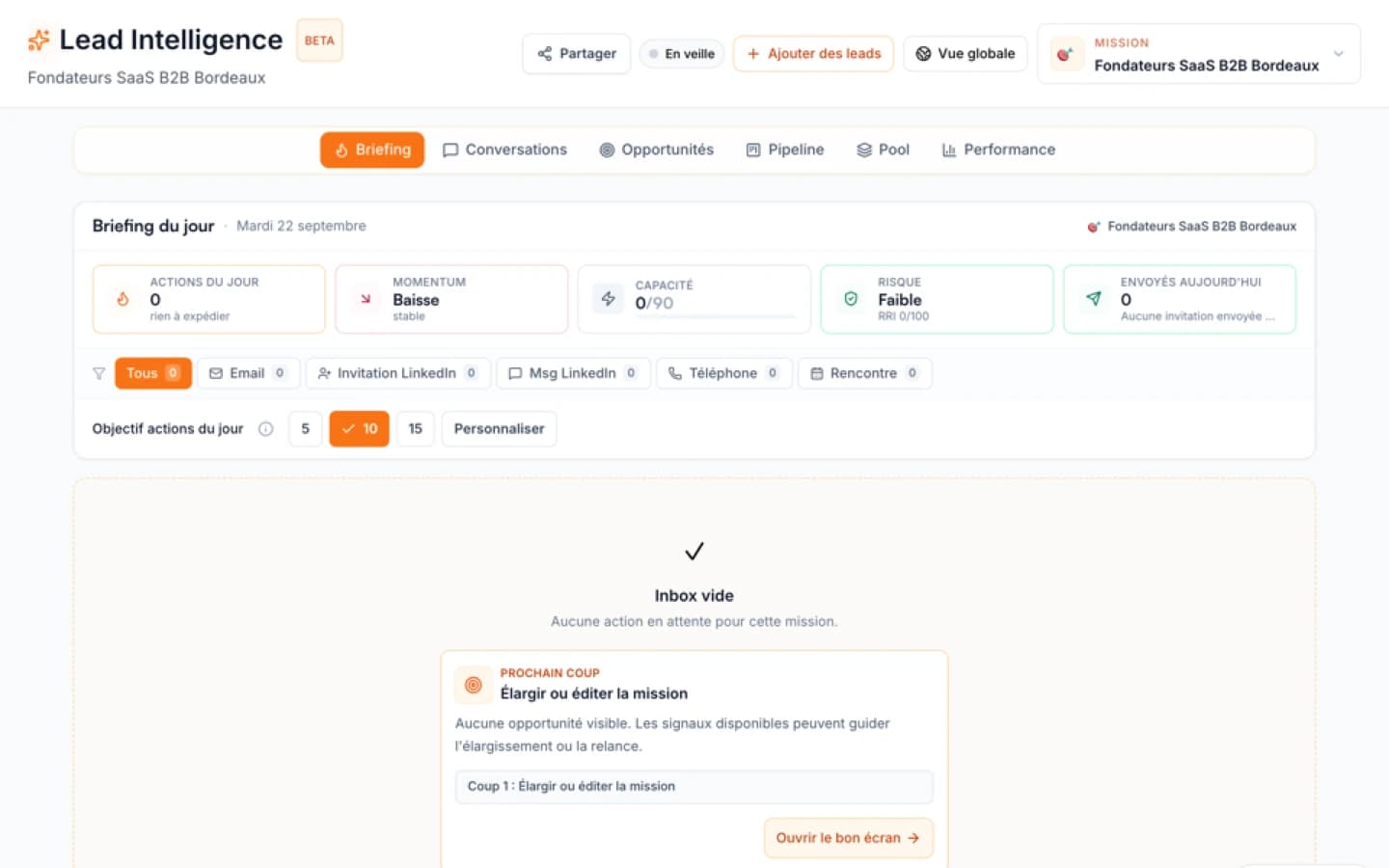
In Ember, Lead Intelligence prioritises opportunities from the available context. It classifies accounts into explained opportunities to watch, act on or set aside. It proposes the next action and channel that fit the lead situation. These capabilities support a review, but do not prove intent, consent, budget or an outcome.
Sources and methodology
External sources frame facts and limitations rather than promise a universal result. Recommendations are editorial analysis. Assumptions, unknowns and revision conditions remain visible throughout the article.
Sources
FAQ
Free diagnostic
Test your sales file
Drop an Excel or CSV and check its readiness without sending its rows to Ember.