
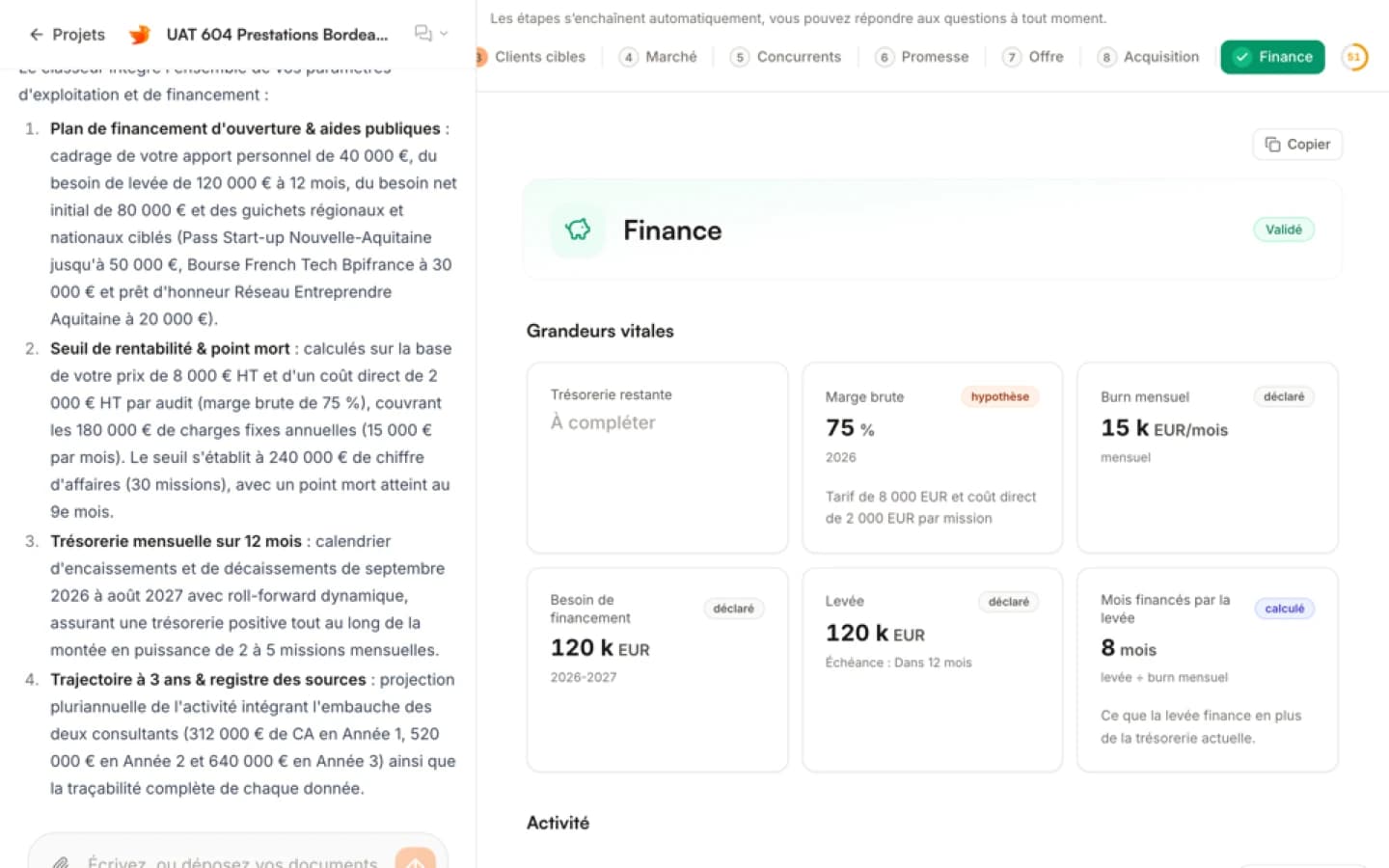
Context and ICP
As the General Manager of a Small and Medium-sized Enterprise (SME), navigating financial planning and strategic growth is increasingly complex. Leaders currently face a challenging macroeconomic environment marked by tight capital and stalled growth, as highlighted in the analysis of SME priorities for 2026. In this context, securing the right resources is not just about finding capital, it is about aligning every operational assumption with a defensible strategy.
Ember, an AI team for entrepreneurship, addresses this exact challenge through its Fund Your Growth capability. For an SME leader, the primary objective is to build a Business Plan to fund and develop the project without wasting time on misaligned options.
Instead of treating financial planning as a static exercise, Fund Your Growth connects assumptions, evidence, funding needs, and the action plan in one single context. It reuses project information as shared context across modules, ensuring that any strategic shift is immediately reflected throughout the entire plan, as detailed on the Fund Your Growth product page.
SME leaders can use this capability to structure funding options directly from their project context, making it easier to evaluate which paths are viable. Additionally, the system organises finance, traction, legal, and investor materials in a Data Room connected to the file, streamlining the due diligence process for bank loans, public subsidies, or private investments. This centralized approach allows general managers to maintain complete control over their strategic narrative while preparing their business for sustainable expansion.
To place this decision in context, the Knowledge guides for finance bring together deeper guidance on the same field.
Problem
Tight capital and stalled growth make this harder still, as the analysis of SME priorities for 2026 explains. For a General Manager, the primary obstacle is not a lack of ambition, but the friction of translating operational reality into a structured, defensible financial plan. Traditional spreadsheets and basic templates are often perfectly adequate for simple, static projections. However, they quickly fall short when a business needs to align complex, dynamic funding strategies with its actual operational constraints. Leaders frequently find themselves trapped in a cycle of manual updates, relying on isolated documents that fail to capture how a change in sales velocity or hiring plans impacts their overall capital requirements. When seeking capital, whether through bank debt, public subsidies, or private equity, the stakes are high. A mismatched funding strategy can dilute equity unnecessarily or saddle the company with unsustainable debt service. Without a clear way to model different funding scenarios based on real operational constraints, decision-makers are left guessing which path is truly coherent with their project stage. Furthermore, the sheer administrative overhead of preparing for a funding round or a major credit application is a significant drain on executive focus. Gathering, organizing, and verifying financial metrics, legal documents, and traction proof is a fragmented process. Without a centralized, structured repository, critical gaps in the company's file remain invisible until an investor or lender points them out, often too late to save the deal.
Prerequisites
Before a General Manager can successfully leverage Fund Your Growth to structure a business plan or map out a funding strategy, certain operational foundations must be in place. This preparation does not require a fully polished financial model, but it does require raw business inputs that reflect the current state of the company.
First, the leadership team must gather existing operational and financial documents. Because the platform reads project documents to connect evidence directly to funding decisions, having baseline materials such as historical financial statements, current traction metrics, and legal structures is essential. These materials are organized within a dedicated Data Room connected directly to the project file, as detailed in the Ember Fund Your Growth documentation.
Second, the executive team must have a clear strategic intent, whether that involves securing non-dilutive funding, preparing for an equity round, or restructuring debt to navigate tight capital conditions. Having these raw inputs ready allows the system to surface weak points and construct a defensible strategy, turning scattered corporate documents into a cohesive plan ready for investor review.
Workflow
The operational workflow for a General Manager using Fund Your Growth is designed to turn fragmented company data into a structured, defensible strategy. This process moves systematically from initial documentation to a complete, investor-ready file, ensuring that the leadership team can secure capital without losing focus on daily operations.
The workflow begins with context consolidation. The General Manager uploads existing operational documents, historical financial statements, and current growth notes into the platform. Instead of requiring a perfectly formatted spreadsheet, the platform reads these diverse materials to establish a unified baseline. This step aligns the historical performance of the Small and Medium-sized Enterprise (SME) with its future funding requirements, identifying the core strengths and potential vulnerabilities in the company's current positioning.
Next, the platform structures the core strategic narrative. It analyzes the uploaded materials to build a Business Plan to fund and develop the project. Rather than generating a static, generic template, this step connects business assumptions directly to available evidence. For the General Manager, this means the system highlights exactly which parts of the growth plan are well-supported by historical data and which assumptions require further validation before meeting with financial partners.
Once the narrative is established, the workflow focuses on verification and organization. The platform organizes finance, traction, legal, and investor materials in a Data Room connected to the file, as detailed in the Fund Your Growth capabilities. This centralized repository ensures that every claim made in the business plan is directly linked to its supporting document. When banks, public institutions, or private investors conduct due diligence, the General Manager can provide immediate, structured access to the necessary proof without the typical administrative delay.
Finally, the validated strategic context serves as a bridge to commercial execution. The business plan, Ideal Customer Profile (ICP), offer, and overall strategy developed during this process are preserved within Ember. This allows the SME to reuse the exact same strategic foundation to prepare future sales missions, ensuring complete alignment between the financial commitments made to backers and the daily outreach conducted by the commercial team.
Expected result
The expected result of deploying Fund Your Growth within a small and medium-sized enterprise (SME) is a decisive shift from fragmented, reactive planning to a unified, defensible strategic posture.
First, the General Manager obtains a comprehensive Business Plan designed to fund and develop the business. Rather than relying on static templates or generic financial advice, the leadership team receives a tailored funding strategy that compares and structures scenarios based on the company's specific stage, geography, and operational constraints. This ensures that the final funding path is entirely coherent with the actual trajectory of the business.
Second, the tool centralizes and structures critical corporate assets. It organizes finance, traction, legal, and investor materials in a Data Room connected directly to the main file, a capability detailed on the Ember Fund Your Growth page. This eliminates the administrative friction of scattered spreadsheets and mismatched documents, presenting a single, verified source of truth to potential financial partners.
Third, the process brings immediate visibility to strategic vulnerabilities. By mapping out assumptions and evidence, the system highlights remaining validation gaps and converts them into a prioritized action plan. The General Manager retains complete control throughout this process, reviewing, approving, or rejecting every proposal before it is integrated into the final file.
Finally, the validated strategic context created during this process does not remain isolated. It establishes a durable foundation of business intelligence that can be reused across other operational modules, such as aligning sales teams or preparing targeted market discovery missions.
This approach also connects with Finance as a Growth Decision for Scale-Up CEOs and Teams, which clarifies the next choice.
Example Ember mission
To illustrate how these capabilities function in practice, consider the scenario of a regional logistics provider facing the dual challenge of tight capital and stalled growth. For a General Manager navigating these pressures, as outlined in the analysis of strategic priorities for SME leaders, the immediate need is to secure non-dilutive funding to modernize their fleet while simultaneously kickstarting a new business-to-business sales push.
The mission begins within Fund Your Growth, where the General Manager uploads historical financial statements, a draft commercial presentation, and current fleet utilization spreadsheets. Acting as an artificial intelligence (AI) team for entrepreneurship, Ember reads these project documents and connects relevant evidence to funding decisions. Instead of forcing the user to fill out endless static forms, the platform reuses project information as shared context across modules.
As the data is processed, Ember connects business modules in a living graph where weak points surface first. For example, the system might highlight that while the company has strong historical traction, its projected revenue growth relies on assumptions that lack documented proof. By making available proof, assumptions, and remaining validation gaps visible, the platform allows the leadership team to address vulnerabilities before presenting to external partners. It turns these gaps in the file into prioritised next actions, such as prompting the General Manager to upload recent client letters of intent to back up the growth forecasts.
Simultaneously, the platform structures funding options from the project context. Rather than presenting a generic list of options, it delivers a funding path coherent with the project, balancing regional innovation grants with asset-based debt. All supporting documentation, including finance, traction, legal, and investor materials, is automatically organised in a Data Room connected to the file, as detailed on the Ember Fund Your Growth page.
Once this strategic foundation is validated, the General Manager can seamlessly transition from securing capital to driving revenue. The validated business plan, ideal customer profile (ICP), and core offer serve as the direct foundation for a targeted commercial push. By passing this rich context to Lead Intelligence, the sales team can immediately launch a prospecting mission. After the mission, the platform shows the contacts analysed, signals detected, and priority actions actually recorded by Ember, ensuring that the company targets the highest-value opportunities with absolute precision.
Limits and non-fit
While Fund Your Growth provides a structured path for SME leaders to secure capital and align their strategy, it is not a universal solution for every operational need. Understanding where the platform reaches its boundaries helps general managers make informed deployment decisions.
First, Ember is not a hands-off automation tool. The platform operates on an agentic model that requires active leadership involvement. The entrepreneur must approve, reject, or edit every proposal before it is integrated into the final file. If an executive expects a fully automated generator that produces a business plan without human oversight, Ember is not the right fit. Furthermore, while the platform structures a highly defensible strategy and organizes key materials in a connected Data Room, Ember does not guarantee that funding will be obtained.
Second, for companies looking for high volume, automated outbound sales execution rather than strategic alignment, traditional databases remain more appropriate. For example, a platform like Apollo highlights access to 240 million contacts and 30 million companies (Apollo) and lets you add prospects to a list or a sequence (Apollo's Chrome extension). Its model relies on credits, including an export credit consumed whenever a contact is exported outside Apollo (pricing page), which can weigh on teams that export a lot; it remains a reference for pure volume-based email campaigns. Ember, by contrast, focuses on strategic priority and context-driven decisions.
Finally, there are functional limitations within the platform itself during its current rollout. Access to Fund Your Growth is enabled progressively depending on the account. Additionally, the product bridges that allow project context to flow seamlessly into Creation and Lead Intelligence are limited, activating only after the required context has been fully validated by the user. For organizations requiring immediate, unvalidated cross-module synchronization, this structured validation process may feel like a constraint, though it is necessary to maintain strategic coherence.
In practice, Building a Fundable B2B Fintech Pitch Deck in a Crowded AI Market completes this framework with another angle on the same topic.
When to use it
For a General Manager (GM) of a Small and Medium-sized Enterprise (SME), the decision to deploy Fund Your Growth usually aligns with specific strategic inflection points. The most pressing scenario occurs when the business faces the dual pressure of restricted capital and flatlining revenue. When navigating these tight conditions, as highlighted in the analysis of strategic priorities for SME leaders, leaders cannot afford to rely on guesswork. They need to stress test their business model, identify structural weaknesses, and build a Business Plan designed to fund and develop the project. Fund Your Growth serves this exact moment by turning assumptions into defensible strategies.
Another critical trigger is preparing for formal discussions with financial partners, whether they are traditional banks, public institutions, or private investors. Instead of presenting a generic spreadsheet, a General Manager can use the platform to compare and structure realistic funding scenarios tailored to the company's specific stage, geography, and constraints. This is particularly valuable when the leadership team needs to organize finance, traction, legal, and investor materials in a dedicated Data Room connected directly to the active file, ensuring all documentation remains unified and up to date as detailed in the Ember Fund Your Growth documentation.
Finally, Fund Your Growth is highly effective when an SME needs to bridge the gap between high level strategy and daily commercial execution. When a General Manager needs to transition from planning to active market discovery, the platform acts as the foundation. The validated business plan, Ideal Customer Profile (ICP), and strategic offer serve as the direct context that prepares subsequent sales missions. This ensures that the commercial team does not waste resources on cold outreach but instead targets opportunities with clear, strategic alignment.
Next step
For a General Manager of a Small and Medium-sized Enterprise (SME), the path forward involves moving from strategic hesitation to structured execution. The immediate next step is to consolidate existing business assumptions, financial records, and operational data to build a Business Plan to fund and develop the project.
By deploying the Fund Your Growth capability within Ember, leadership teams can systematically identify what is missing from their current strategic posture. The platform automatically turns gaps in the file into prioritised next actions, ensuring that the executive team knows exactly which areas require immediate validation. Furthermore, it organises finance, traction, legal, and investor materials in a Data Room connected to the file, creating a single repository that is always ready for external review.
Rather than navigating these complex requirements in isolation, leaders can rely on Ember as an AI team for entrepreneurship. This structured approach helps decision-makers understand a changing context, choose the next priority, and take action with confidence. To begin, leaders can access the Fund Your Growth workspace to map their current assets, identify critical gaps, and establish a clear, defensible strategy for their next growth phase.
Before deciding, What Traction Evidence to Verify Before Choosing Growth? helps connect this method with adjacent priorities.
Sources
To ground these strategic recommendations in current market realities, this analysis relies on several key industry references and product documentations. The core challenges of managing flatlining growth under tight capital constraints are analysed in the strategic guide on SME priorities for 2026. The functional capabilities of the platform, specifically how it structures financial and investor materials, are detailed in the Ember Fund Your Growth documentation. For the context on outbound sales tools, the information on Apollo (access to 240 million contacts and 30 million companies, and an export credit consumed whenever a contact is exported outside Apollo) comes from its official website and its pricing page, consulted on 28 September 2026.
Sources
FAQ
Mini audit
Test your Business Plan
Identify strengths, missing proof and the next priority.