
Context and ICP
For a Chief Executive Officer (CEO) of a growing startup or a Small and Medium-sized Enterprise (SME) leader, securing the right capital is a continuous challenge. In the early stages of a business, founders often have to manage financial strategies themselves before recruiting a dedicated Chief Financial Officer (CFO), a pivotal transition explored by Spiko. Navigating these complex financial waters while trying to accelerate business development requires both rigorous planning and clear execution, as detailed in growth guides by Stripe.
The primary obstacle for these leaders is not a lack of funding options, but the absence of a coherent, defensible strategy. Traditional approaches often rely on static templates or generic lists of potential investors and grants, which fail to reflect the unique operational reality of the business. This disconnect makes it difficult to present a convincing case to financial partners or to align internal milestones with funding requirements, a common hurdle in startup finance discussed by Vocation.
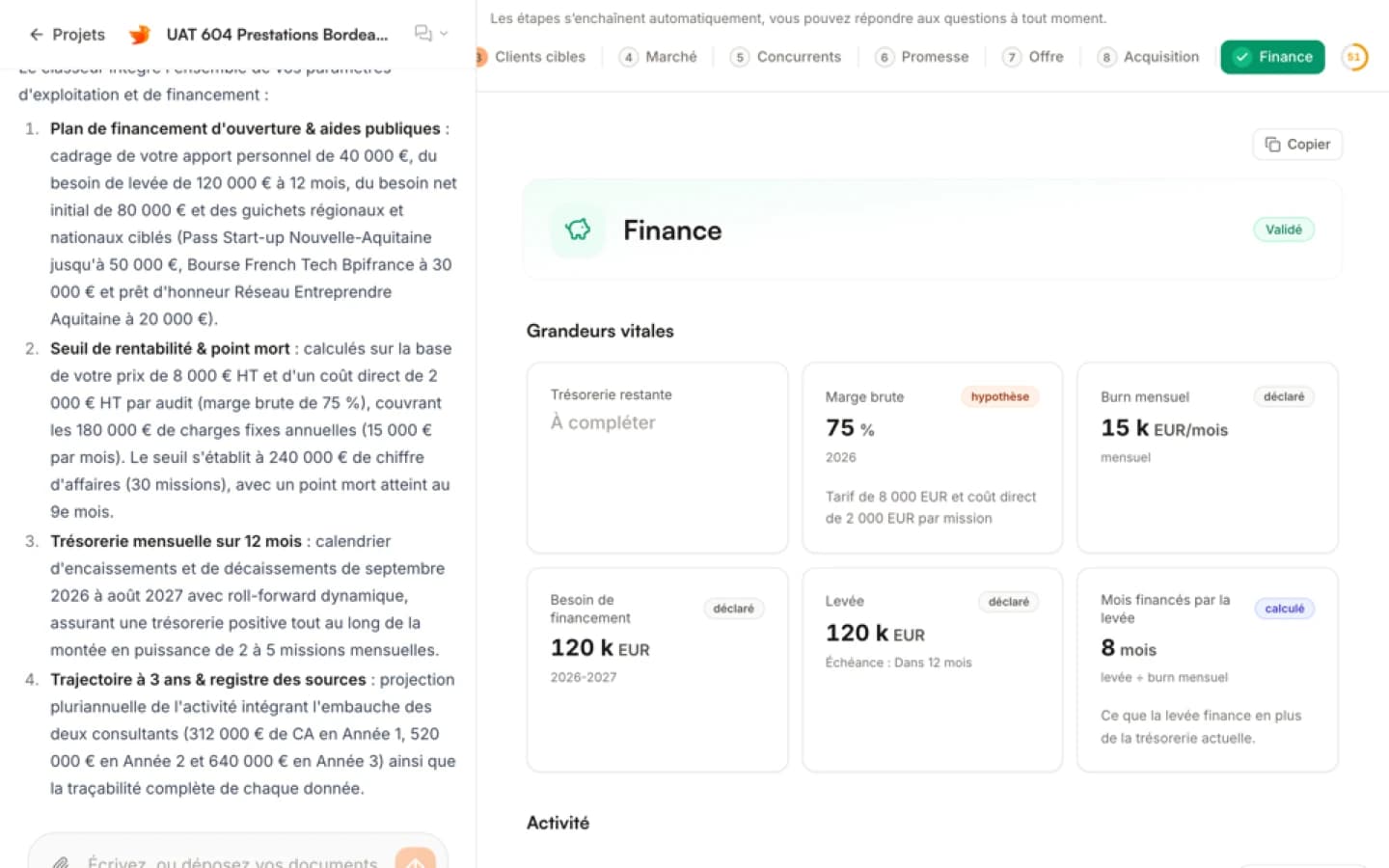
Ember addresses this strategic gap through its Fund Your Growth capability. Designed specifically to help entrepreneurs build a Business Plan to fund and develop their projects, this capability shifts the focus from superficial templates to structured reasoning. It connects assumptions, evidence, funding needs, and the action plan in a single, coherent context. By reusing project information as shared context, it allows SME leaders and startup founders to map out their financial future with clarity, ensuring that every funding decision is backed by solid operational evidence.
To place this decision in context, the Knowledge guides for finance brings together deeper guidance on the same field.
Problem
Managing the financial trajectory of a growing business is one of the most demanding responsibilities for a startup Chief Executive Officer (CEO) or Small and Medium-sized Enterprise (SME) leader. In the early and scaling stages, founders must act as their own financial strategists before they can justify hiring a dedicated Chief Financial Officer (CFO). According to analysis by Vocation, navigating startup finance involves balancing immediate operational needs with long term strategic planning. This dual burden often leaves leaders stretched thin, attempting to build complex financial projections while simultaneously driving product development and sales.
The challenge intensifies when preparing for a funding round or structuring a sustainable growth plan. As noted by Spiko, understanding how to structure these early financial missions is critical, yet many founders lack the specialized background to design a bulletproof strategy. When attempting to accelerate development, as outlined by Stripe, companies need cohesive strategies rather than fragmented tactics. Without a structured framework, founders often rely on generic templates that fail to reflect their specific business model, stage, or geography.
This lack of structure creates significant friction when interacting with investors and financial partners. Founders struggle to identify which assumptions are backed by real evidence and which gaps still need to be validated. Crucial materials, including traction metrics, legal documents, and financial models, remain scattered across different folders instead of being organized in a secure, professional environment. Without a clear way to turn these gaps into prioritized next actions, CEOs risk presenting a weak, indefensible strategy to potential backers, ultimately delaying their growth and jeopardizing their capital acquisition.
Prerequisites
Before a Chief Executive Officer (CEO) or a Small and Medium-sized Enterprise (SME) leader can effectively leverage the Fund Your Growth capability within Ember, certain foundational elements must be in place. Preparing these prerequisites ensures that the transition from raw business ideas to a structured, defensible funding strategy is as smooth as possible.
First, the leader must gather existing project documentation. This includes early traction data, basic financial assumptions, and legal documents. In the early stages of a startup, founders typically manage these financial strategies themselves before recruiting a dedicated Chief Financial Officer (CFO), a pivotal transition highlighted in startup finance guides by Spiko. Having these raw materials ready is crucial because Ember is designed to read project documents and connect relevant evidence directly to funding decisions.
Second, a clear operational direction is necessary. To accelerate development and scale effectively, as outlined in growth strategies by Stripe, a business needs a structured plan rather than a reactive approach to capital. The founder should have a baseline understanding of what they want to achieve, whether that is launching a new product, expanding to a new geography, or hiring key team members.
Finally, the founder must be prepared to actively participate in the process. While Ember helps organize finance, traction, legal, and investor materials in a Data Room connected to the file, as shown on the Ember Fund Your Growth page, the entrepreneur remains the ultimate decision-maker. The prerequisite here is a commitment to review, edit, and approve proposals, ensuring the final Business Plan truly reflects the strategic vision of the company.
To explore this point further, What Metrics Do Seed Investors Want to See from B2B SaaS? details a step directly related to this decision.
Workflow
To execute a successful capitalization strategy without a dedicated Chief Financial Officer (CFO), a Chief Executive Officer (CEO) can follow a structured, step-by-step workflow within the Fund Your Growth capability. This process transforms raw operational data into a defensible strategy, keeping the founder in complete control at every stage.
The workflow begins with context consolidation. The entrepreneur uploads existing company documents, pitch drafts, and financial history. Ember reads these project documents and connects relevant evidence to funding decisions, ensuring that no historical proof is overlooked. This information is consolidated into a shared project context, which serves as the single source of truth across all business modules.
Next, the system maps these inputs into a living graph. Instead of presenting a static spreadsheet, Ember connects various business modules in a dynamic network where weak points and validation gaps surface first. This dynamic prioritization helps the leader identify which assumptions require immediate proof before presenting the business to external partners.
Once the gaps are identified, the workflow moves to scenario modeling. The system structures funding options based on the specific project context, comparing multiple funding scenarios adapted to the company stage, geography, and operational constraints. The entrepreneur can then evaluate these options, choosing to approve, reject, or edit any proposal before it is integrated into the final file.
With the strategy selected, the system automatically translates decisions into a concrete action plan. It organizes critical finance, traction, legal, and investor materials in a dedicated Data Room connected directly to the file, as outlined on the Ember Fund Your Growth page. This centralized repository ensures that the startup is always due-diligence ready.
Finally, the validated context unlocks bridges to other operational areas. Once the core business plan and funding strategy are finalized, this rich context is prepared for reuse by other capabilities. For example, the validated Ideal Customer Profile (ICP) and strategy can be seamlessly transferred to Lead Intelligence to prepare and launch targeted sales missions, aligning the company's financial goals with its daily outbound execution.
Expected result
When a Chief Executive Officer (CEO) or a Small and Medium-sized Enterprise (SME) leader successfully deploys the Fund Your Growth capability, the immediate result is a shift from reactive fundraising to structured, proactive execution. Instead of struggling with fragmented spreadsheets and disconnected pitch slides, the leader establishes a single, coherent source of truth that aligns the company's financial trajectory with its operational reality.
The primary outcome of this process is a comprehensive Business Plan designed to fund and develop the project. This is not a static document meant to sit on a hard drive, but a dynamic strategic asset. For early-stage companies that cannot yet justify the expense of a full-time Chief Financial Officer (CFO), as discussed in analyses of the startup CFO role by Spiko, this capability serves as a strategic bridge. It allows founders to master their own financial narrative and maintain complete control over their capitalization strategy.
A key concrete deliverable of this workflow is the creation of a centralized Data Room. This feature organizes finance, traction, legal, and investor materials in a Data Room connected directly to the project file, as detailed on the Ember Fund Your Growth page. When speaking with venture capitalists or bank lenders, having these documents structured and instantly accessible eliminates the administrative friction that often delays or derails funding rounds.
While traditional financial consulting agencies or generic modeling templates can be good enough for businesses with highly predictable, slow-growth models, they fall short for fast-scaling startups. According to insights on scaling from Stripe, rapid development requires continuous strategic adaptation. By using Ember, the business leader ensures that every financial assumption is backed by visible proof, and any remaining validation gaps are highlighted before they turn into costly mistakes.
Ultimately, the expected result is a business that is fully prepared for its next phase of growth. The validated financial strategy and business plan context can then seamlessly feed into other commercial operations, such as preparing targeted sales missions, ensuring that the company's funding strategy and go-to-market execution remain perfectly synchronized.
This approach also connects with How should sales-led founders build financial models?, which clarifies the next choice.
Example Ember mission
To illustrate how a Chief Executive Officer (CEO) or Small and Medium-sized Enterprise (SME) leader can apply these concepts, consider a typical mission executed within Ember. In this scenario, a scaling software startup is preparing for its next phase of expansion. The founder needs to secure capital but lacks a full time Chief Financial Officer (CFO) to build a defensible model, a common challenge highlighted in startup finance discussions on Vocation and Spiko.
The mission begins when the CEO uploads the company's historical financial drafts, pitch slides, and current traction metrics into Ember. Using the Fund Your Growth capability, the platform reads these project documents and connects relevant evidence directly to potential funding decisions, as detailed on the Ember Fund Your Growth page. Rather than forcing the founder to fill out static templates, the system reuses this project information as a shared context across all modules.
As the analysis progresses, Ember replaces a generic list of financing options with a highly coherent funding path that aligns with the specific constraints of the business. It maps out the company's financial health, making all available proof, underlying assumptions, and remaining validation gaps visible to the founder. This structured approach is critical when executing growth strategies, as noted in scaling guides by Stripe.
Instead of leaving the CEO with a passive diagnostic, the platform turns these identified gaps in the file into prioritized next actions. Simultaneously, Ember organizes all finance, traction, legal, and investor materials in a secure Data Room connected directly to the active file, ensuring the startup is fully prepared for external due diligence. Through this single, continuous mission, the SME leader transitions from unstructured preparation to a clear, defensible strategy.
Limits and non-fit
While the Fund Your Growth capability provides a structured path for Chief Executive Officer (CEO) and Small and Medium-sized Enterprise (SME) leaders to build a defensible strategy, it is not a universal solution for every financial or operational scenario. Understanding where the platform fits and where its boundaries lie is essential for making informed strategic decisions.
First, Fund Your Growth is not a replacement for a dedicated, full-time Chief Financial Officer (CFO) when a company reaches late-stage complexity. While the platform organizes finance, traction, legal, and investor materials in a Data Room connected to the file, highly complex corporate transactions, international tax structuring, and custom audit requirements still demand human expertise. As discussed in analyses of startup financial roles by Vocation, the strategic scope of a financial leader changes as an organization matures. Relying solely on software during advanced scaling phases is a non-fit, and knowing when to transition to a dedicated executive is a critical milestone, as highlighted by Spiko.
Second, Ember does not execute the physical or technical scaling of your operational infrastructure. For example, setting up global payment systems, managing multi-currency merchant accounts, or engineering localized checkout flows requires specialized transactional platforms, as outlined in scaling guides by Stripe. Ember helps you plan and defend the business model, but the technical implementation of these operational systems remains outside its scope.
Third, the platform is designed around human review and strategic reasoning rather than automated document generation. Ember does not guarantee that funding will be obtained, as the final decision always rests with investors and financial institutions. Check the current account’s available functions before planning around a particular feature.
Finally, if your immediate business need is high-volume, unsegmented outbound sales outreach, Ember is not the correct fit. While the Lead Intelligence capability helps sales teams prioritize opportunities by reusing the Business Plan and Ideal Customer Profile (ICP) context, it is not designed for mass-email spamming. For businesses that optimize purely for mass contact databases and automated sequence volume, traditional outbound platforms are more suitable. Ember focuses on contextual prioritization and signal monitoring to identify the conversations that deserve attention now, rather than competing on raw database size.
In practice, Build a Target Investor List in 2026 Without a Warm Intro completes this framework with another angle on the same topic.
When to use it
For a Chief Executive Officer (CEO) of a startup or a Small and Medium-sized Enterprise (SME) leader, the decision to seek external capital or structure a growth phase marks a critical turning point. According to insights on scaling businesses from Stripe, accelerating development requires clear strategies and robust operational foundations. Early-stage companies often reach a point where financial complexity outpaces the founder's bandwidth, yet hiring a full-time Chief Financial Officer (CFO) may not be immediately viable. As discussed by Spiko and Vocation, understanding when to recruit a dedicated financial leader and how to manage early startup finance are common hurdles for growing teams. This is precisely when the Fund Your Growth capability in Ember becomes essential, serving as a structured bridge before a full-time executive hire.
There are three primary scenarios where deploying this capability yields the highest strategic return:
First, when building a comprehensive Business Plan to fund and develop the project. Instead of treating the business plan as a static document, leaders use Fund Your Growth to align their operational assumptions with realistic funding strategies. This ensures that every growth projection is backed by coherent financial logic rather than guesswork.
Second, during active fundraising or strategic audits when preparing a secure environment for investors. The capability organizes finance, traction, legal, and investor materials in a Data Room connected to the file, as detailed in the Ember Fund Your Growth documentation. This centralized organization prevents the common bottleneck of scattered files and delayed due diligence, allowing the Chief Executive Officer to present a professional, investor-ready package instantly.
Third, when transitioning from reactive cash management to proactive strategic planning. When an SME leader needs to evaluate different capital sources, such as non-dilutive debt, venture capital, or public grants, they require a clear framework to compare scenarios. By using Ember, leaders can model these paths against their actual business context, ensuring that their capital strategy directly supports their long-term operational goals.
Next step
For a Chief Executive Officer (CEO) or Small and Medium-sized Enterprise (SME) leader, the path forward requires moving from theoretical strategy to active execution. Instead of waiting for a perfect market window, the most effective next step is to audit your current readiness. By identifying what information is missing and structuring your core narrative, you can turn strategic gaps into a clear roadmap.
This is where Ember helps you transition from planning to action. Through the Fund Your Growth capability, you can build a comprehensive Business Plan designed to fund and develop your project. The platform automatically analyses your existing documents, highlights remaining assumptions, and turns gaps in your file into prioritised next actions. Additionally, it organises your finance, traction, legal, and investor materials in a secure Data Room connected directly to your file, ensuring you are always prepared for due diligence.
To begin structuring your growth strategy and preparing your business for its next funding milestone, you can explore the Fund Your Growth workspace and start mapping your trajectory today.
Before deciding, How do B2B founders build a winning fundraising data room? helps connect this method with adjacent priorities.
Put the funding choice to the test
Check the company’s current runway, required milestone and the terms of each available source before approaching funders.
Sources
This article relies on verified industry analyses and official documentation to provide Chief Executive Officer (CEO) and Small and Medium-sized Enterprise (SME) leaders with actionable insights on financial structuring. The foundational principles of startup financial management and the evolving role of the Chief Financial Officer (CFO) are drawn from the expert analysis published by Vocation. To understand the strategic timing of financial hires and the operational milestones that trigger dedicated financial structuring, we evaluated the framework provided by Spiko. Furthermore, the core methodologies for scaling operations and managing sustainable growth phases are grounded in the scaling guides published by Stripe. These external perspectives complement the capabilities of Ember, an Artificial Intelligence (AI) team for entrepreneurship. Specifically, the Fund Your Growth capability helps founders build a Business Plan to fund and develop their projects, while it organises finance, traction, legal, and investor materials in a Data Room connected to the file.
Sources
FAQ
Mini audit
Test your Business Plan
Identify strengths, missing proof and the next priority.