
Choosing between Apollo and ZoomInfo comes down to how your sales team buys data and manages outbound volume. Apollo provides a self-serve prospecting engine governed by monthly or annual credits, while ZoomInfo operates as an enterprise intelligence layer with custom quotes behind a sales wall.
Both databases cover business-to-business profiles in the United States, yet their pricing structures, contractual commitments, and product scopes answer very different operational realities.
Operating Models: Self-Serve Credits vs Enterprise Procurement
The fundamental split between the two platforms lies in commercial access and deployment velocity.
Apollo allows revenue teams to start prospecting immediately through transparent, tiered self-serve plans. Users can sign up on a free tier or upgrade online without speaking to a representative. Under its official pricing structure, Apollo lists Basic at $49, Professional at $79, and Organization at $119 per seat per month when billed annually. Teams seeking month-to-month flexibility can opt for Basic at $65 or Professional at $99 per seat per month, though the Organization plan requires an annual commitment with at least three seats.
ZoomInfo takes the opposite approach to procurement. The company positions itself as the intelligence layer beneath every GTM motion. Rather than publishing fixed plan rates, ZoomInfo offers custom packages based on your B2B data use cases and requires buyers to submit a form to get pricing. This enterprise procurement path typically involves direct sales negotiations, multi-seat minimums, and structured annual contracts.
For an early-stage startup or a lean outbound team, Apollo offers low financial friction and predictable seat commitments. Conversely, established enterprise revenue teams equipped with standard procurement pipelines often default to ZoomInfo to unify corporate intelligence across dozens of sales representatives. If your team is still refining its early outbound motion, review the sales knowledge guides for additional context on managing prospecting overhead.
Metering Mechanisms: Credit Burn vs Custom Data Packaging
Understanding the daily cost of a platform requires looking at how contact reveals and exports are metered.
Apollo operates on a granular consumption model where different actions burn different numbers of credits. According to Apollo's pricing documentation:
- Revealing a verified email consumes 1 credit.
- Accessing a phone number consumes 8 credits.
- Running an artificial intelligence research task consumes 1 credit per execution.
- Using the United States dialer consumes 1 credit per 30 seconds.
This consumption dynamic means credit burn accelerates sharply if your outbound strategy relies heavily on direct phone outreach. Furthermore, Apollo states that unused credits expire at the end of each billing cycle and do not carry over. Any contact records exported to a CSV file or pushed via API to an external CRM consume export credits, as detailed in the Apollo pricing terms.
ZoomInfo does not use an open self-serve credit calculator. Instead, ZoomInfo tailors packages around specific data use cases, bundling platform features, organizational access, and record allowances directly into negotiated enterprise contracts.
| Feature & Operational Factor | Apollo | ZoomInfo |
|---|---|---|
| Access model | Self-serve online checkout | Enterprise sales representative |
| Public pricing transparency | Tiered seat pricing displayed online | Custom quote via commercial form only |
| Phone reveal cost | Eight credits per direct number | Included in custom package terms |
| Outreach workflows | Native email sequences and reminders | Enterprise platform integration |
| Minimum commitment | Monthly billing available on select plans | Annual enterprise contract |
Workflow Scope: Built-in Outreach or Platform Intelligence Layer
Beyond raw company profiles, the two platforms diverge in how they handle downstream sales activity.
Apollo functions as both a prospect directory and an execution tool. Teams can build filters using seniority, company size, and location, then immediately enroll those contacts into automated nurture and follow-up sequences within Apollo. This tightly coupled workflow helps small sales teams bypass the need for an external sequencer during initial outbound experiments. Founders working to land their first enterprise customers often prefer this consolidated footprint to keep tooling overhead low.
ZoomInfo centers its value proposition on deep organizational intelligence. Presenting its suite as an enterprise GTM platform adjoined to verified B2B data, ZoomInfo focuses on account mapping, corporate hierarchies, and buying intent signals designed to feed existing enterprise CRM architectures. While Apollo excels as an all-in-one prospecting and sending console for agile teams, ZoomInfo is built to anchor a larger, multi-layered enterprise tech stack.
When Apollo Suffices and When ZoomInfo Fits
Apollo is the rational choice when:
- You need immediate access to contact data without negotiating with an enterprise sales rep.
- Your outreach relies primarily on verified email addresses, where credit consumption is efficient at one credit per reveal.
- You want prospecting search, contact enrichment, and email sequence execution consolidated in one place.
- You require month-to-month billing flexibility or low annual seat minimums.
ZoomInfo fits better when:
- Your organization requires custom data licensing negotiated for expansive enterprise sales teams.
- You want an established enterprise data layer to support complex, account-based go-to-market motions across deep CRM installations.
- Your budget supports negotiated annual software agreements and structured vendor procurement.
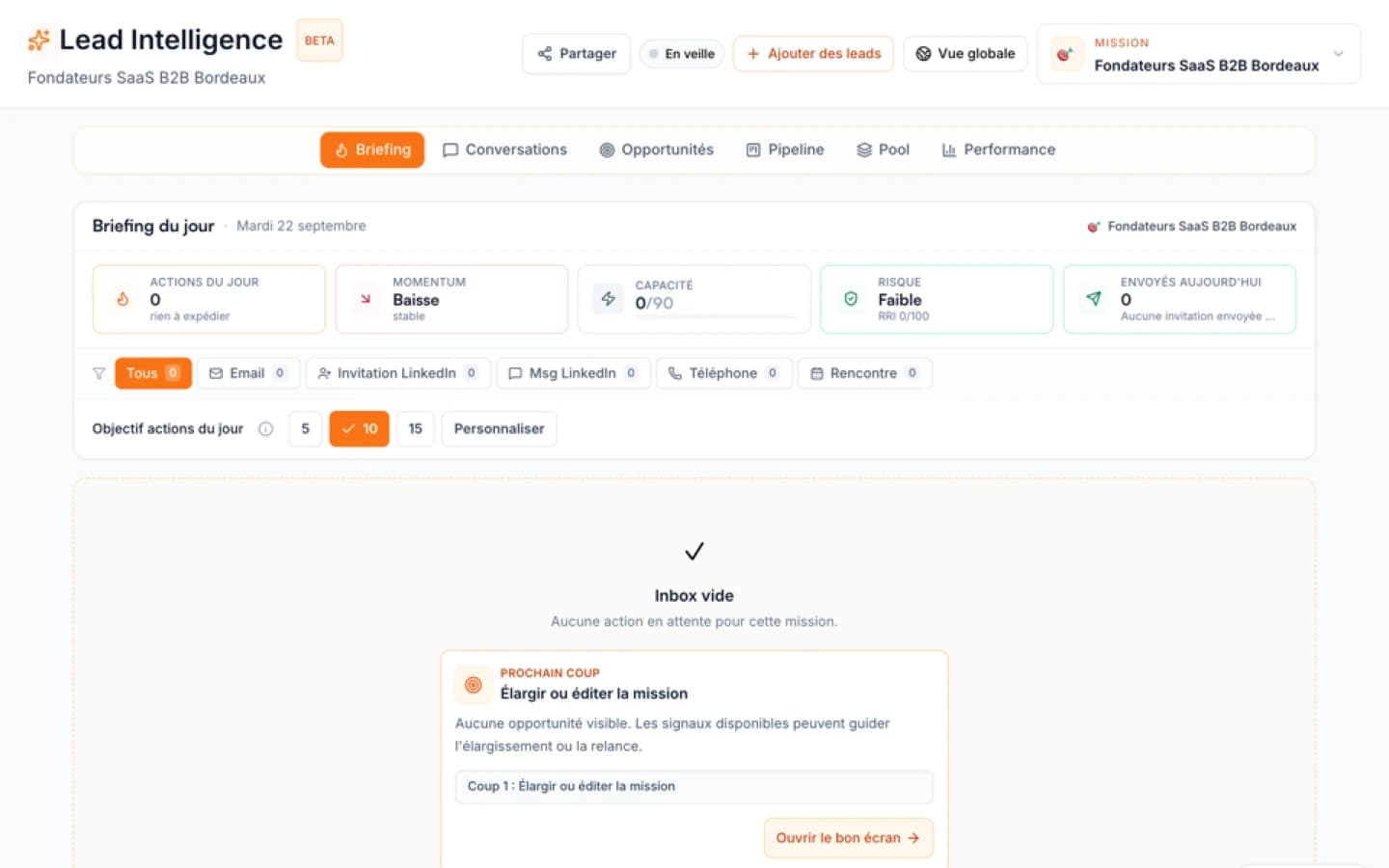
For businesses looking to identify high-probability accounts and extract structured intelligence without the complexity of sprawling enterprise directories or unpredictable credit traps, Lead Intelligence provides a focused framework for actionable B2B discovery. Evaluate your team's calling volume, sequence requirements, and contracting preferences before locking your revenue operations into an annual agreement.
Sources
- Apollo: contact discovery, outreach and export-credit conditions: source S1
- Apollo: contact discovery, outreach and export-credit conditions: source S2
- Apollo price and term receipts
- ZoomInfo: Aucun tarif public : le prix passe par un formulaire commercial
- ZoomInfo: Positionnement affiche sur la page d'accueil
FAQ
Free diagnostic
Test your sales file
Drop an Excel or CSV and check its readiness without sending its rows to Ember.