
Context and ICP
For early-stage founders, building a business is as much about securing capital as it is about capturing attention. In the initial phases of a venture, establishing an Ideal Customer Profile (ICP) and gaining market traction requires a clear distribution strategy. According to Paul Irolla, in a post on his Substack dated February 9, 2025, the startups that succeed today are not the ones that spend the most on marketing, but the ones whose founder dares to take a public position. However, translating public visibility into a fundable, structured business requires a rigorous underlying strategy.
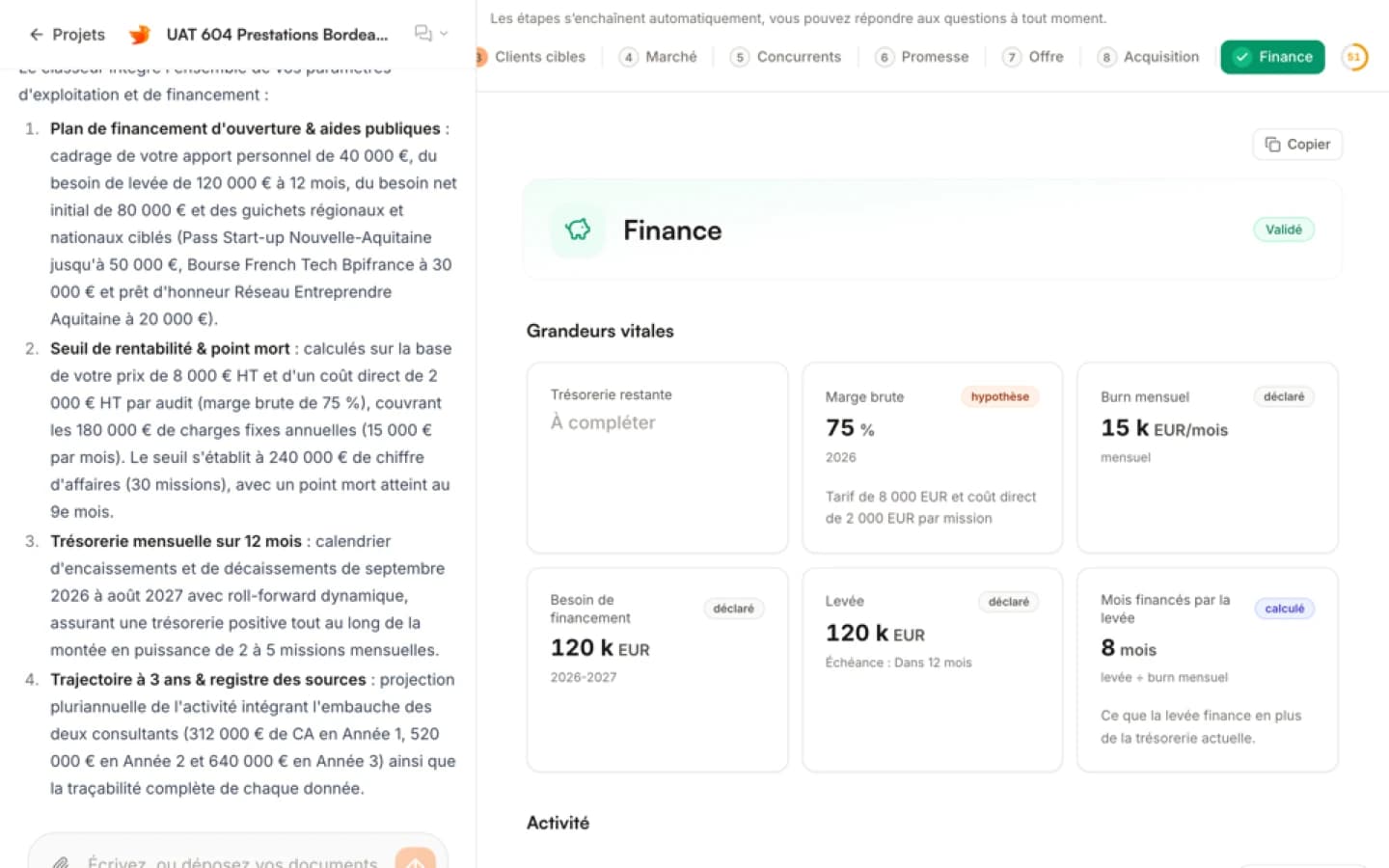
This is where the Fund Your Growth capability of Ember becomes essential. Instead of treating visibility and fundraising as separate tracks, early-stage founders can use this module to build a Business Plan to fund and develop the project. Ember, acting as an AI team for entrepreneurship, connects assumptions, evidence, funding needs, and the action plan in one unified context.
By leveraging Fund Your Growth, founders can reuse project information as shared context across modules. What the founder already knows about their visibility and audience can therefore inform funding decisions. The system structures funding options from project context, so that the founder's narrative is backed by coherent financial planning. Furthermore, it organises finance, traction, legal, and investor materials in a Data Room connected to the file, which helps move from building public visibility to defending a strategy in front of investors. For a detailed breakdown of how this mechanism operates, founders can explore the How Fund Your Growth Works for Your Pitch.
To place this decision in context, the Knowledge guides for finance brings together deeper guidance on the same field.
Problem
Paul Irolla writes that the startups that succeed today are not the ones that spend the most on marketing, but the ones whose founder dares to take a public position. Taking a position is not enough to convince a funder, though.
The core problem for early-stage founders is that they often treat fundraising and visibility as two entirely separate tracks. They draft financial projections for investors in one silo, while trying to build brand awareness in another. This disconnect creates a major strategic vulnerability. When presenting to partners or backers, founders struggle to show how their visibility efforts translate into real business value. Conversely, their marketing campaigns often lack the structural depth of their actual business plan, leading to inconsistent messaging and wasted resources.
To overcome this, founders must be able to connect their strategic assumptions to concrete evidence. Proving early traction is difficult when data is scattered across different tools. As detailed in the How Fund Your Growth Works for Your Pitch, a founder's narrative must bridge the gap between financial planning and market positioning. An early-stage founder needs to show that their growing visibility is a structured path toward sustainable growth, which requires a unified way to organize finance, traction, legal, and investor materials. Without this alignment, it is nearly impossible to build a Business Plan to fund and develop the project effectively, leaving founders unprepared to defend their strategy when the opportunity arises.
Prerequisites
To address this challenge, founders must meet several strategic prerequisites before attempting to scale their market presence. True visibility requires a structured foundation where business assumptions and operational proof are fully aligned.
First, a founder must centralize their existing business materials. Ember supports this by organizing finance, traction, legal, and investor materials in a Data Room connected to the file. Having these documents in one place helps tie each claim made to investors or partners to a document in the file.
Second, founders must connect their narrative to real market traction. According to Paul Irolla, the startups that succeed are the ones whose founder dares to take a public position, not the ones that spend the most on marketing. Preparing traction signals before launching a visibility campaign helps sustain that position over time.
Finally, understanding how these pieces fit together is essential. Founders can learn more about structuring these elements in the How Fund Your Growth Works for Your Pitch, which explains how one project context connects the Business Plan, the pitch deck and the Data Room.
To explore this point further, How to set B2B prices for SMBs without a benchmark? details a step directly related to this decision.
Workflow
The operational workflow begins with structuring the core business model. Early-stage founders use Fund Your Growth to build a Business Plan to fund and develop the project, helping ground their growth strategy in explicit financial assumptions rather than vague projections. This process does not just prepare the venture for potential investors. It pushes the founder to clarify their distribution model and value proposition, which are essential for building market visibility.
As the strategy takes shape, the platform organizes finance, traction, legal, and investor materials in a Data Room connected to the file. This centralized repository makes it easier to find proof of early traction or audience engagement and tie it to the overarching business narrative.
Once this foundation is validated, the structured context, including the business plan, Ideal Customer Profile (ICP), offer, and strategy, can be reused to prepare targeted outbound activities. For founders looking to expand their reach, this validated context is the starting point of a prospecting mission, rather than a generic list. By maintaining a single source of truth, the founder ensures that their market positioning remains consistent across both investor pitches and customer outreach, and reusing their fundraising preparation to frame their outreach.
Expected result
By utilizing the Fund Your Growth capability within Ember, early-stage founders can connect their business assumptions to evidence organized in one file. The primary outcome is a Business Plan designed to fund and develop the project, whose core narrative can then support external visibility. Ember does not guarantee that funding will be obtained.
A key practical result of this structured approach is the creation of a centralized Data Room. This feature organizes finance, traction, legal, and investor materials in a Data Room connected directly to the project file. Having these materials organized helps avoid the common pitfall of presenting an inconsistent business case to partners, journalists, or early backers.
Furthermore, this structured foundation directly feeds into the founder's distribution and visibility efforts. Instead of relying on generic outbound volume, which creates noise, founders can leverage their validated strategy for targeted outreach. The validated context from the Business Plan, including the Ideal Customer Profile (ICP), the core offer, and the growth strategy, is reused to prepare sales and visibility missions. This continuity helps ground any subsequent visibility campaign in the strategic priorities of the business.
This approach also connects with How SME CEOs Use Fund Your Growth to Structure Financing, which clarifies the next choice.
Example Ember mission
To understand how this works in practice, consider an early stage founder aiming to build market authority without a massive advertising budget. Paul Irolla writes on his Substack that the startups that succeed are not the ones that spend the most on marketing, but the ones whose founder dares to take a public position. In this scenario, the founder uses Ember to run a structured preparation mission.
The journey begins within the Fund Your Growth module. The founder uploads their initial pitch drafts, customer interview notes, and early traffic metrics. Ember reads these project documents and connects relevant evidence to funding decisions, so that no valuable proof is left aside. This analysis replaces a generic list of financing options with a funding path coherent with the project.
As the system processes the information, it makes available proof, assumptions, and remaining validation gaps visible to the founder. Instead of leaving these gaps unresolved, the platform turns gaps in the file into prioritised next actions, such as securing a specific customer testimonial or clarifying a distribution channel. To keep everything organised, Ember files finance, traction, legal, and investor materials in a Data Room connected directly to the file.
This structured foundation does not remain isolated. Because Ember reuses project information as shared context across modules, this validated business plan and strategic positioning directly feed into subsequent visibility efforts. For instance, the founder can then move on to Lead Intelligence, which reuses the Business Plan, Ideal Customer Profile (ICP), offer, and strategy to prepare a targeted outreach mission, turning structured business planning into active market presence.
Limits and non-fit
While Fund Your Growth is essential for establishing the strategic foundation of a business, it is not a tool for executing active marketing campaigns, public relations, or direct audience acquisition. Its primary function is to help founders build a Business Plan to fund and develop the project, and to organize finance, traction, legal, and investor materials in a Data Room connected to the file.
If an early stage founder expects Fund Your Growth to directly distribute content, automate social media posting, or scrape contact lists for immediate cold outreach, this capability will not meet those operational needs. It operates strictly at the strategic and structural level.
For founders who have structured their strategy and are ready to transition from visibility planning to active market engagement, Ember offers Lead Intelligence. This capability is specifically designed to reuse the Business Plan, Ideal Customer Profile (ICP), offer, and strategy to prepare a sales mission. Rather than relying on static databases, Lead Intelligence monitors signals about people and companies to keep context current, and connects executed actions, replies, meetings, and outcomes to identify situations that convert.
For founders who require massive, volume-heavy cold outbound databases rather than context-driven prioritization, traditional platforms might be considered. Ember publishes Lead Intelligence and is therefore not a neutral observer. These platforms often run on credits: on Apollo's pricing page, consulted on September 28, 2026, export credits are consumed whenever a contact is exported outside Apollo. It is worth estimating that volume before committing.
In practice, How to Set a B2B Price Without a Market Benchmark? completes this framework with another angle on the same topic.
When to use it
For an early stage founder, building visibility is not just about posting content on social media. It is about establishing a defensible market position that attracts both customers and investors. The Fund Your Growth capability within Ember is designed for specific strategic moments in this journey.
First, you should use this capability when you need to transition from raw ideas to a structured, fundable business model. According to Paul Irolla, the startups that succeed are not the ones that spend the most on marketing, but the ones whose founder dares to take a public position. To make this authority credible, you must ground your visibility in a solid business strategy. Fund Your Growth helps you build a Business Plan to fund and develop the project, ensuring your public narrative aligns with realistic financial projections.
Second, this capability is critical when your growing visibility begins to attract external interest. As your market presence expands, investors, partners, and early supporters will ask for documentation. This is the exact moment to organize finance, traction, legal, and investor materials in a Data Room connected to the file, a core feature of Fund Your Growth. Having these materials structured and ready prevents delays when opportunities arise.
Finally, use this capability before transitioning from general brand awareness to direct, targeted outreach. High-volume prospecting tools such as Apollo run on credits, consumed for example on every contact export (Apollo's pricing page): that is a cost to estimate before committing. Before committing to high volume tools, early stage founders need to define their core Ideal Customer Profile (ICP) and strategic offer. Establishing these fundamentals within Fund Your Growth ensures you have a validated strategic foundation. This foundation can then feed into other Ember capabilities, such as Lead Intelligence, which reuses your Business Plan, ICP, and strategy to prepare highly targeted, context driven outreach.
Next step
To transition from passive visibility to active, fundable traction, the immediate next step is to ground your brand-building efforts in a rigorous business framework. You can achieve this by defining your strategic milestones and identifying the precise evidence partners and investors will look for.
By leveraging the Fund Your Growth capability within Ember, you can build a Business Plan to fund and develop the project while choosing a coherent funding strategy. The system automatically turns gaps in your file into prioritised next actions, helping you identify which visibility and traction milestones you need to validate next. As you gather these early proofs of market interest, the platform organises finance, traction, legal, and investor materials in a Data Room connected to the file, so that what you say publicly stays documented for your next growth phase.
Before deciding, Finance as a Growth Decision for Scale-Up CEOs and Teams helps connect this method with adjacent priorities.
Sources
- Paul Irolla, "Le founder-led growth pour faire réussir tes projets", Substack, February 9, 2025: paulirolla.substack.com.
- Apollo, pricing page, consulted on September 28, 2026: apollo.io/pricing.
- Ember guide: How Fund Your Growth Works for Your Pitch.
- Functions of Fund Your Growth and Lead Intelligence: product description by Ember, its publisher.
Sources
FAQ
Mini audit
Test your Business Plan
Identify strengths, missing proof and the next priority.