
Revenue-Based Financing (RBF) is structurally superior to a venture capital round for a profitable B2B SaaS company when new capital is deployed directly into proven, repeatable acquisition channels. Because RBF replaces permanent equity dilution with a flexible royalty tied to gross revenues until reaching a predetermined repayment multiple, it preserves founder ownership and board independence. Conversely, traditional venture capital remains the better vehicle when a company must fund aggressive research and development or sustain negative unit margins during a winner-take-all land grab where immediate cash flow extraction would jeopardize company survival.
For a software business with existing cash generation, evaluating these instruments requires looking past nominal cost. The choice determines whether the business remains an independent cash-flow engine or boards a venture treadmill that demands continuous equity dilution and an eventual liquidity event.
The True Cost of Capital: Permanent Equity Dilution Versus Cash Flow Drag
The primary advantage of venture capital is that it imposes zero immediate cash drain on the company balance sheet. Equity investors provide cash upfront in exchange for preferred shares, accepting the risk of total loss without demanding monthly debt service or revenue cuts. This allows management to reinvest every dollar of top-line software revenue back into growth.
The downside is permanent and compounding. Equity sold during early funding rounds is permanently surrendered. If the company compounds in enterprise value over the next five to ten years, that equity stake represents the most expensive capital the founders will ever take. Furthermore, equity rounds introduce protective provisions, liquidation preferences, and board seats that restrict strategic options, including dividends or strategic acquisitions.
Revenue-Based Financing functions on the opposite premise. A capital provider advances funds in exchange for a fixed percentage of monthly gross revenues, typically varying between single-digit percentages, until a total repayment cap (such as a predetermined multiple of the principal) is satisfied. Once the total sum is repaid, the contract terminates, and the provider retains no ongoing claim on the business, no shares, and no governance rights.
The cost of RBF is paid entirely out of short-term liquidity. If gross margins are thin or operational cash flows are tightly balanced, surrendering a monthly percentage of top-line revenue can strain working capital. For a profitable B2B SaaS firm, however, where software gross margins typically remain high and subscription revenues are predictable, this monthly repayment functions like a temporary operational expense rather than a permanent loss of enterprise value.
Macroeconomic Realities and the Refinancing Treadmill
Founders considering institutional equity often assume that an initial funding round simply accelerates their existing path. In practice, raising venture capital binds the company to a sequential milestone cycle where each round must justify the next at an increased valuation.
When market dynamics shift, this cycle becomes hazardous. According to an analysis published by Mag Startup, the two-year conversion rate from seed to Series A dropped from 31.8% for the Q1 2020 cohort to approximately 12% for the Q1 2022 cohort. Relying on continuous equity infusions means that even healthy, growing companies can face down-rounds or recapitalizations if they fail to meet the hypergrowth benchmarks required by venture capital funds.
The credit environment has simultaneously tightened. Findings from the 2026 Report on Employer Firms by the Federal Reserve Small Business Credit Survey indicate that small business revenue and employment growth expectations reached their lowest levels since 2020, with 22% of financing applicants receiving none of the funding they sought and only 42% securing the full amount requested. In an economic backdrop where the Federal Reserve established a federal funds target range of 3.75% to 4%, the hurdle rate for capital efficiency has risen across all funding types.
For a profitable SaaS company, stepping into institutional equity means accepting the risk that external capital markets may close before the company reaches self-sufficiency. As outlined by Rainmakers, typical Series A rounds deploy between 800,000 euros and 5 million euros to scale commercial reach. If that capital does not convert into exponential growth, the business finds itself stranded between venture expectations and standard corporate profitability.
When Revenue-Based Financing Wins for B2B Software
For a profitable software firm, RBF is particularly effective under four specific operational conditions:
- Clear Unit Economics for Customer Acquisition: When the customer acquisition cost (CAC) and customer lifetime value (LTV) are well understood, RBF capital can be treated as fuel for an already functioning engine. If every dollar spent on paid acquisition or sales rep hiring yields recurring software revenue with high gross margins, paying a temporary revenue percentage to finance that acquisition generates a net positive return without surrendering equity.
- Preservation of Exit Flexibility: Venture capital investors require substantial returns, which structurally rules out private dividends, modest secondary sales, or acquisitions by mid-sized private equity funds. RBF providers have no interest in forcing an exit; their return is realized entirely through the contractual revenue share. The founder retains total freedom to run the business for long-term cash flow or sell to any buyer at any valuation.
- Bridge to Higher Valuation: Even for companies that ultimately plan to raise institutional equity, taking an interim RBF facility can fund product expansion and sales hires to reach higher recurring revenue milestones. Arriving at a funding table with higher annual recurring revenue substantially reduces the equity percentage founders must concede.
- Governance Simplicity: RBF agreements do not require voting seats, information rights that exceed standard financial reporting, or negative covenants that block key operational decisions.
When Institutional Equity Remains the Superior Choice
Revenue-Based Financing is not an all-purpose replacement for venture capital. There are structural scenarios where equity is unambiguously better suited:
- Long Payback Periods and R&D: If the business must fund eighteen months of core technical architecture before commercial launch, there are no revenues against which to levy an RBF percentage. Taking debt or revenue-share capital without predictable incoming receipts creates immediate default risk.
- Winner-Take-All Market Dynamics: When network effects dictate that the first player to scale captures the entire market, profitability is a secondary consideration compared to land-grab velocity. Equity financing allows management to burn significant capital to capture market share without managing monthly cash debt service.
- Complex Enterprise Sales Cycles: If sales cycles span twelve to eighteen months with unpredictable closing dates, monthly revenue commitments can cause severe working-capital volatility. Equity provides a stable cash cushion that absorbs pipeline lulls.
Structuring the Decision Before Engaging Capital Providers
Choosing between equity and revenue-share mechanisms requires a rigorous audit of financial assumptions. Before negotiating term sheets, a founder must model how gross margins, customer churn, and monthly debt service intersect under conservative scenarios.
Founders can explore structured corporate finance principles in the Knowledge guides for finance to evaluate capital costs across different stages of maturity. If you are comparing strategic planning software to map out these scenarios, reviewing Upmetrics vs Ember: Choosing Your Startup Finance Tool highlights the importance of linking operational hypotheses directly to funding mechanics.
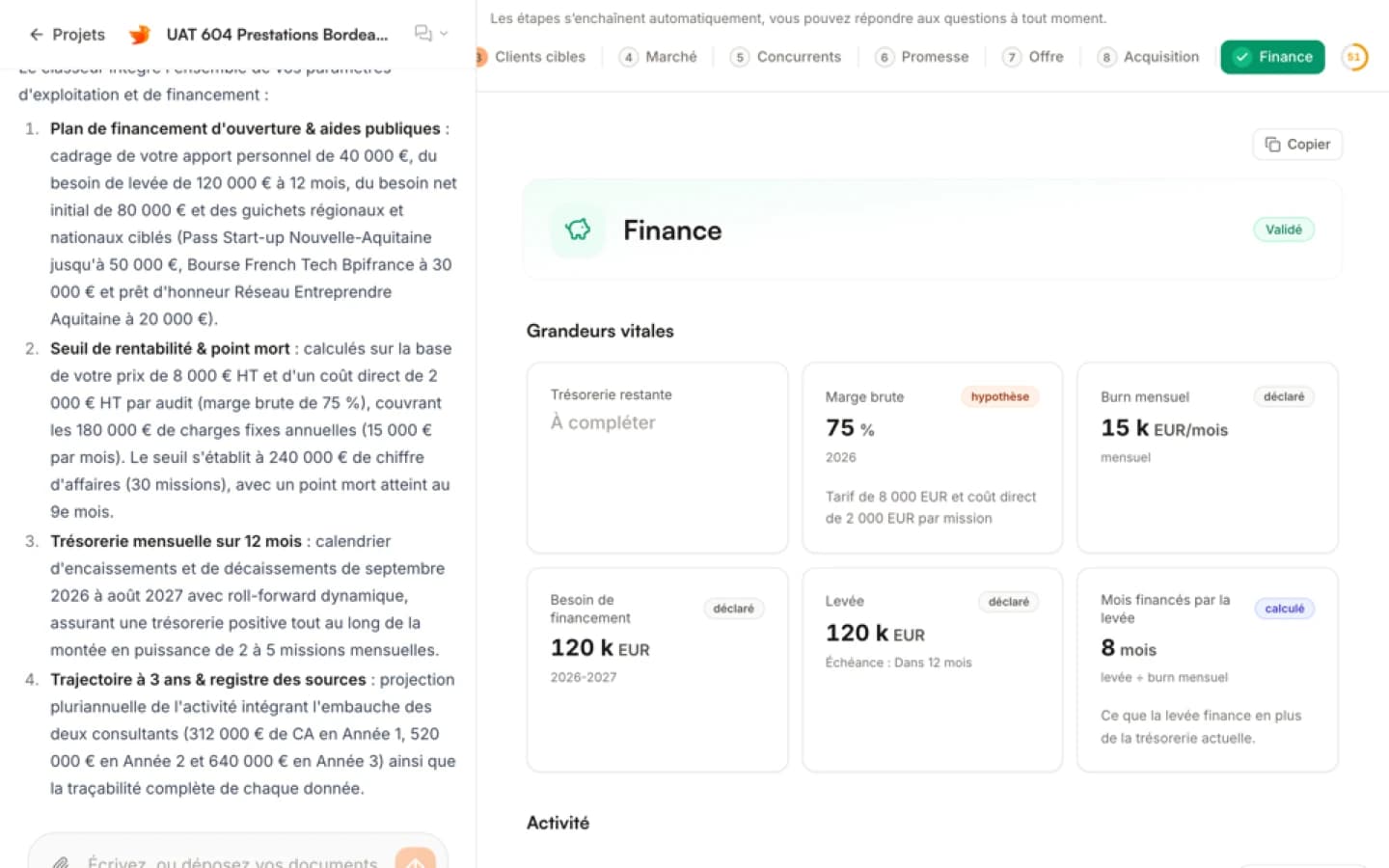
Within the Ember platform, the Finance ta croissance module guides founders through nine connected project blocks, linking ICP definition, market pricing, and acquisition channels directly to dynamic financial projections. By evaluating working capital needs against both non-dilutive repayment schedules and equity milestones, founders can test whether their cash flows can support revenue-based obligations before signing a commitment. You can access the dedicated workspace directly through Ember Fund Your Growth to stress-test your revenue model against varying repayment multiples.
Sources
- Seed Funding : Pourquoi Beaucoup de Startups Échouent à ...
- Seed, Série A, Série B : comprendre les grandes étapes de ...
- Série A,B,C et levée de fonds : définition et exemples
- SBA, parcours du prêt 7(a)
- SBIR, présentation générale
- États-Unis : décision de taux de la Réserve fédérale du 16 septembre 2026 : source S1
- Carta, State of Pre-Seed Q2 2026: record average SAFE and note size, AI at half of dollars : source S1
- Federal Reserve Small Business Credit Survey, official 2026 Report on Employer Firms: source S1
- Ember Finance ta croissance, stratégie de financement
FAQ
Mini audit
Test your Business Plan
Identify strengths, missing proof and the next priority.