
Early-stage founders face a recurring trap when preparing to raise capital or apply for growth loans: spending weeks assembling financial forecasts in a vacuum, completely detached from the strategic logic of the business.
Financial planning software for startups generally falls into two distinct categories: standalone forecasting software built around templated financial statements, and context-driven decision platforms that connect strategic hypotheses directly to financial outputs. Upmetrics represents the traditional modeling path, whereas Ember Fund Your Growth approaches financial planning through an integrated decision architecture. Choosing between them comes down to whether you need a dedicated forecasting canvas or a structured environment that links your market narrative to your capital requirements.
What Upmetrics Offers for Financial Modeling
Upmetrics is a dedicated business planning platform centered on standard financial projection workflows and collaborative planning. Its core value lies in letting founders generate formal financial statements without building spreadsheets from scratch.
According to the Upmetrics features documentation, the platform allows operators to move from a written plan to running the business by building forecasts without spreadsheets, modeling scenarios, and comparing actual performance against projected figures. The tool provides a clean interface for projecting revenue, managing expenses, tracking cash flow, and generating balance sheets, with options to track performance against external accounting software.
For founders who already have a validated strategy and simply need a clean workspace to input their balance sheet assumptions, Upmetrics provides an accessible entry point. According to the Upmetrics pricing page, the platform offers a Premium plan at $19 per month and a Professional plan at $49 per month when billed monthly. For teams paying annually, the Upmetrics pricing documentation lists the rates at $14 per month for Premium and $37 per month for Professional.
Where Upmetrics stops, however, is at the boundary of your commercial narrative. It provides the financial templates and the mathematical engine, but it does not evaluate whether your go-to-market plan actually supports your projected customer acquisition numbers or whether your core assumptions hold up against typical market realities.
How Ember Connects Strategic Narrative to Financial Scenarios
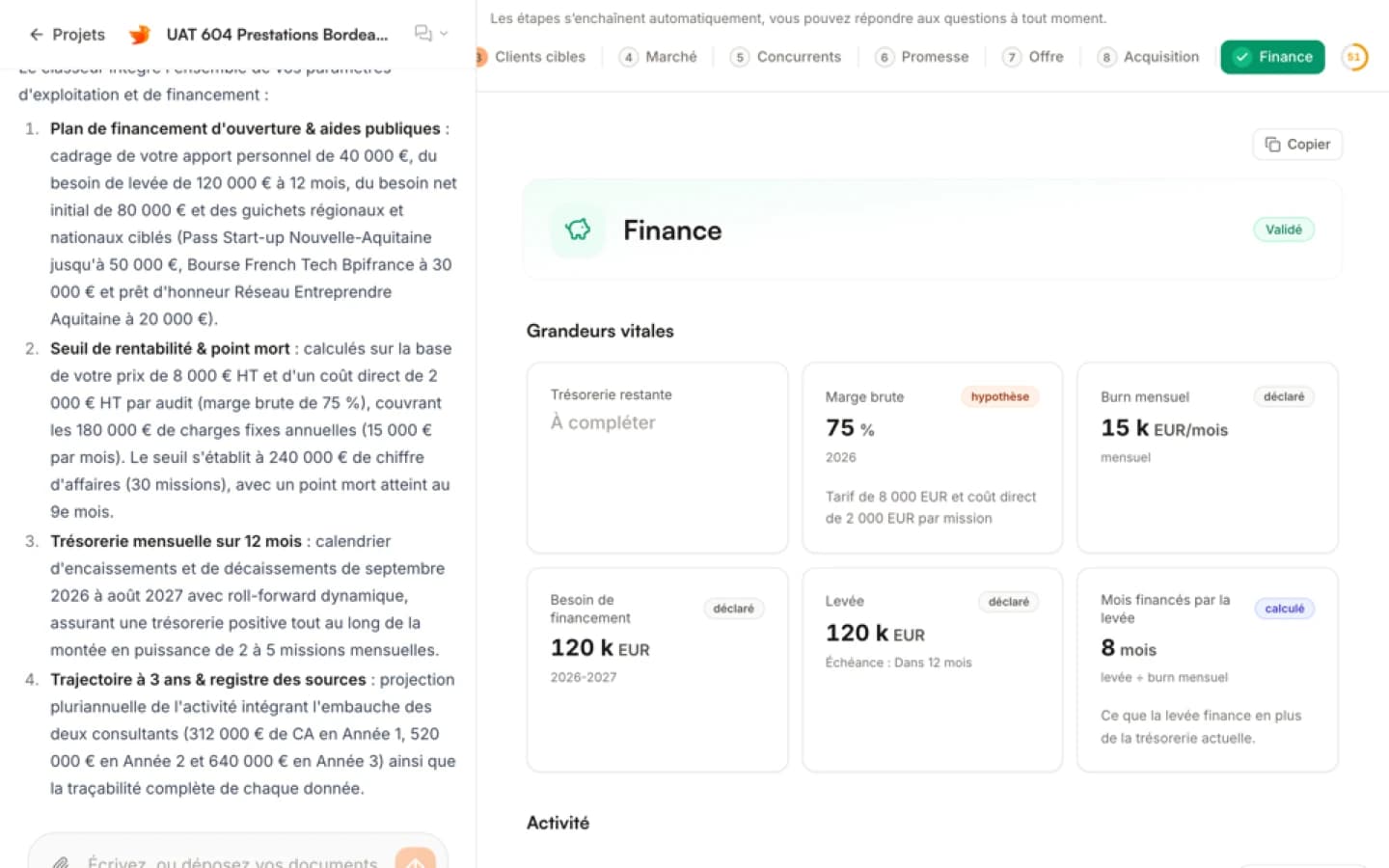
Ember Fund Your Growth approaches the problem from the opposite direction. Rather than treating financial modeling as an isolated set of accounting sheets, it links your assumptions, evidence, funding needs, and operational action plan into a single working context.
As outlined on the Ember AI business plan overview, the system acts as a decision architecture designed to sharpen your thinking before outside stakeholders challenge it. Instead of forcing you to fill out blank projection tables, Ember guides you through a progressive workflow of nine structured blocks:
- Project definition
- Purpose (Why)
- Ideal Customer Profile (ICP)
- Market sizing and dynamics
- Competitor analysis
- Value proposition and promise
- Core offer architecture
- Acquisition and distribution
- Financial modeling and funding strategy
In this architecture, your financial projections do not exist in isolation. The finance module actively draws upon the inputs, validation status, and constraints established in earlier blocks, such as your pricing model, ICP characteristics, and acquisition channels. Every figure within the plan is categorized by its evidence tier: primary project documents, verified catalog sources, web references, user-declared inputs, or pure working hypotheses.
When you build funding scenarios, Ember structures possibilities based on your stage, geography, and operating constraints. It surfaces reviewed public funding programs across supported jurisdictions, including France, Germany, and broader European programs, while explicitly flagging unconfirmed amounts as needing manual verification.
Crucially, Ember operates on human validation. Every agent proposal must be reviewed, edited, or rejected by the founder before it enters the project graph. Once complete, the platform organizes your work into an exportable Data Room across seven core directories, covering project dossiers, corporate identity, market analysis, commercial traction, financial statements, legal records, and supporting documents.
Side-by-Side Comparison: Strategic Architecture vs. Standalone Forecasting
The fundamental distinction lies in whether your primary bottleneck is calculating spreadsheet line items or stress-testing the strategic engine behind those figures.
| Decision Criterion | Upmetrics | Ember Fund Your Growth |
|---|---|---|
| Primary Core Focus | Standalone business plan writing and statement forecasting | Integrated strategic decision architecture and funding preparation |
| Financial Mechanism | User-entered revenue and expense models without spreadsheets | Projections dynamically informed by ICP, offer, and acquisition blocks |
| Evidence and Assumption Tracking | User-maintained manual inputs and linked accounting actuals | Multi-tier evidence grading separating confirmed facts from hypotheses |
| Output Ecosystem | Standard business plan exports and financial reports | Ten editable deliverables plus a structured seven-directory Data Room |
| Public Support Scenarios | Manual scenario planning | Structured funding scenarios including verified public support tracks |
| Investor Pipeline Workflow | Exportable files for external sharing | Integrated handoff to fundraising outreach workflows |
Key Tradeoffs: Which Approach Fits Your Startup?
Choosing between these two approaches depends on your current fundraising stage, team structure, and existing documentation.
When Upmetrics Is the Practical Choice
Upmetrics is well suited for:
- Traditional small businesses and steady cash-flow ventures: If you are opening an agency, an e-commerce shop, or a local service business requiring standard bank financing, you rarely need an interconnected strategic knowledge graph. You need an affordable, clean forecast that satisfies a loan officer.
- Teams with an existing, validated strategic dossier: If your ICP, acquisition strategy, and competitive positioning are already documented elsewhere and you strictly need a budget-friendly tool to model statements, the entry-level pricing documented by Upmetrics provides a straightforward option.
- Operators focused primarily on budget-versus-actual tracking: If your focus is tracking month-to-month accounting variance against static forecast targets, dedicated planning platforms offer specialized reporting features for that workflow.
When Ember Fund Your Growth Is the Stronger Match
Ember is built for founders who need to defend their logic under scrutiny:
- Early-stage venture-backed or deep-tech founders: When pitching institutional investors, the numbers in your financial model matter less than the coherence of the logic behind them. Ember surfaces structural weaknesses across your go-to-market and unit economics before investors spot them.
- Projects navigating multi-source funding: If your capitalization table combines private capital with regional or European public grants, Ember helps structure scenarios tailored to specific geographies, preventing you from treating soft money as confirmed equity. Founders exploring early-stage capital structures can review how stacked post-money SAFEs affect dilution to better understand how initial funding vehicles impact later rounds.
- Founders building institutional-grade documentation: If you need to generate a complete suite of materials, from investment memorandums and market studies to an organized Data Room, Ember eliminates the disconnect between what your pitch narrative claims and what your financial forecast displays.
Practical Decision Path for Early-Stage Founders
To choose the right path, evaluate your immediate deliverable:
- Audit your strategic readiness: Do you have clear, stress-tested answers for customer acquisition costs, channel constraints, and competitive defensibility? If those assumptions are untested, putting them into a traditional financial template merely produces precise fiction.
- Determine who will challenge your numbers: If your primary reader is an external bank examining standard debt coverage ratios, a conventional statement generator will suffice. If you are presenting to angel syndicates, venture funds, or public innovation juries, inconsistencies between your acquisition model and your payroll plan will derail the conversation.
- Select your tooling based on context management: Use standalone modeling tools if you want total manual control over discrete financial balance sheets. Turn to an interconnected platform if you want your financial projections, commercial strategy, and fundraising documentation to live in a single, verifiable system.
Founders preparing an upcoming round can review the Knowledge guides for finance to structure their underlying assumptions, or explore Ember Fund Your Growth to model funding scenarios directly tied to their core business strategy.
Sources
FAQ
Mini audit
Test your Business Plan
Identify strengths, missing proof and the next priority.