
Fundraising founders often confuse two distinct stages of capital raising: preparing a coherent investment case and distributing files to investors. Choosing between Papermark and Ember Fund Your Growth comes down to whether your bottleneck is tracking how outside readers interact with your slides or building an investment thesis whose underlying logic, unit economics, and assumptions can actually survive scrutiny.
Papermark is an open-source document sharing and virtual data room platform designed to distribute pitch decks and transaction files securely while tracking page-by-page reader engagement. Ember Fund Your Growth is a decision architecture that structures the business across nine connected strategic building blocks, stress-tests financial assumptions, and organizes diligence materials in a contextual data room. They address fundamentally different problems in the fundraising lifecycle.
Document Analytics Versus Strategic Architecture
A pitch deck that receives high engagement metrics will still fail if the financial model contradicts the go-to-market strategy or if the underlying market sizing cannot withstand investor scrutiny. The gap between sending a deck and defending a round marks the boundary between these two tools.
                    Fundraising Workflow
                            │
        ┌───────────────────┴───────────────────┐
        ▼                                       ▼
  Preparation Phase                       Outreach Phase
(Ember Fund Your Growth)                   (Papermark)
  - 9 connected building blocks            - Secure link generation
  - Cross-tested assumptions               - Page-by-page dwell tracking
  - 10 editable deliverables              - Dynamic watermarking
  - Contextual 7-folder data room          - NDA enforcement before view
Fundraising stages separate strategic validation from document distribution.
Papermark addresses the distribution phase. When a founder emails a pitch deck to venture funds, traditional attachments offer zero visibility into whether the deck was opened, forwarded, or dropped after slide two. By serving documents through trackable links, Papermark provides granular viewer analytics, access restrictions, and virtual data room infrastructure.
Ember Fund Your Growth addresses the upstream phase. Before distributing documents, a founder must ensure that the customer persona aligns with the acquisition channel, that pricing supports the unit economics, and that financing needs reflect realistic operational constraints. Rather than tracking who opens a PDF, it guides the founder through an iterative process where decisions and weaknesses surface before third parties challenge them.
Papermark: Secure Pitch Deck Sharing and Diligence Rooms
For teams that already have finalized investor materials and need secure distribution, Papermark provides a specialized virtual data room and document tracking tool. According to the Papermark data room features guide, modern virtual data rooms exist to prove who accessed each file, restrict what viewers can do with the content, and generate an audit trail for due diligence.
Papermark's core capabilities focus on security and engagement:
- Document tracking and dwell time: Founders can monitor viewer engagement at a granular level. The platform records viewer behavior and time spent per page, helping teams identify which slides hold partner attention and which are skipped.
- Access control and watermarking: According to the Papermark virtual data room overview, the platform provides dynamic watermarks stamping viewer details, email verification, password controls, and non-disclosure agreement enforcement before document access.
- Virtual data room tiers: On the Papermark pricing page, the Data Rooms Base plan is listed at 99 euros per month billed annually, including 3 team members, unlimited data rooms, and dynamic watermarks, while higher tiers like Data Rooms Plus are listed at 249 euros per month billed annually with SOC 2 Type II and ISO 27001 certifications.
- Open-source flexibility: Unlike closed alternatives, Papermark maintains an open-source codebase and self-hosting capabilities, enabling organizations with strict data sovereignty requirements to run the software on their own infrastructure.
These features make Papermark effective during active outreach. For example, publisher statistics on the Papermark pitch deck metrics report indicate an average total view time of 3.2 minutes per deck, while also noting that 49 percent of analyzed decks span between 9 and 16 pages. Notably, that report page displays internal discrepancies regarding its underlying sample size, referencing both 3000 decks and 2,239 decks across different sections, as well as varying collection dates. Regardless of publisher sample variations, the operational reality remains the same: founders have only a few minutes to capture investor attention.
However, Papermark assumes the content inside your deck is already coherent. It does not critique your retention metrics, verify whether your valuation aligns with public subsidy programs, or warn you if your customer acquisition cost contradicts your pricing tier.
Ember Fund Your Growth: Coherent Thinking Before Outreach
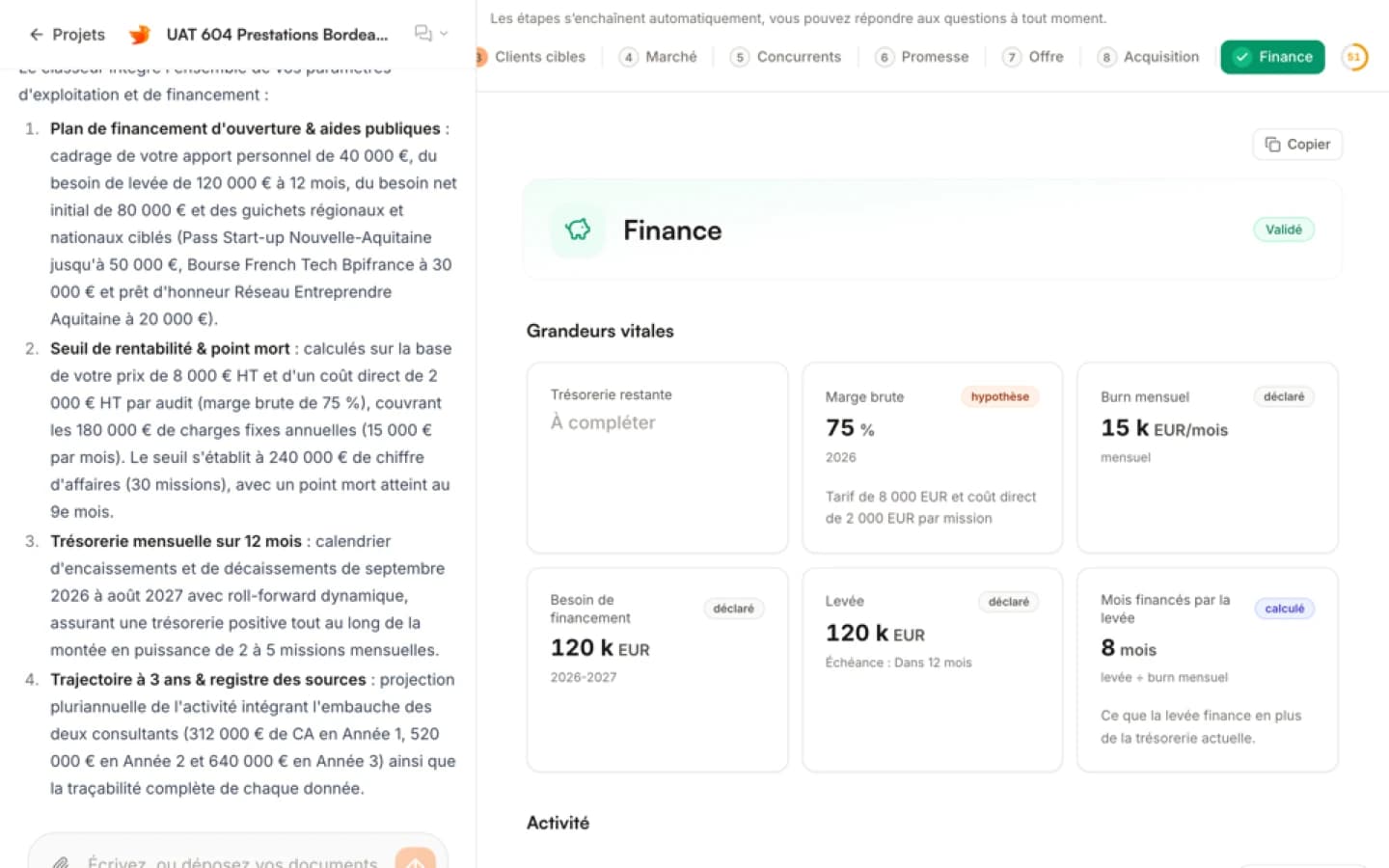
Ember Fund Your Growth approaches fundraising as a structural coherence challenge rather than an asset hosting problem. Built under the thesis that a strong raise begins with rigorous thinking, it structures your company across nine core building blocks: project, why, ideal customer profile (ICP), market, competitors, promise, offer, acquisition, and finance.
Instead of generating unverified pitch copy, the product functions through structured rules:
- Relational graph: The nine blocks remain connected. When you alter your acquisition channel or customer profile, the finance module updates its dependencies, pulling weaknesses and inconsistencies to the top.
- Epistemic separation: Financial assumptions, founder declarations, web evidence, and uploaded project documents are tracked separately. A declared hypothesis is never mislabeled as confirmed traction.
- Contextual data room: Once decisions are finalized, Ember provides a data room organized across seven clear directories: dossier, identity, market, commercial, finance, legal, and documents. Founders can upload their own files and share read-only views via 30 day revocable links.
- Ten structured deliverables: The module produces up to ten distinct editable deliverables on explicit founder request, including the investment memorandum, presentation note, why manifesto, market study, competitive analysis, ICP profile, promise statement, offer grid, acquisition plan, and financial forecast.
Ember does not provide page-by-page slide heatmaps or dynamic viewer watermarking. It is not an alternative to specialized compliance-heavy deal rooms for large mergers and acquisitions. Furthermore, access to Fund Your Growth is rolled out progressively based on account permissions, and its catalog of public funding options covers selected regions including France, Germany, and European institutions rather than an exhaustive worldwide registry. For deeper benchmarks on related financial tools, see our analysis comparing Visible.vc vs Ember Fund Your Growth: Which Platform Fits?.
Comparison: Deck Distribution Versus Contextual Preparation
Evaluating these tools requires looking at what each platform actually delivers during a financing round.
| Decision Criterion | Papermark | Ember Fund Your Growth |
|---|---|---|
| Primary focus | Document distribution and reader tracking | Strategic coherence and thesis preparation |
| Analytical output | Page dwell time and viewer audit trails | Cross-validated financial and strategic graph |
| Virtual data room model | Standalone repository with watermarking | 7 directories connected to core project logic |
| Security compliance | SOC 2 Type II and ISO 27001 on select plans | Project-level access with 30 day revocable links |
| Strategic deliverables | None (hosts founder-provided PDFs and decks) | Up to 10 structured deliverables on request |
| Deployment model | Cloud hosted or self-hosted open source | Progressive access web platform |
Papermark's advantages lie in document security during syndication. If you have an audited financial model, an approved deck, and need to email fifty angel investors with dynamic email watermarking and link expiration, Papermark is the right utility. It prevents unauthorized distribution and alerts you when an investor opens slide six.
Ember's advantages emerge when preparing the substance. If your pitch deck glosses over gross margin deterioration, or if you need to reconcile your hiring plan with non-dilutive grant options before approaching venture capitalists, Ember ensures that the answers you give in the room match the documentation in your data room. Additional frameworks for capital planning can also be explored through the Knowledge guides for finance.
Choosing the Right Approach for Your Raise
Selecting the right tool depends on where your fundraising risk sits:
- Choose Papermark when your pitch materials and financial models are finalized and vetted. If your immediate requirement is sending confidential links, protecting slide content with watermarks, or analyzing investor drop-off across individual pages, Papermark provides a dedicated distribution layer.
- Choose Ember Fund Your Growth when your investment case still needs stress-testing. If you need to ensure that your go-to-market assumptions, market size estimates, and financial projections align into a defensible dossier, Ember provides the structural rigor required before opening your round.
Many founders utilize both sequentially: they use Ember Fund Your Growth to pressure-test their strategic thesis, build their forecast, and assemble their core files, then transition the final artifacts into dedicated document tracking platforms when conducting high-volume investor outreach.
Sources
- Digify Data Room: Quick Overview
- Virtual data room for diligence and transactions
- 15 Virtual Data Room Features That Actually Matter in 2026
- Papermark : plans Free, Pro, Business et Data Rooms, prix en euros par mois, nombre de documents, membres et fonctions de data room : source S1
- Papermark, Pitch deck Metrics report 2024-2025 : source S1
- Ember Finance ta croissance, stratégie de financement
FAQ
Mini audit
Test your Business Plan
Identify strengths, missing proof and the next priority.