
Choosing between government-guaranteed bank debt and convertible equity at the seed stage comes down to a clear structural trade-off: equity instruments defer valuation and preserve cash at the cost of compounding ownership dilution, while bank debt protects founder equity at the expense of mandatory cash flow service and personal liability. For early-stage B2B software and tech founders in the United States, navigating this trade-off requires evaluating current regulatory underwriting guidelines alongside market-standard investor mechanics.
Neither instrument is universally superior. An institutional debt facility requires predictable, unencumbered operating cash flow to service debt amortization immediately, whereas a convertible instrument absorbs operating losses while your product finds repeatable market traction. Deciding which path fits your company depends on whether your risk profile centers on equity dilution or near-term solvency.
SBA 7(a) Working Capital Debt Under SOP 50 10 8.1
The Small Business Administration (SBA) 7(a) loan program provides federal loan guarantees to participating commercial lenders, enabling eligible businesses to secure capital for working capital, equipment, or business acquisition. According to SBA lender guidelines, standard 7(a) loans offer financing up to $5 million, with maximum maturities of 10 years or less for working capital and inventory, or up to 25 years for real estate.
The operational baseline for 7(a) lending changed with the issuance of Standard Operating Procedure (SOP) 50 10 8.1. As documented in SBA Information Notice 5000-880695, SOP 50 10 8.1 was published on August 14, 2026, and took effect on October 1, 2026, governing applications assigned an SBA loan number on or after that date. This update incorporated earlier operational modifications issued throughout the year, including the sunset of the Small Business Scoring Service (SBSS) score for small loans effective March 1, 2026, and updated coordination rules for maximum loan limits across the 7(a) and 504 programs effective July 4, 2026, as noted in the SBA Policy Notice records.
Further operational shifts highlighted by WBD lender reporting detail that SOP 50 10 8.1 reorganized loan requirements into distinct appendices, such as Appendix 15 covering changes of ownership and Appendix 19 detailing collateral rules. The updated framework maintains a distinction between Standard 7(a) loans exceeding $350,000 and 7(a) Small Loans of $350,000 and less.
For an early-stage B2B founder, taking on 7(a) debt under SOP 50 10 8.1 involves specific non-negotiable considerations:
- Cash flow coverage: The SBA guarantee protects the lender, not the borrower. The bank will evaluate historical cash flow or heavily substantiated debt-service coverage ratios (DSCR). Seed-stage B2B companies with negative operating margins or extended enterprise sales cycles often struggle to qualify without commercial traction.
- Personal guarantees: Anyone owning 20 percent or more of the operating company must provide an unlimited personal guarantee. Defaulting puts personal assets, including primary residences, at stake.
- Capital preservation: If qualified, a 10-year working capital loan protects founders from giving away substantial chunks of ownership before reaching an inflection point in company valuation.
Founders reviewing alternative non-dilutive programs alongside bank lending can consult our guide on how startups can adapt to cuts in public innovation grants for broader grant context.
Post-Money SAFEs and MFN Mechanics
Convertible equity instruments, most notably the Simple Agreement for Future Equity (SAFE), were developed to sidestep the underwriting rigidity and immediate debt obligations of commercial loans. According to Y Combinator's SAFE documentation, the SAFE was created in 2013 by Carolynn Levy and has since been used to raise over 15 billion dollars for early-stage companies.
A SAFE is a private investment contract that gives the investor the right to receive equity shares in a future priced equity financing round. Unlike convertible promissory notes, standard post-money SAFEs do not carry interest rates, maturity dates, or default covenants. They allow a company to take on seed capital immediately without setting an explicit valuation or entering debt repayment schedules.
However, the specific mechanics of modern SAFEs, particularly those containing Most Favored Nation (MFN) provisions, introduce distinct dilution risks. Under Y Combinator's standard deal terms, an accepted startup receives $500,000 structured as a $125,000 post-money SAFE converting into a fixed 7% of company equity, alongside an uncapped $375,000 SAFE carrying an MFN clause. In YC's published mechanics, if the company subsequently raises money on a SAFE with a $15 million post-money valuation cap, the $375,000 MFN SAFE converts at that terms threshold, yielding an additional 2.5% equity stake ($375,000 divided by $15,000,000).
The MFN provision automatically entitles the holder to adopt any more favorable terms, such as a lower valuation cap or an investor discount, issued on subsequent SAFEs between the MFN agreement date and the qualifying priced round. This creates specific structural dynamics:
- No immediate cash outflow: Investors receive no debt service, protecting operating runway for software engineering, customer acquisition, and hiring.
- Stacked dilution risks: Because post-money SAFEs calculate dilution against company capitalization immediately prior to the priced round, layering multiple uncapped or capped SAFEs can silently dilute founders far more heavily than anticipated once the round converts.
- Down-round vulnerabilities: If market sentiment cools or growth slows, issuing follow-on SAFEs at lower caps retroactively expands the equity granted to earlier MFN holders.
Founders assessing early capitalization dynamics can find broader institutional context in our analysis of navigating seed fundraising in a concentrated VC market.
Comparing SOP 50 10 8.1 Debt and MFN SAFEs
Evaluating bank debt against convertible equity requires weighing underwriting criteria, balance sheet obligations, and governance requirements against long-term cap table dilution.
| Evaluation Criterion | SBA 7(a) Working Capital Debt | MFN Post-Money SAFE |
|---|---|---|
| Core Instrument Nature | Commercial senior loan backed by federal guaranty | Executory convertible equity contract |
| Maximum Size Profile | Up to $5 million maximum under SBA rules | Determined by investor syndicate and cap |
| Underwriting Basis | Historical cash flow, DSCR, and business viability | Team quality, market narrative, and traction |
| Repayment Requirement | Monthly principal and interest amortization | No cash repayment; converts in priced round |
| Founder Personal Risk | Personal guarantees required for 20%+ owners | No personal guarantees or personal asset risk |
| Impact on Ownership | Zero dilution of company equity | Dilutes common equity when priced round closes |
| Regulatory Framework | SOP 50 10 8.1 guidelines and SBA notices | Standardized contract law and securities laws |
As shown in the table above, the trade-off is stark. SBA 7(a) borrowing protects ownership but introduces immediate liquidity demands and severe personal risk. MFN SAFEs eliminate insolvency exposure and personal guarantees but obligate the cap table to substantial dilution down the road.
Evaluating the Strategic Fit for Your Startup
Deciding which vehicle to pursue requires an honest appraisal of your business model, customer contracts, and runway requirements.
When SBA 7(a) Working Capital Debt Makes Sense
An SBA 7(a) working capital facility is best suited for B2B companies that exhibit strong recurring operational cash flows and low asset obsolescence:
- Demonstrated profitability or break-even cash flow: If your B2B startup already operates at break-even or generates predictable cash from enterprise annual contracts, bank debt avoids selling equity at early valuations.
- Predictable customer payback periods: When sales cycles and customer acquisition costs yield reliable cash returns within 60 to 90 days, drawing on credit can fund inventory or accounts receivable without permanent cap table penalties.
- Founder willingness to accept personal risk: The founders must have the financial balance sheet to support mandatory personal guarantees under SOP 50 10 8.1 without threatening personal solvency in a downside scenario.
Where commercial performance warrants debt, incumbent regional banks and certified SBA lenders provide established underwriting pipelines that serve standard small businesses effectively.
When Post-Money SAFEs Make Sense
For most pre-seed and seed B2B software companies, convertible equity remains the default capital structure:
- Pre-revenue or cash-burning research phases: Startups spending capital on product development and market discovery cannot support monthly principal and interest amortizations without risking premature bankruptcy.
- Venture-scale growth trajectories: When founders target large addressable markets requiring rapid hiring and aggressive go-to-market deployments, equity investors absorb the risk of complete capital loss in exchange for equity upside.
- Speed and execution flexibility: Standardized SAFE templates avoid extensive underwriting audits, allowing founders to close angel and institutional checks rapidly and focus on building product.
Founders curious about broader macro implications on early-stage financings can read our overview on how public market rebounds affect early stage fundraising.
Modeling Capitalization Options with Ember
Evaluating debt repayment schedules alongside prospective SAFE dilution requires connecting your operational milestones directly to your capitalization model. Choosing the wrong financing vehicle can either suffocate your business with debt service or surrender majority control before Series A.
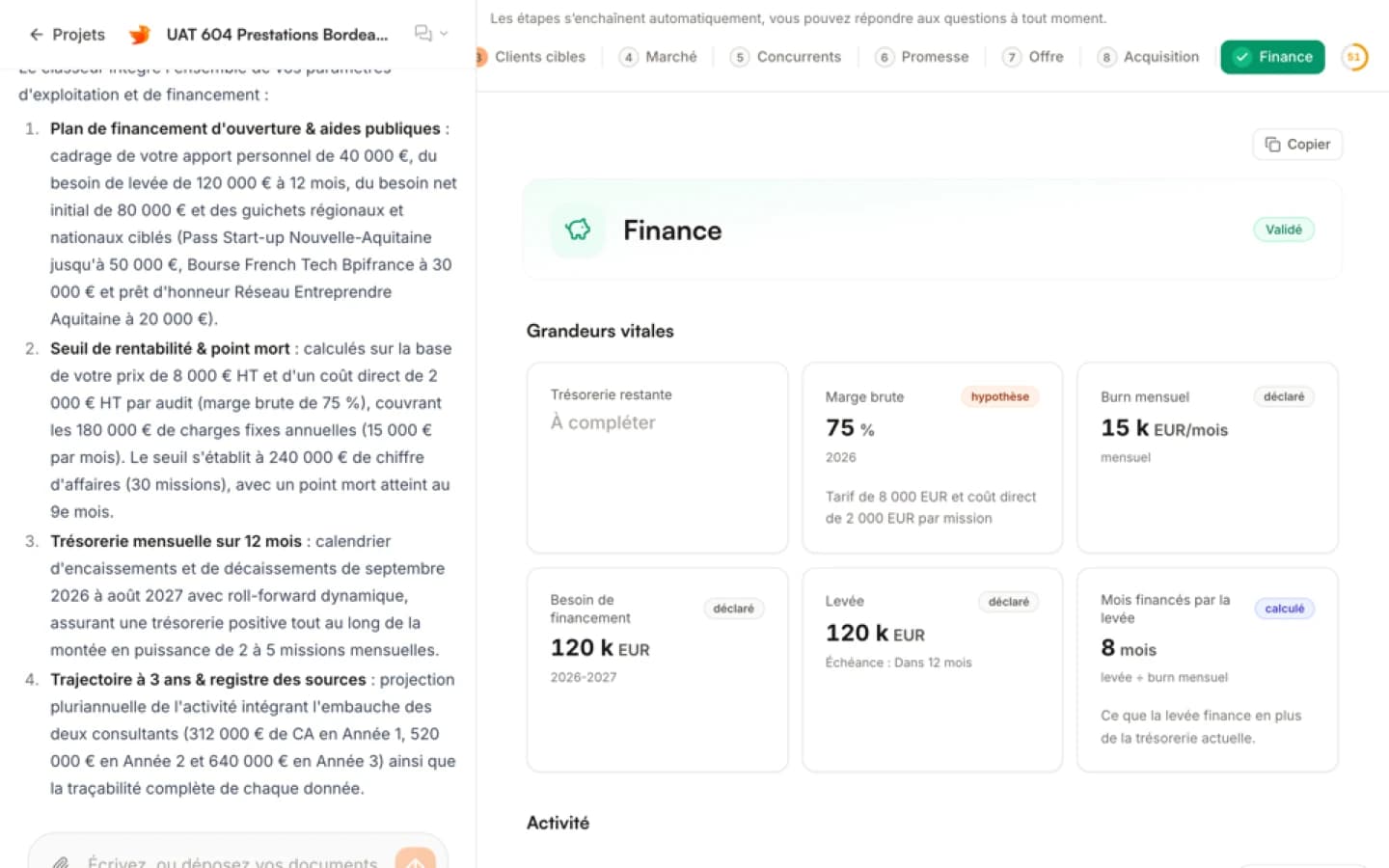
Within Ember, the Fund Your Growth module, available progressively depending on account permissions, helps founders prepare defensible financing plans. The workspace organizes your project across nine structured modules, linking assumptions, customer acquisition costs, and capital requirements in a unified environment. Once verified, Ember structures your narrative, financial projections, and verification records into an organized Data Room, keeping your declared numbers, market estimates, and validated traction strictly separated.
Whether you are stress-testing operating cash flows against SBA working capital requirements or mapping future SAFE conversion scenarios before signing an MFN agreement, you can review detailed playbooks in the Knowledge guides for finance to build a clear, defensible capitalization strategy.
Sources
- Issuance of SOP 50 10 8.1
- SBA lender resources: Partnering with SBA loan programs
- Three Major SBA Announcements
- Y Combinator's standard deal: $500,000 as a $125,000 post-money SAFE for 7% plus a $375,000 uncapped MFN SAFE: source S1
- Y Combinator's standard deal: $500,000 as a $125,000 post-money SAFE for 7% plus a $375,000 uncapped MFN SAFE: source S2
- Y Combinator, official SAFE standard documents
- Ember Finance ta croissance, stratégie de financement
FAQ
Mini audit
Test your Business Plan
Identify strengths, missing proof and the next priority.