
Expanding a venture to the United States forces early-stage founders to reconcile ambitious commercial narratives with unforgiving legal and financial standards. Software can structure an investment thesis, align strategic hypotheses, and format presentation materials, but it cannot alter statutory liabilities or guarantee investor checks. For an international founder considering Fund Your Growth by Ember, verifying the boundaries between automated strategic preparation and jurisdictional reality is essential before committing core operational workflows.
Understanding what preparation software solves and where founder responsibility begins requires examining three core areas: financial modeling standards, public capital eligibility, and corporate governance mechanics.
Financial Modeling Standards: Aligning with US Market Expectations
When pitching US angel syndicates or venture capital funds, international founders frequently make the mistake of presenting financial projections modeled on their domestic accounting frameworks. European systems often emphasize balance sheet formats and statutory chart-of-accounts conventions, such as the French Plan Comptable Général. In contrast, US institutional investors expect standard corporate financial statements: an Income Statement, a Balance Sheet, and a Cash Flow Statement organized around recognized operational metrics.
The SEC capital-raising guidance emphasizes that an entrepreneur preparing to solicit investment must substantiate their capital target with defensible projections: "The answer to that question should reflect a thoughtfully calculated “runway” based on projected expenses." A credible model does not merely display a revenue forecast; it isolates fixed burn, variable customer acquisition costs, and working capital needs to demonstrate exactly how far each dollar carries the business.
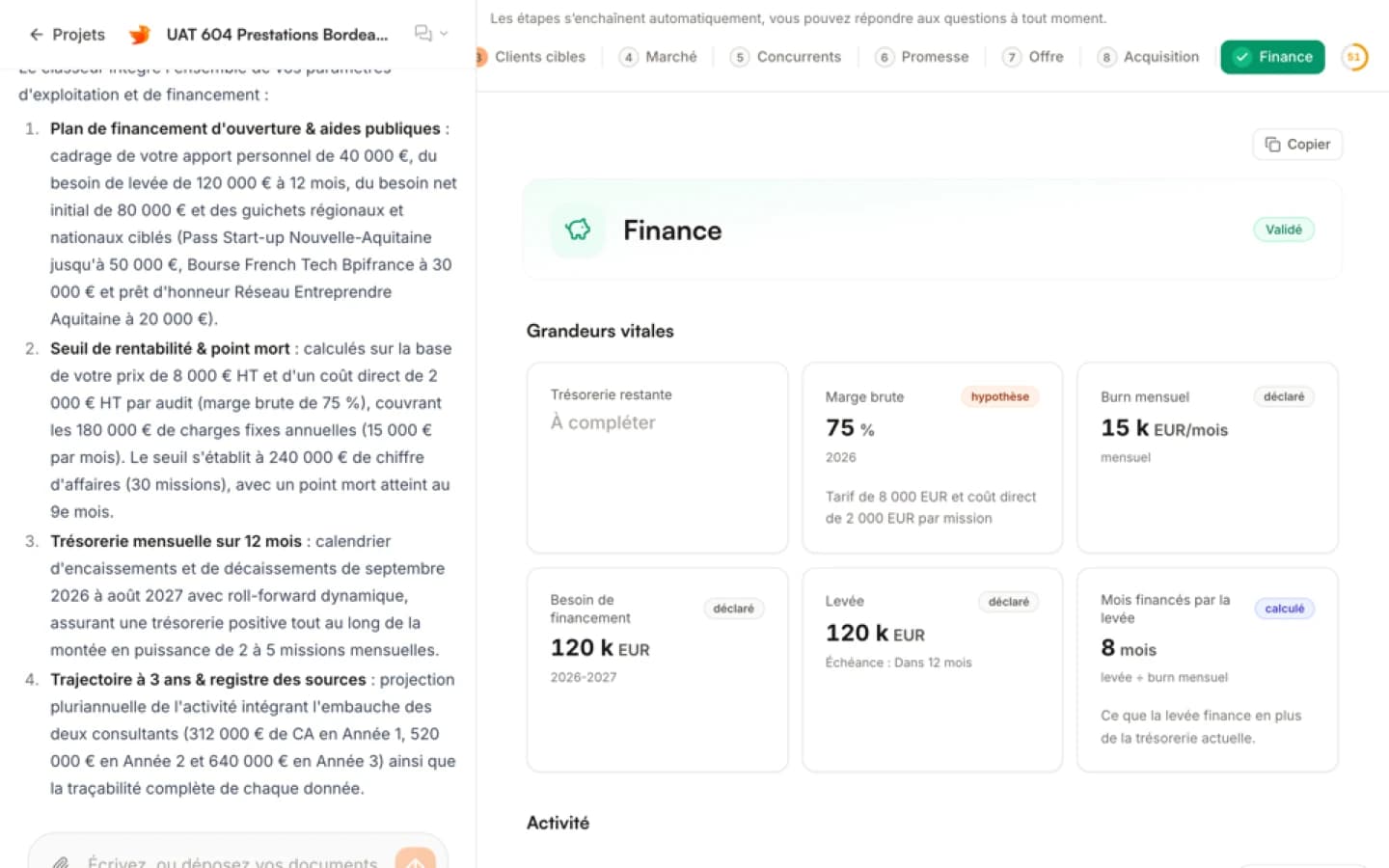
Fund Your Growth structures financial models based on the selected project country rather than the interface language. When a founder selects the United States as their project jurisdiction, the platform applies standard US presentation rules, producing the three traditional financial statements with corresponding Excel models, while maintaining the flexibility to edit narrative deliverables in any of its supported languages. Founders can explore broader contextual guidance on financial architecture across the Knowledge guides for finance.
However, founders must treat these outputs as living working drafts. A generated financial model cannot certify compliance with United States Generally Accepted Accounting Principles (US GAAP) or replace an independent audit. The founder remains solely responsible for the validity of unit economics, gross margin assumptions, and hiring timelines entered into the platform.
Public Capital and Debt: Sifting Federal Programs from Marketing Claims
Founders relocating or expanding to the US frequently seek non-dilutive capital or government-backed loan programs to extend their runway. Two primary avenues dominate early-stage inquiries: guaranteed commercial loans and federal research grants. Navigating either path requires understanding how underwriting decisions are made.
The Small Business Administration (SBA) operates the popular 7(a) loan program, which provides federal loan guarantees rather than direct lending. According to official guidelines on SBA 7(a) loans, founders must navigate independent underwriting: "You will always work directly with your lender and not with SBA." Eligible businesses must be organized for profit, operate legitimately within the US, demonstrate sound creditworthiness, and show a realistic cash-flow capacity to service debt under unfavorable conditions. Commercial software can organize supporting documents, but it cannot influence an individual lender credit committee.
For deep-tech and proprietary research projects, federal agencies administer the Small Business Innovation Research (SBIR) program. As outlined by the official SBIR program overview, "SBIR provides equity free funding through federal agencies to American small businesses" to stimulate technological innovation and private-sector commercialization. This non-dilutive funding targets rigorous research milestones and technical feasibility; it is not a general-purpose operational subsidy for early-stage commercial expansion. Founders deciding between these paths can review the detailed structural differences in SBA Loans vs. SBIR Grants: How to Fund Your Business.
Fund Your Growth indexes public aid references across multiple jurisdictions, including the United States, allowing founders to evaluate high-level eligibility criteria and generate draft application documents. Nevertheless, the platform makes no guarantee of award or admission. Government agency submission portals require company-supplied legal documents, officer attestations, and corporate identification numbers that no third-party software can substitute.
Corporate Governance Realities: The Delaware Franchise Tax Trap
Many international founders register a Delaware C-Corporation to facilitate investment from US funds. Delaware remains the premier legal domicile for venture-backed companies, but administrative oversights during incorporation can create unexpected liabilities.
A recurring issue occurs when founders authorize millions of shares of common stock with no par value or standard par value without understanding the state franchise tax calculation. The Delaware Division of Corporations franchise tax guide specifies that corporations pay annual franchise tax using either the Authorized Shares method (which requires a minimum payment of $175.00) or the Assumed Par Value Capital Method (which requires a minimum payment of $400.00), with a maximum annual tax ceiling of $200,000.00 under either method.
Under the Authorized Shares method, authorizing 10,000,000 shares to accommodate future option pools and investor rounds results in an automated assessment running into tens of thousands of dollars. However, recalculating the tax using the Assumed Par Value Capital Method, by dividing total gross assets from federal tax filings by issued shares, often reduces the liability down to the statutory baseline for early-stage companies with modest balance sheets.
Strategic tooling helps founders draft pitch materials, but maintaining statutory records demands disciplined corporate governance. Founders looking to structure diligence-ready legal records can consult How to Build a Diligence-Ready Corporate Minute Book?.
Verifying What Fund Your Growth Delivers
Before adopting any strategic platform, founders must separate marketing positioning from verified operational capabilities. Fund Your Growth functions as a structured environment that connects strategic hypotheses, qualitative evidence, funding requirements, and operational plans.
The platform walks the founder through nine interconnected strategic building blocks:
- Project identity and operational baseline
- Founding purpose and strategic context
- Ideal customer profile definition
- Addressable market segmentation
- Competitive landscape analysis
- Core customer promise
- Product and service offer structure
- Go-to-market acquisition planning
- Financial modeling and capital requirements
Once validated by the founder, this framework produces ten editable deliverable documents, including an investment memorandum, executive summary presentation note, market study, competitive analysis, and financial projection model. It also structures an integrated data room organized across seven clear directories: dossier, identity, market, commercial, finance, legal, and documents.
| Evaluation Criterion | Fund Your Growth Deliverables | Founder Operational Responsibilities |
|---|---|---|
| Strategic Positioning | Nine interconnected building blocks linking market claims to internal evidence | Validating core product assumptions and real-world customer discovery |
| Financial Deliverables | Three standard financial statements formatted for US reporting conventions | Supplying audited financial data and verified historical unit economics |
| Diligence Organization | Seven structured data room directories with version control and 30-day sharing | Uploading executed contracts, corporate bylaws, cap tables, and legal filings |
| Public Funding Readiness | High-level eligibility checklists and draft application templates | Official agency portal submissions, registrations, and banking details |
| Private Capital Outreach | Structured six-stage pipeline bridge to prospect potential investors | Conducting partner pitches, negotiating terms, and closing capital rounds |
Founders should note clear platform boundaries. Fund Your Growth is deployed through progressive account access and operates on desktop web browsers. The dedicated mobile applications for iOS and Android support the Second Brain environment rather than full dossier generation. While the software can draft pitch narratives, it does not act as a broker-dealer, does not issue certified accounting opinions, and does not guarantee capital introductions or funding awards.
For international entrepreneurs entering the United States, adopting Ember provides a disciplined mechanism to refine strategic thinking and organize a defensible data room before facing institutional due diligence. Verifying that internal financial assumptions match US conventions ensures that the resulting materials withstand scrutiny from lenders, regulators, and venture investors alike.
Sources
FAQ
Fund Your Growth
Connect strategy, proof and funding
Turn project assumptions into defensible decisions and next actions.