
Question and scope
Setting a Business-to-Business (B2B) price when there are no direct competitors to benchmark against requires shifting from a reactive comparison model to an active value-discovery model. For early-stage founders, the absence of a clear market baseline often feels like a strategic blind spot. However, relying on competitor benchmarks is frequently a flawed approach from the start. According to practitioner testimonies shared on Reddit, even when competitors exist, obtaining transparent pricing data in the B2B space is notoriously difficult because most contracts are negotiated privately behind closed doors. When you are introducing a truly novel solution, the search for a traditional benchmark is entirely obsolete.
The scope of this challenge lies in defining the economic value you create rather than the cost of the software you deploy. As highlighted in a strategic discussion by Cerbos on pricing strategies for early-stage startups, founders must anchor their pricing in the customer's cost of inaction or the expensive workarounds they are currently forced to use. To build a defensible pricing model without a benchmark, you must quantify the manual labor, lost productivity, or operational risks your product eliminates. This methodology, as explored in the How to set a B2B price when you have no benchmark? on B2B pricing, transforms pricing from an arbitrary guessing game into a logical extension of your customer's balance sheet.
Ultimately, your pricing strategy is not just a sales tool: it is the foundation of your financial model and your fundraising viability. Investors do not look for a perfect competitive match; they look for a logical connection between your pricing assumptions, your unit economics, and your growth capital needs. This is where structuring your business assumptions becomes critical. Through the Fund Your Growth capability, Ember helps founders navigate these complex financial decisions. The platform reads project documents and connects relevant evidence to funding decisions, replacing a generic list of options with a funding path coherent with the project. By making available proof, assumptions, and remaining validation gaps visible, it turns critical gaps in your business plan into prioritised next actions, ensuring your pricing strategy stands up to investor scrutiny.
To place this decision in context, the Knowledge guides for finance brings together deeper guidance on the same field.
Dataset
While looking at competitor pricing pages is good enough when you are entering a highly commoditized market with established baselines, it fails completely when you are creating a new category. In fact, according to practitioner feedback on Reddit, many Business-to-Business (B2B) founders discover that competitor pricing is heavily guarded, highly customized, or simply non-existent for novel solutions (Reddit testimony). To set a price without a direct benchmark, early-stage founders must build their own dataset of value indicators.
This dataset is not built on competitor spying, but on active customer discovery. As highlighted in industry discussions on early-stage pricing, pricing is an ongoing process of discovery rather than a static calculation (Cerbos Fireside Chat). Founders must gather qualitative data on the buyer's alternative cost of doing nothing, the manual hours saved, and the potential revenue unlocked.
When translating this qualitative feedback into a quantitative pricing model, the structure of your pricing metric matters as much as the price point itself. For example, credit-based pricing models are common in data platforms, but they turn every user action into a metered decision, which can frustrate customers as costs compound with wasted exports or bounced emails (Factors.ai analysis). Your dataset must therefore identify the metric that aligns most naturally with the value the customer receives, rather than arbitrary usage limits that penalize adoption.
To help founders organize these pricing assumptions and align them with their broader financial strategy, Ember provides dedicated tools. Through the Fund Your Growth capability, Ember replaces a generic list of options with a coherent funding and financial path. It makes your available proof, pricing assumptions, and remaining validation gaps visible, turning those gaps into prioritized next actions. By connecting your business modules in a living graph where weak points surface first, Ember helps you stress-test your pricing model against your actual capital requirements and growth plans, ensuring your pricing strategy is ready to be defended.
Methodology
To establish a pricing model without direct competitors, early-stage founders must transition from cost-plus or competitor-matching models to a value-based methodology. This approach focuses on the economic impact your solution delivers to the buyer.
First, identify the cost of the status quo. Even when no direct competitor exists, your prospect is currently solving their problem through alternative means, such as manual labor, fragmented software, or custom internal workarounds. Calculate the direct and indirect costs of these manual processes. The difference between their current cost and the efficiency of your solution represents the gross value created.
Second, engage in active discovery during early sales conversations. According to practitioner experiences shared on Reddit, business-to-business (B2B) founders frequently discover that the best way to gauge willingness to pay is to pitch varying price points to early prospects and observe where the friction occurs. This real-world feedback is far more valuable than hypothetical surveys. As discussed in a pricing strategy guide by Cerbos, early-stage startups should treat pricing as a continuous experiment rather than a static decision.
Third, align your pricing structure with the value metric that matters most to the customer. If your product saves time, pricing per active user or per automated transaction might make the most sense. However, founders must watch out for complex structures. For instance, credit-based models can turn every user action into a metered decision, which sometimes introduces friction during the sales process.
To systematically map out these pricing assumptions and test their impact on your business model, founders can leverage specialized tools. While general spreadsheets are good enough for basic calculations, Ember offers a more integrated approach. Through the Fund Your Growth capability, Ember helps structure your business plan and funding strategy by making available proof, assumptions, and remaining validation gaps visible. By connecting your business modules in a living graph, it ensures that your pricing strategy aligns seamlessly with your overall financial projections and operational goals, turning validation gaps into prioritized next actions.
To explore this point further, Finance ta croissance Use Cases for Accounting Firm Owners details a step directly related to this decision.
Analysis
When analyzing how to structure your pricing without a benchmark, you must evaluate the psychological impact of your pricing model on the buyer. For example, while credit-based pricing is common in data-heavy industries, it has a distinct drawback. As detailed by Factors.ai and echoed by Coldreach, credit-based pricing turns every single action into a metered decision. When a sales team scales from one seat to five, the credit math does not just multiply linearly because wasted exports, bounced emails, and re-enrichment compound the overall cost. For a founder launching a new category, forcing customers to calculate the return on investment (ROI) of every click can create friction that stalls adoption.
To avoid these pitfalls, early-stage founders must gather qualitative feedback directly from early adopters. This is especially true because obtaining competitor pricing in the Business-to-Business (B2B) space is notoriously difficult. As practitioners share in community discussions on Reddit, many B2B founders find that competitor prices are hidden behind sales walls, making direct benchmarking nearly impossible even if an adjacent competitor exists.
Consequently, pricing becomes an exercise in active discovery. During an industry panel hosted by Cerbos, experts highlighted that early-stage startups should focus on flexible pricing structures that align with the customer's growth. Instead of trying to find a perfect, static number, the goal is to establish a baseline that proves value and then iterate as you gather usage data.
Every pricing decision you make directly shapes your financial model, your cash runway, and your attractiveness to investors. When you have no benchmark, your pricing assumptions must be defended through a rigorous business plan. Ember helps founders navigate this complexity through its Fund Your Growth capability. Rather than leaving you to guess how pricing changes affect your viability, Fund Your Growth reads project documents and connects relevant evidence to funding decisions. It replaces a generic list of options with a funding path coherent with the project, making available proof, assumptions, and remaining validation gaps visible. By connecting your business modules in a living graph where weak points surface first, you can stress-test how different pricing levels impact your path to profitability and turn remaining gaps into prioritized next actions.
Findings
lternatives-for-b2b-sales-teams), some plans meter particular actions; check the current terms where exporting contacts, enriching records, and verifying emails each consume credits. When a sales team scales from one seat to five, the credit math does not just multiply linearly because wasted exports, bounced emails, and re-enrichment compound the cost, a challenge also explored by Coldreach. For early-stage founders, this highlights the risk of choosing a value metric that penalizes customer adoption and active usage.
Instead of metering every minor action, founders must align their pricing with the core value delivered. According to the insights shared in the Cerbos Fireside Chat, early-stage startups should focus on pricing models that scale with the customer's growth and actual value realization rather than arbitrary usage caps. When direct competitor benchmarks are absent, the pricing strategy must be treated as a set of testable assumptions rather than a fixed decision.
This is where structuring your financial model and business assumptions becomes critical. Within Ember, the Fund Your Growth capability helps founders move past generic options to build a coherent funding and pricing strategy. Rather than relying on static spreadsheets, the platform connects business modules in a living graph where weak points and pricing assumptions surface first. By reading project documents and connecting relevant evidence to funding decisions, it makes available proof, assumptions, and remaining validation gaps visible. This structured approach turns gaps in your business file into prioritized next actions, allowing you to test and validate your pricing model with real market feedback.
This approach also connects with How to Read a Bpifrance Investor Presentation to Benchmark Your Fundraise?, which clarifies the next choice.
Limitations
If you are operating in a highly commoditized market where direct competitors exist, traditional benchmarking tools or simple cost-plus pricing models are often good enough to get started. However, when creating a new category, those baselines fail, and value-based pricing becomes necessary despite its inherent limitations.
The primary limitation of value-based pricing is its heavy reliance on subjective assumptions about the economic impact of your solution. If your estimated value is based on unverified assumptions, you risk overpricing and blocking early sales, or underpricing and leaving significant revenue on the table.
Furthermore, early-stage founders often isolate pricing decisions from their overall capitalization and growth strategy. Pricing is not just a sales tool. It is a fundamental driver of your business plan and your ability to secure external funding. When you lack historical pricing data, investors will scrutinize your revenue assumptions. You must be able to defend how your pricing model supports your cash runway and financial projections.
This is where structuring your broader business strategy becomes critical. While you validate your pricing assumptions in the market, Ember can help you align these decisions with your funding strategy. Through the Fund Your Growth capability, Ember replaces a generic list of options with a funding path coherent with your project. The platform reads project documents and connects relevant evidence to funding decisions, making your available proof, assumptions, and remaining validation gaps visible. By connecting your business modules in a living graph where weak points surface first, Ember turns gaps in your file into prioritized next actions. This ensures that your pricing assumptions are not just isolated guesses, but are fully integrated into a defensible plan to fund and develop your project.
Conclusions
Pricing in a benchmark vacuum is not about guessing a random number. It is about establishing a value framework that your customers can logically defend to their own internal decision makers. When you lack direct competitors, your pricing must reflect the tangible cost of the status quo and the economic impact your solution introduces. For early stage founders, this means shifting the conversation from what the software costs to build, to what problem it solves and how much that resolution is worth to the buyer.
As you validate these pricing assumptions through real customer conversations, you will inevitably uncover gaps in your business model. This is where structuring your broader financial and funding strategy becomes essential. With Ember and its Fund Your Growth capability, you can move away from generic options and build a coherent funding path tailored to your specific project. The platform reads your project documents, connects relevant evidence to funding decisions, and makes your available proof and remaining validation gaps visible. By turning these gaps into prioritised next actions, Ember helps you structure your business plan and funding strategy with a clear, defensible logic, ensuring your pricing model aligns perfectly with your overall growth trajectory.
In practice, Use cases of Fund Your Growth for agency leaders completes this framework with another angle on the same topic.
Recommendations
To establish a sustainable business-to-business (B2B) pricing model without direct benchmarks, early-stage founders should focus on three core recommendations.
First, shift the focus from competitor tracking to the cost of the status quo. In many cases, trying to uncover what others charge is a distraction. According to founder testimonies shared on Reddit, obtaining clear competitor pricing in niche or emerging B2B markets is notoriously difficult and often inaccurate. Instead of guessing, founders should measure the manual hours, lost revenue, or operational inefficiencies their customers experience today. The price of your solution should be anchored directly to the cost of this inaction.
Second, design your pricing structure to scale with the value your customer receives, rather than the cost of your inputs. As explored in the startup pricing guide by Cerbos, early-stage pricing should remain flexible enough to capture value as you learn how customers interact with your product. However, founders must be careful not to introduce friction. For instance, while credit-based models are common, they can turn every customer interaction into a metered decision, which can complicate the sales process as teams scale.
Third, treat your pricing as a core element of your overall business plan and funding strategy rather than an isolated decision. Your pricing model dictates your unit economics, which in turn determines your capital requirements. For standard business models, generic financial templates are often good enough to map out basic cash flow. However, when you are building a unique category, your pricing assumptions must be tightly integrated with your operational milestones.
To help founders navigate these complex dependencies, Ember provides a structured environment to validate these assumptions. Through the Fund Your Growth capability, Ember replaces a generic list of options with a funding path coherent with your specific project. By reading your project documents, it connects relevant evidence to funding decisions and makes your available proof, assumptions, and remaining validation gaps visible. This living graph connects your business modules so that weak points surface first, turning gaps in your pricing or funding file into prioritised next actions. This structured approach ensures your pricing is not just a placeholder, but a defensible component of your growth strategy.
When to use this analysis
This pricing analysis is specifically designed for Business-to-Business (B2B) founders who find themselves in one of two challenging scenarios. The first is when you are pioneering a completely new product category, meaning no direct equivalent exists in the market. The second is when your closest alternatives operate in a highly opaque enterprise sales environment where pricing is locked behind custom negotiations and sales calls. If you are operating in a highly commoditized market where direct competitors publish their rates openly, traditional benchmarking tools or simple cost-plus pricing models are often good enough to get started. However, when those baselines are absent, you must build your pricing model from the ground up using a value-based framework.
According to practitioner feedback shared on Reddit, many B2B founders struggle to uncover what their competitors actually charge because enterprise software companies rarely publish their pricing sheets. This lack of transparency makes traditional benchmarking impossible. Furthermore, as highlighted in the Cerbos fireside chat on pricing, early-stage startups must focus on designing pricing models that align with the specific value they deliver rather than trying to copy opaque market baselines. This analysis is most useful when you need to translate your product's qualitative benefits into a structured, quantifiable Return on Investment (ROI) that an enterprise buyer can easily justify to their internal finance team.
When you are ready to transition from theoretical pricing to an executable business strategy, structuring these assumptions becomes critical. Ember helps founders navigate this transition through its Fund Your Growth capability, which replaces a generic list of options with a funding path coherent with the project. By integrating your pricing assumptions directly into your broader business plan, you can model how different price points impact your cash runway, hiring plans, and overall growth strategy. For ongoing strategic decisions, you can also leverage Ember's Second Brain to reason through pricing scenarios and refine your customer-facing materials.
Before deciding, How to Read a Bpifrance Financement Presentation for SME? helps connect this method with adjacent priorities.
Testing a price
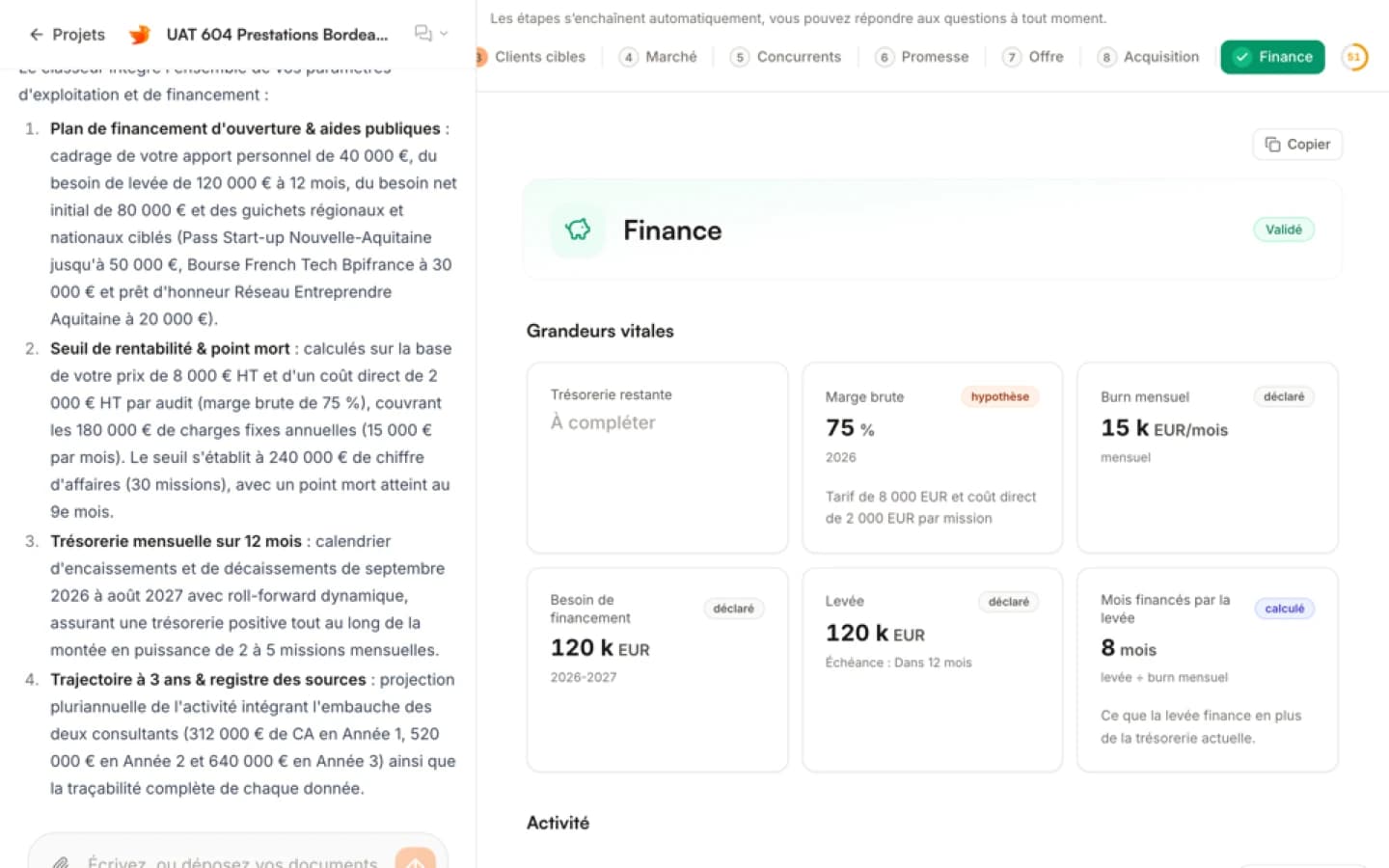
Fund Your Growth can help connect offer, finance and acquisition assumptions. A buyer conversation or paid pilot is still needed to test willingness to pay. Any benchmark or forecast should include its period, scope and uncertainty.
Sources
To build this analysis, we relied on a curated selection of reference materials. Real-world experiences from early-stage teams navigating opaque Business-to-Business (B2B) markets are documented in community discussions on Reddit. Practical frameworks for aligning value metrics with customer discovery are detailed in the Cerbos fireside chat on pricing strategies. Additionally, the core methodology for establishing B2B pricing without traditional reference points is outlined in the research guide published by How to set a B2B price when you have no benchmark?.
Sources
FAQ
Fund Your Growth
Connect strategy, proof and funding
Turn project assumptions into defensible decisions and next actions.