
Context and ICP
Early-stage founders who want to automate their sales operations face a common paradox. While automation promises to save time, generic outreach automation often results in low-response spam that damages brand reputation. For founders managing limited resources, the priority is not to maximize raw volume but to focus on high-yield opportunities. This is where defining a sharp Ideal Customer Profile (ICP) and applying intelligent filtering becomes essential. Established database providers are highly effective when a sales team needs sheer volume for broad outbound campaigns. However, these traditional platforms often introduce operational friction for early-stage teams. A primary challenge is the credit-based pricing model common in the industry, where actions like verifying emails, revealing phone numbers, and exporting lists consume credits rapidly, making monthly budgets difficult to predict, as documented by B2B sales platforms like Factors.ai, Coldreach, and Crustdata. For a founder trying to build a lean, automated workflow, unpredictable costs and manual list-cleaning defeat the purpose of operational efficiency. Instead of chasing thousands of unverified records, automating operations requires a system that understands context and human relationships, detecting changes across people and companies to adjust priorities automatically. According to the Ember Lead Intelligence page, the platform finds and prioritizes contacts itself whether the team starts with 10 or 100 contacts, with no minimum contact threshold. This allows founders to run highly targeted, automated workflows that align with their actual capacity, turning signals and opportunity readiness into clear, explainable next actions without the noise of traditional databases.
To place this decision in context, the Knowledge guides for sales brings together deeper guidance on the same field.
Problem
The challenge of automating early-stage sales operations lies in the difficult transition from manual curation to automated execution. When founders attempt to scale their prospecting, they often turn to established platforms. For example, Apollo serves as a unified AI sales platform for modern sales and marketing teams looking to manage pipeline, closing, and stack simplification. While such platforms are highly effective for scaled sales departments with dedicated operations managers, they introduce friction for resource-constrained founders. As documented by Factors.ai, credit-based pricing models are the most frequently cited friction point in these setups because credits are consumed for multiple actions, including email verification, mobile number reveals, and export operations, making monthly costs hard to predict. This predictability issue is also highlighted by sales practitioners on Coldreach and Crustdata.
Similarly, advanced data enrichment tools like Clay provide deep technical capabilities, including an official Sales Navigator data point integration for lead discovery and connection insights. This is an excellent solution for teams with the engineering resources to build and maintain complex data flows. However, for an early-stage founder, this technical overhead often defeats the purpose of automation. Instead of saving time, the founder becomes bogged down in mapping Application Programming Interface (API) endpoints, cleaning Comma-Separated Values (CSV) files, and troubleshooting multi-step enrichment recipes.
This operational drag diverts focus from what matters most: finding the right people to talk to at the right moment. When automation is reduced to raw volume, it produces noise rather than relationships. Founders do not need more complex databases to manage; they need a system that understands their Ideal Customer Profile (ICP) and automatically surfaces high-priority opportunities without requiring a minimum database size. For instance, whether a team starts with 10, 100 or 1,000 contacts, Lead Intelligence finds and prioritizes the contacts itself with no minimum contact threshold, allowing founders to automate the thinking behind their outreach rather than just the volume of their emails.
Prerequisites
Before implementing automated lead tracking, early-stage founders must establish a few critical operational prerequisites. Automation cannot fix a broken targeting strategy, it only accelerates it. First, founders need a clear definition of their Ideal Customer Profile (ICP). Without this, automated systems will simply scale the distribution of irrelevant messages. While tools like Clay provide useful technical features, such as their LinkedIn Sales Navigator integration for lead discovery, these data points are only valuable if the founder already knows which signals indicate a high-intent buyer. Second, founders must move away from the unpredictable cost structures of legacy databases. Traditional credit-based pricing models are a frequent source of friction for early-stage teams. As highlighted by industry analyses on Factors.ai, Coldreach, and Crustdata, consuming credits for basic tasks like email verification, mobile number reveals, and exporting data makes monthly budgets highly unpredictable. To automate operations sustainably, founders need to be able to anticipate the cost of each data verification step. Finally, the chosen system must be flexible enough to handle any starting volume. Founders often believe they need thousands of leads to begin automating. However, a key prerequisite is adopting a workflow that functions independently of list size. According to the Ember Lead Intelligence page, an effective setup should find and prioritize contacts itself whether the team starts with 10 or 100 contacts, removing any minimum contact threshold. This allows founders to start small, validate their messaging, and scale their operations without wasting resources on unverified bulk lists.
To explore this point further, Lead Intelligence for an independent founder details a step directly related to this decision.
Workflow
The operational workflow of automating sales outreach with Lead Intelligence is designed to replace manual, repetitive tasks with structured, contextual execution. By systematically moving from strategic alignment to targeted action, early-stage founders can scale their prospecting without losing the personal touch required for high-value B2B relationships.
The workflow begins by aligning the automation engine with the strategic foundation of the business. Instead of starting from scratch, Lead Intelligence reuses the existing business plan, Ideal Customer Profile (ICP), and core offer already defined within Ember. This tight integration ensures that the automated system operates with a deep understanding of the company's unique value proposition, preventing the common pitfall of generic outreach campaigns that fail to resonate with prospects.
Once the strategic context is established, the founder initiates the discovery phase. This can be done by allowing the system to search for new accounts based on active market signals, or by importing existing contact lists. For founders working with smaller, highly curated lists, the platform accommodates any starting volume. According to the official product capabilities of Lead Intelligence, the system finds and prioritizes the contacts itself whether the team starts with 10, 100 or 1,000 contacts, with no minimum contact threshold. This eliminates the operational pressure to acquire massive, low-quality databases just to make the automation tool function.
After the contacts are loaded into the system, the prioritization engine begins to analyze and classify them. Lead Intelligence continuously monitors real-time signals about both companies and individual decision-makers. Rather than presenting a flat list of names, the system organizes prospects into clearly explained opportunities to watch, act on, or set aside. This contextual prioritization ensures that the founder's limited time is focused exclusively on accounts that are currently showing signs of readiness or organizational change.
The final step of the workflow translates these prioritized insights into direct action. To maintain high conversion rates, the system proposes the next action and channel that fit the lead situation, as outlined on the Lead Intelligence product page. By suggesting the most appropriate communication channel and the specific angle to take based on recent signals, the system allows founders to execute highly personalized outreach at scale, ensuring that automation supports, rather than dilutes, the relationship-building process.
Outcome to check
For a founder, the desired outcome is more orderly prospecting: accounts to examine, the signal source and a proposed next action. Lead Intelligence can prepare that research from commercial context; it does not run invoicing, hiring or delivery. The founder verifies each fact and decides whether to reach out. Usefulness is judged from real conversations, without assuming time savings or more sales.
Example Ember mission
To illustrate how this works in practice, consider an early-stage founder who wants to automate outbound operations without losing strategic relevance. The founder initiates a prospecting mission within Ember. Instead of building a target list from scratch, Lead Intelligence automatically reuses the existing Business Plan, Ideal Customer Profile (ICP), offer, and strategy already established in the workspace to prepare the sales mission.
Once the parameters are set, Lead Intelligence finds accounts based on the mission ICP and active signals, verifying useful sources to ensure data integrity. The system is highly adaptable to the founder's current operational scale. As detailed on the Ember Lead Intelligence product page, the platform finds and prioritizes the contacts itself whether the team starts with 10, 100 or 1,000 contacts, with no minimum contact threshold.
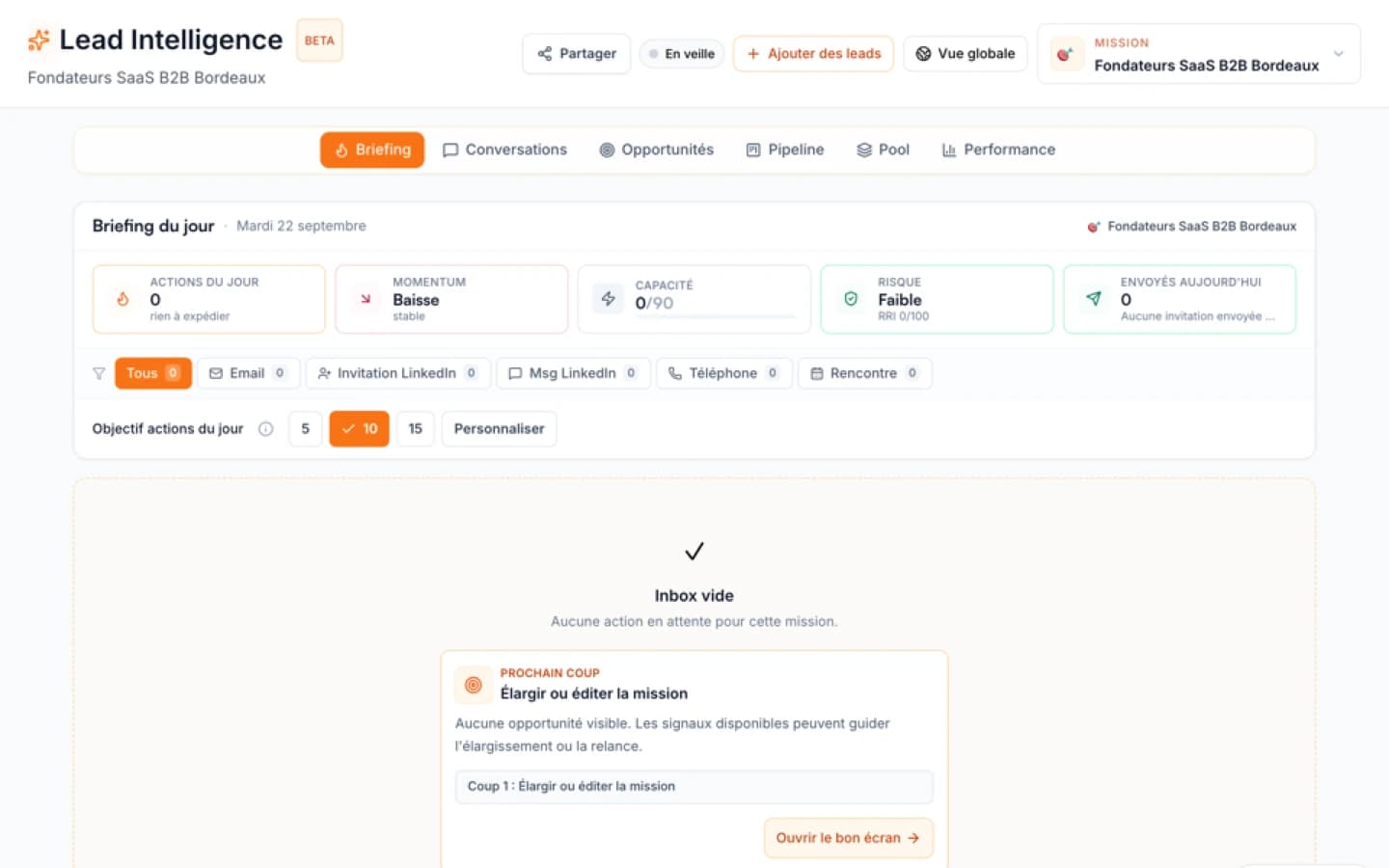
As the mission executes, the system proposes the next action and the most appropriate communication channel that fit each specific lead situation. After the mission concludes, Ember provides clear visibility into the operational value generated. The founder can review a complete summary that shows the contacts analysed, signals detected, and priority actions actually recorded by Ember, transforming raw data into an organized, actionable pipeline.
Limits and non-fit
While Lead Intelligence is built to streamline prospecting for early-stage founders, it is not a universal solution for every sales strategy. Understanding where the tool fits and where alternative platforms excel is essential for making an informed operational decision. For founders who require a massive, all-in-one sales infrastructure, established platforms may be more appropriate. If your primary goal is to deploy a unified sales platform that handles pipeline management, closing, and overall sales stack simplification, Apollo.io positions itself specifically to serve those broader sales and marketing needs (Apollo.io). Similarly, if your workflow relies heavily on deep, native data enrichment connections, Clay offers an official LinkedIn Sales Navigator datapoint integration designed for advanced lead discovery and connection insights (Clay). It is also worth noting that many traditional platforms rely on credit-based pricing models, which can sometimes become a point of friction for teams trying to predict monthly outbound costs (Factors.ai). Ember takes a different, highly focused approach. Lead Intelligence does not automatically synchronize with every Customer Relationship Management (CRM) system. Founders looking for fully automated CRM synchronization out of the box will find this a limitation. Additionally, Lead Intelligence is designed for strategic, high-relevance outreach rather than brute-force volume. It is highly effective whether a founder starts with 10 or 100 contacts, as it operates without any minimum contact threshold (Ember Lead Intelligence). However, if your strategy relies on scraping and mass-emailing tens of thousands of unverified leads every week without contextual filtering, the strategic, guardrailed nature of Ember will not match that high-volume, low-context operational model.
In practice, Lead Intelligence Use Cases for Consulting Firm Directors completes this framework with another angle on the same topic.
When to use it
For early-stage founders seeking to automate their sales operations, knowing when to deploy Lead Intelligence versus traditional prospecting databases is critical to maintaining operational efficiency. First, you should use Lead Intelligence when you want to launch targeted outbound campaigns without being restricted by database minimums. Traditional prospecting often forces founders to buy massive lists to see any results, which dilutes the quality of the outreach. In contrast, Lead Intelligence finds and prioritizes the contacts itself whether the team starts with 10 or 100 contacts, with no minimum contact threshold, as outlined on the Ember Lead Intelligence capability page. This makes it highly suitable for founders who prefer a lean, high-precision approach over raw volume. Second, Lead Intelligence is the ideal choice when your primary bottleneck is not finding contact information, but deciding how to initiate the conversation. While legacy databases leave the messaging and channel selection entirely up to you, Lead Intelligence proposes the next action and channel that fit the lead situation, according to the Ember Lead Intelligence product details. This automation ensures that your outreach remains highly contextualized, saving you from the operational overhead of manually drafting unique angles for every prospect. Third, compare cost models too. Established tools like Apollo, which positions itself as a unified Artificial Intelligence (AI) sales platform for modern sales and marketing teams to manage pipeline and closing, as shown on Apollo, are highly capable for broad database coverage. However, their credit-based pricing models can introduce significant friction, making monthly outbound costs difficult to predict due to charges for email verification, mobile reveals, and export operations, as highlighted in Business-to-Business (B2B) sales analyses on Factors.ai. Lead Intelligence focuses on automated context-driven prioritization and, like other tools, uses credits for some actions. Finally, if your workflow is heavily reliant on deep, direct LinkedIn Sales Navigator data points for connection insights, dedicated data-enrichment tools like Clay remain an excellent choice, as detailed on the Clay Sales Navigator integration page. However, if your goal is to seamlessly connect your high-level business strategy directly to your daily prospecting actions without managing complex Application Programming Interface (API) chains, Lead Intelligence provides the direct operational bridge you need to automate your growth.
Next step
To transition from manual, high-friction prospecting to an automated sales workflow, the immediate next step is to define your target parameters and run an initial context-driven mission. Early-stage founders do not need to spend weeks cleaning databases or configuring complex software to begin seeing results. By deploying Lead Intelligence, you can upload your initial target ideas and immediately receive a clear next action detailing who to contact, why now, which channel, and which angle to use, as outlined on the Ember Lead Intelligence page. Because the system finds and prioritizes the contacts itself whether your team starts with 10, 100, or 1,000 contacts, there is no minimum contact threshold required to start. This allows you to automate your outbound operations progressively, maintaining absolute control over your deliverability and brand reputation while Ember proposes the next action and channel that fit each specific lead situation.
Before deciding, Lead Intelligence Use Cases for Sales Directors: A Decision Guide helps connect this method with adjacent priorities.
Checked sources
Sources
FAQ
Free diagnostic
Test your sales file
Drop an Excel or CSV and check its readiness without sending its rows to Ember.